

Need some ready cash? Prepared to embellish creative lies? Then grab your 3D renderer and your generative AI, and join the space business!
Eventually, many of us will go to the moon, or Mars, or beyond, right?
Elon Musk said so. Humanity will become an inter-planetary species, which is cool, because then planets become disposable commodities. When we ruin one, we just hop into a spaceship built by a billionaire, and colonise another.
After all, if an Earth that is two or three degrees warmer is a climate crisis that could destroy our cities and cause the extinction of humanity, as we are often told, then it stands to reason that Mars, which is nowhere near as warm (minus 63°C, give or take 80°), would be a much better place for humanity to thrive.
Or does it?
Bold ambition, and fraud
It’s all very well to dream up science fiction scenarios, and bold ambition is a great source of innovation. But bold ambition with good marketing also causes misallocation of capital resources, and inevitably, fraud.
Here’s the truth. It will never happen that humans live off-world in any significant numbers for any significant amount of time. (I should qualify “never”: by never, I mean not in the foreseeable centuries.)
Proposed orbital hotels, hotels on the moon or Mars, or permanent settlement away from Earth, are outright scams. The proposers are not “dreaming big”. They’re stealing money.
And yet, we keep seeing news headlines about imminent space hotels. Sham companies are soliciting investment and advance bookings worth millions of dollars. They always vanish with the money, and yet chancers keep trying.
Moon hotel
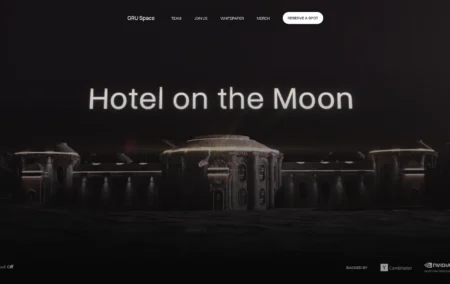
The latest to try his hand at selling tickets to the moon is a smooth-talking pipsqueak by the name of Skyler Chan. With breathtaking audacity, the 21-year-old named his company after the super-villain in the Despicable Me movies: GRU. It stands, rather ungrammatically, for Galactic Resource Utilization Ltd.
Space.com reports that GRU “is taking $1 million reservations for hotel rooms on the moon”.
And so it is. In its defence, the $1 million deposit is “fully refundable”. But the $1,000 fee you’re required to pay even before you fill out the application form is not refundable. That goes straight into young Mr Chan’s back pocket.
He won’t have to share it with many people. The GRU “team” consists of Chan, and his “employee #1”, Dr. Kevin Cannon, who joined “last month”. Cannon is described as “the world expert in lunar and martian regolith”. There’s also an “advisor”, Dr. Robert Lillis, associate director for planetary science at UC Berkeley’s Space Sciences Laboratory.
This trio proposes to manufacture, on-site, the materials for a space hotel, using moon dust. (You can buy a brick made with “simulated regolith” for another $1,000 in the merch store. And hats off to them if they sell any. It will be the biggest marketing coup since pet rocks.)
Puffery
Chan’s bio is quite impressive: “Skyler graduated early from Berkeley EECS to make humanity interplanetary. Previously he built vehicle software at Tesla, built a NASA funded 3D-printer launched into space, and authored at the largest space conference. Air Force-trained pilot at 16.”
As his age might indicate, however, almost all of that is not true, or wildly exaggerated. For example, he is a drone and glider pilot, and the closest he got to any Air Force was a stint in the air cadets as a young teenager in Canada. For example, he was an undergraduate junior member of a team that worked on that 3D printer. For example, he was an intern at Tesla for all of four months.
Cannon’s bio isn’t much better. “The world expert in lunar and martian regolith” is an assistant professor at the Colorado School of Mines. He claims to have been a “chief lunar geologist” at Ethos Space Resources.
“We build spaceports,” says that company, having built exactly none of them.
“We design, engineer, and construct landing pads for rockets to land and relaunch. Regolith is processed into solid rock building materials by our Durandal heaters,” it says, having built no landing pads.
“We construct and operate the infrastructure for rockets to refuel on the Moon and Mars. Liquid oxygen extracted from lunar regolith with our Pantheon system provides 80% of the propellant mass for spaceflight,” it says, having built none of that infrastructure.
It proposes to extract silicon from lunar regolith, as if silicon – and not water, oxygen or methane – is what holds back the non-existent “in-space economy”.
Moonbats
Likewise, Chan and Cannon propose to use lunar regolith to construct bricks for their proposed hotels, but neither has ever touched martian regolith (because no space mission has ever returned soil from Mars), and neither could have had access to more than a few grams of moon dust.
None of the technology that GRU promises has ever been demonstrated, even on Earth. The founders have not even constructed a hotel on terra firma, let alone in space.
Nobody has demonstrated that building or manufacturing, off-world, using regolith, is even possible at a small scale, let alone at the scale required to construct a hotel on the moon by 2032.
And the AI-generated images of the supposed hotel rooms are insane.
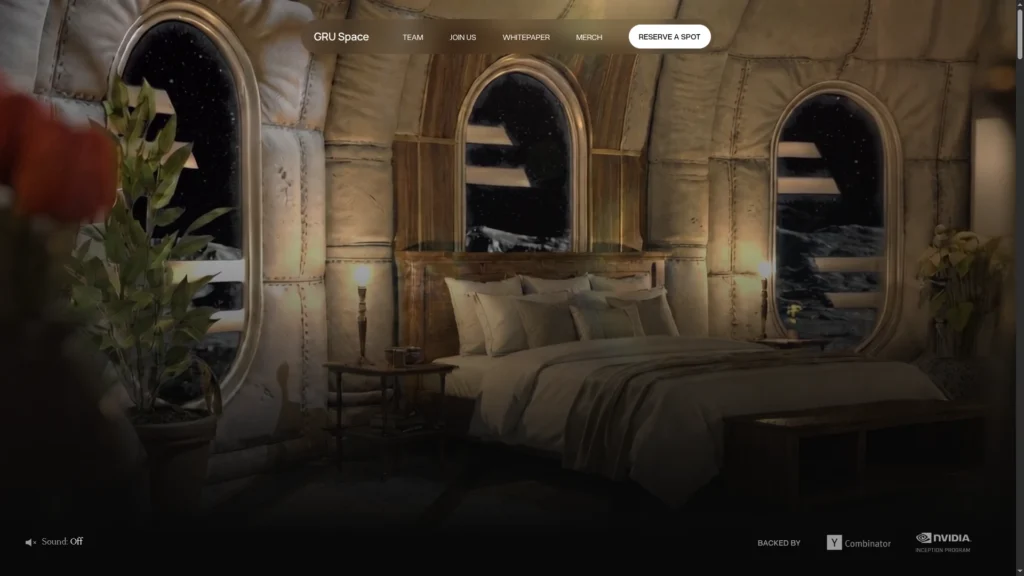
Building anything on that scale, pressurising it, and furnishing it as depicted, is far beyond anything that anyone could conceivably achieve in the foreseeable future.
They’re moonbats. The entire thing is a scam.
Space station
Eighteen months ago, Wired ran a feature (archived) on what a proposed new space station would look like. This was Haven-1, “the world’s first commercial space station set to be placed in low-Earth orbit by the SpaceX Falcon rocket next year [i.e. 2025]” by an outfit called Vast.
It didn’t launch. The company now says it will launch in 2027.
It probably won’t.
It also has some insane graphics. Like this:
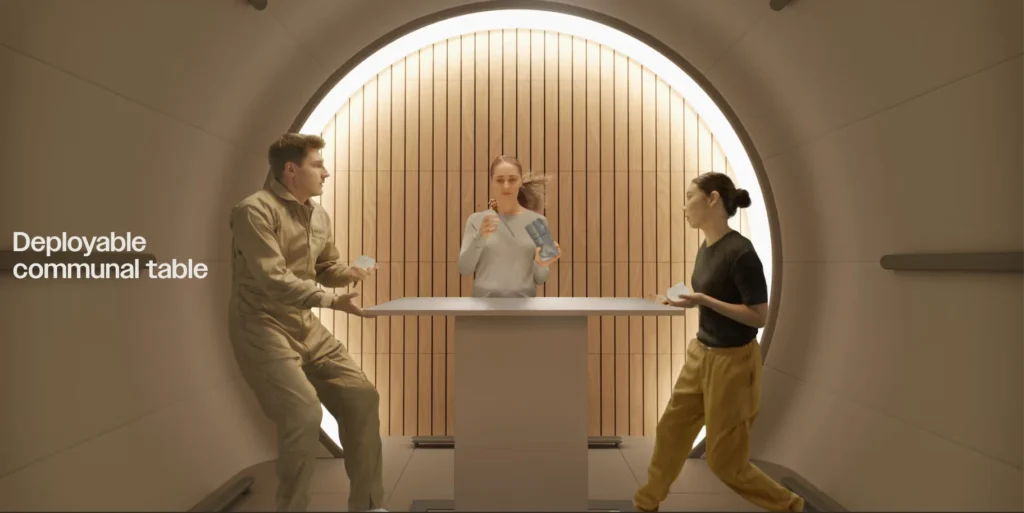
Uhm, guys, you’re in microgravity. What would you need a table for if nothing you set on the table would stay there? And what’s with the wood trim? Fine-grained maple? The problem with space stations is their poor interior décor?
Orbital hotel
Then there’s Voyager Station, named after a Star Trek ship. The designers of this rotating wheel space station hit on an important point: microgravity is seriously bad for you.
It causes weight loss, muscle atrophy (including the heart muscles), reduced bone density, disorientation, nausea, and more.
There’s a reason the record for the longest stay in space was set by Russian cosmonaut Valeri Polyakov, who spent 14 months and 14 days in space aboard the Mir space station in 1995, and nobody has beaten that record yet. Extended stays in space suck.
So a group of “NASA veterans” founded the Orbital Assembly Corporation (OAC), which proposed to build a rotating wheel that creates artificial gravity. It sold shares, and reportedly raised $1 million from the public.
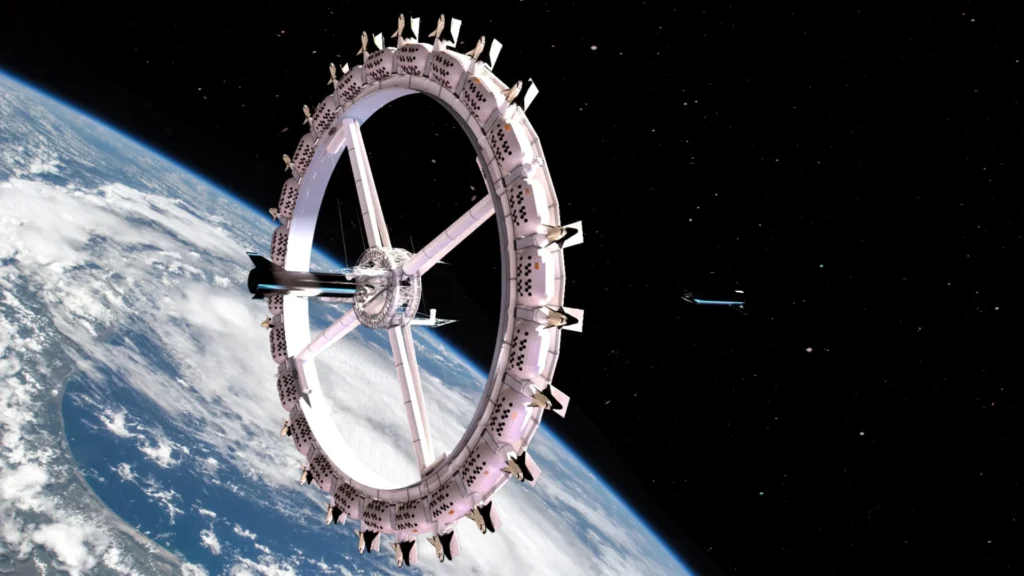
Again, however, the problem is that this has never been done, even on a small scale. A demonstration of the concept, Nautilus X, was cancelled by NASA in the early 2010s. On the scale that this lot were proposing, the engineering challenges would be stupendous.
We may never be able to create sufficiently strong materials to hold such a wheel together while spinning. Balancing a spinning wheel with varying weight distribution as people and objects move around inside it, and space weather buffets it from outside, would be a massive challenge. Lifting the millions of metric tons of material that would be needed to construct such a wheel into space (or mining and manufacturing such material off-world) is an insanely high hurdle.
Yet in 2025, they were still telling us this space hotel would open in 2027.
The key figure behind the OAC, 747 pilot John Blincow, has moved on to bigger and better scams, and the company renamed itself to Above Space.
It still uses the same low-res render (of the improbable space wheel) it has been touting since 2020, but it is now tucked away on a page simply entitled “the future”.
From the top
The people who scam investors into funding space projects that violate the laws of physics, and promise wealthy customers bookings for space hotels that will never be built, might look like small-time swindlers.
They have learnt from the biggest and best, however.
They take their cue from people like Richard Branson, the founder of Virgin Galactic, which once promised space hotels and day trips to the moon, and “missions to Mars and beyond”, but has been reduced to offering sub-orbital joy-rides without the capability to launch anything into orbit.
They take their cue from people like Elon Musk, who gushes about making humanity a “multi-planet species”, and who always over-promises and under-delivers. As impressive as his re-usable rockets are, they are a very long way from making humanity interplanetary.
It is conceivable that Musk or his taxpayer-funded sugar-daddy, NASA, could launch a manned mission to Mars. But doing so will always be an extreme sport. It will involve a small number of people, who remain off-world for a relatively short time.
Zero chance
It will take many years before space travel is a commercially viable venture, independent of government-funded projects.
There is zero chance that humans will spend extended periods living on the moon or Mars in the foreseeable future, or that a significant number of people will travel there.
Even if we could manufacture habitats at scale using materials mined in situ, the technology for which is decades away, there are too many other reasons to conclude that life in space will never really be possible.
Radiation levels are too high. Temperatures (and temperature variations) are too extreme. Producing food at scale off-world will likely never be feasible. Counteracting any of these problems will require insane amounts of energy.
The human body suffers serious physical harm from extended periods in low or zero gravity. Research among astronauts suggests that the human psyche cannot stand much more than a year or so in the confined quarters that are all that space can offer for the foreseeable future.
Earth is our only home
The human body is adapted to live on Earth, with Earth’s gravity, Earth’s atmosphere, Earth’s resources, and Earth’s climate. It can hardly stand minor variations in that environment here on Earth.
If you think you can survive for years on Mars, try living a few years at the South Pole, or in a hut in central Sahara, just for practice. See how well you do.
If we are to live in space for extended periods, we must simulate an Earth-like environment, and this presents problems that cannot be solved with any technology we might develop in the foreseeable future.
The dream of being a multi-planetary species will remain the subject of science fiction for our lifetime, and several lifetimes after us.
People who sell that dream, right now, for actual money, are all frauds. They are asking investors to misallocate capital towards projects that will never materialise, and taking money from gullible people.
By all means, give them your $1,000 non-refundable application fee for a $1 million deposit on a lunar honeymoon. But don’t say you weren’t warned that it will never happen in your lifetime, of that of your children or grandchildren.
[Image: GRU Hotel.webp]
The views of the writer are not necessarily the views of the Daily Friend or the IRR.
If you like what you have just read, support the Daily Friend