

There is a particular confidence that comes from spending one’s career on a trading floor, and Hendrik du Toit has it in abundance. The Ninety One chief executive, a man who built a global asset manager from a Johannesburg desk, looked at the South African National Defence Force this month and reached for the only verb his profession really trusts: close it. The defence force, he told an audience of fruit farmers, wastes R100 billion a year “on nothing.” It is “defending nothing.” If he had the chance, he would wind the whole thing up.
One admires the decisiveness, the other simply wishes it had been preceded by a glance at the figures.
The first problem with closing a R100 billion operation is that no such operation exists. The defence budget, Vote 23, for those who like to check the prospectus before recommending liquidation, is scheduled to shrink to roughly R57.6 billion next year. Du Toit has, in other words, identified roughly R40 billion of waste in a department that does not have it to waste, a simple Google would have clarified this mistake. For a man whose entire trade is the disciplined reconciliation of assets against liabilities, this is a remarkable bit of freehand accounting. One does not need to admire the SANDF to expect its critics to know what it costs.
Now, the irritating thing about the speech is that beneath the showmanship sits a genuine insight, and Du Toit very nearly trips over it. He is quite right that the military should not be doing the police’s job. The SANDF is dragged into anti-crime operations, illegal-mining sweeps and infrastructure protection not because soldiers are the correct tool, but because the South African Police Service (SAPS) cannot hold the line. And here is the part that should have given a fund manager pause: the police fail year after year and are rewarded with a larger budget, while the army absorbs their shortfall on a smaller one. If you are hunting for an institution that consumes public money and defends nothing, the defence force is, awkwardly, not your best candidate. The SAPS has been allocated R127.072 billion for the 2026/27 financial year, with the budget expected to increase to R135.8 billion by 2028/29.
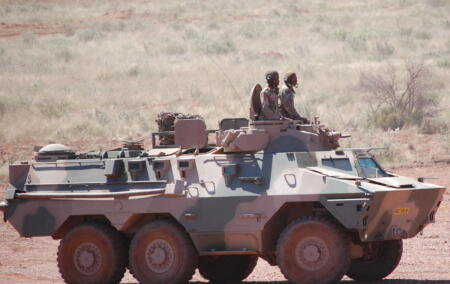
So, the diagnosis is half-right and the prescription is precisely backwards. Yes, the patient is gravely ill. The honest assessment is in fact bleaker than anything Du Toit offered; this is not a force on the brink of collapse but one that has already collapsed. Of nearly 200 aircraft, a good day sees anywhere from ten to fourteen per cent airworthy. The navy’s vessels are essentially ornamental, rarely troubling the open sea. Soldiers, who remain well-trained, are reduced to buying their own boots and body armour. The air force and navy’s combined post-salary budget, roughly R4.5 billion, is in-line with the 2026/27 VIP protection budget, of R4.516 billion. The amount needed to return the entire Gripen fighter fleet to full operational status is R4.96 billion.
None of this is a secret; the department confesses much of it in its own planning documents, in the special dialect of bullet points and vision statements that institutions adopt when they can no longer bear to speak plainly.
But notice what that collapse actually is. It is not a flourishing enterprise that should be shuttered, it is a starved one. The money is not spent “on nothing”, it is spent badly, which is an entirely different and far more fixable complaint. Roughly two-thirds of the budget vanishes into salaries, leaving almost nothing for training, maintenance, spares or ammunition. That top-heavy wage bill is the real waste, and it persists for a reason no asset manager will like: trimming it means cutting thousands of jobs in a country drowning in unemployment, and the governing party has quietly decided it would rather run the military as an employment scheme than as a fighting force. That is the genuine scandal, a government that increasingly justifies its army by how many people it keeps on the payroll rather than what it can defend.
Which is where Du Toit, for all his impatience with the state, ends up making the government’s own argument for it. The ANC reframes the SANDF as a jobs programme. while Du Toit reframes it as a failed business. Both have made the identical category error; they are measuring a military by its commercial return. But you do not assess a fire brigade by how many blazes it ignites, or judge an insurance policy by how seldom you claim on it. The value of a defence force is deterrence and sovereignty, a cost you pay precisely so that you never have to discover what its absence is worth. A man who spent decades pricing risk for a living ought to recognise a hedge when he sees one.
And then there is the small matter of the Constitution, which Du Toit proposes to overrule by executive instinct. Section 200 does not establish the defence force as a discretionary line item to be discontinued when the quarterly numbers disappoint. It exists to defend the Republic, its territory and its people. A chief executive may shutter an unprofitable subsidiary; a country may not file its own sovereignty under “discontinued operations.” You can sell a loss-making division. You cannot sell the border.
The answer to a broken army is not to abolish it but to fix it with the same ruthlessness Du Toit would bring to a bloated balance sheet, and, for once, the two instincts align. Stop the grand symbolic purchases. Repair what already exists, get the helicopters flying and the fighters serviceable before anyone dreams of a shiny new toy. Buy the boots, demand transparent, quarterly reporting to Parliament tied to hard measures of output, so that every rand can be followed. Prove the institution can handle money responsibly before handing it more. This is not soft-headed sentiment about the troops; it is exactly the phased, accountable, capital-disciplined approach a serious investor claims to prize.
Du Toit remains one of the country’s sharpest commercial minds, and South Africa would do well to listen to him on embassies, on trade and on the long, grinding work of rebuilding broken institutions. But the Republic is not a portfolio, the army is not a position to be closed out, and you cannot short your own sovereignty and expect to be around to book the profit. The SANDF is not defending nothing; it has simply been left with far too little to defend us properly; and the man who built a fortune spotting the difference between a failing business and a starved one really should have known which this was.
[Image: Ricardo Teixeira]
If you like what you have just read, support the Daily Friend