

That the state lacks the capacity to provide many services should come as no surprise to the Hayekian liberal.
In December 2023, a handful of Knysna residents patched the potholes in the badly neglected George Rex Drive, which was supposed to have been relaid years ago, with money that has long since evaporated.
It was a modest start, but several years later, the Knysna Infrastructure Group (full disclosure: its founder, Eugene Vermaak, is a personal friend of mine) is paying to keep an engineer on site at the town’s wastewater works, arranged for a local businessman to put up the R500,000 needed for its restoration, and signed a memorandum of understanding with the municipality on remediating sewerage leaks that threaten the estuary.
Much to the dismay of local Democratic Alliance counsellors, it is a pointedly apolitical group. It will work with municipal staff no matter who runs its council, to assist, mentor, and facilitate infrastructure maintenance.
Around the country
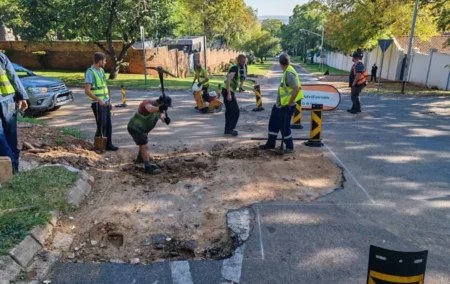
Around the country, AfriForum has filled thousands – if not hundreds of thousands – of potholes, often at their own expense.
Gift of the Givers has drilled boreholes for hospitals in Johannesburg, schools in Gqeberha and entire Eastern Cape towns that ran dry.
Around Frankfort, in the Free State, farmers and businesses put up roughly R100 million for a solar plant, and contracted a private company to run the Mafube municipality’s electricity network, which it has done since 2012 at a 99% collection rate.
Almost everyone doing this work describes it in the same apologetic register.
They are supporting the municipality. They are stepping in until things improve.
Vermaak is careful to say the group does not want to take over the running of the council. The KIG won’t align itself with any political party, and won’t register as a political party itself, either.
Popo Molefe, the former North West premier who has thrown in with the Knysna effort, casts it as an offshoot of Operation Vulindlela – a helping hand to the state’s own project of fixing itself.
That framing raises an important objection, however.
The case for the state
Municipalities are the country’s principal agent of local infrastructure and service delivery. For the 2026/27 financial year, they received an allocation of R182.3 billion of national revenue, with another R422.5 billion earmarked for strengthening local governments through the Department of Cooperative Governance and Traditional Affairs (COGTA).
Volunteers with bags of cement do not build bulk water schemes or extend services to people who cannot pay. They act where their members live.
Critics of “going off the grid” put it sharply: affluent communities can insulate themselves through private systems, while poor ones are left with piecemeal and precarious substitutes.
That deepens inequality and corrodes shared citizenship. If everyone who can afford to exit does so, the residual public system serves only those with no alternative, stripped of the political voice that might have forced it to work.
So, the conclusion follows naturally: private effort is a stopgap. The real work is building a capable state.
Thirty-two years of building
The trouble is that we have been building it since 1994, and it is less capable now than when we started.
In 2009, government launched Operation Clean Audit, promising that every municipality would achieve a clean audit by 2014. By 2014, only 40 had done so.
In the 2024/25 outcomes released this June, 39 municipalities out of 257 – 15% – got clean audits, and 38 had regressed since 2020/21. More than half are technically bankrupt. Treasury has withheld R13.5 billion from 69 of them. The metros, where most South Africans actually live, continue to decline.
Meanwhile the state is not small. Consolidated spending this year is R2.67 trillion. The wage bill is R852.6 billion, 32.1% of everything government spends. Debt service costs R432.4 billion, more than policing.
Whatever we have been buying with three decades of state-building, it has not been capacity. Perhaps that is because fully 60% of non-interest spending is dedicated to redistribution, through the “social wage” – that is, income grants.
An objective that has proved to be impossible to achieve for three decades ought to be reconsidered.
State capacity is not a skill that improves when you spend money on it.
When the state runs short of money, capacity is what gets defunded – by cadre deployment, by rent-seeking, by political patronage, by tender corruption, and by the R1.47 billion that 215 municipalities spent on consultants to do work their own staff could not manage.
Incapacity as design
It would be embarrassing, if it wasn’t entirely predictable and expected. Friedrich Hayek countered the supporters of planned, technocratic economies (such as that of the Soviet Union) by writing that knowledge is decentralised and unevenly dispersed among different members of society. Therefore, decisions are best made by those with local knowledge rather than by supposed expert planners.
To paraphrase Hayek: “If we possess all the relevant information, if we can start out from a given system of preferences, and if we command complete knowledge of available means, the problem which remains is purely one of [capacity].”
The problem is that none of those assumptions are true for government planners. They don’t know what people need, how they prioritise their needs, and what the means are for satisfying those needs. Nor do they have the means to discover this knowledge, since these preferences can only be revealed by the economic choices people make. No survey, or census, or expert report, can capture this infinitely dispersed, subjective knowledge.
This is a key reason why classical liberals like Hayek strongly preferred free markets to government intervention in the economy, because the price mechanism is the only known means to reveal the preferences and priorities of the people.
So, classical liberals shouldn’t be embarrassed by a lack of state capacity. A small government is assumed to lack capacity. It issupposed to lack capacity. That is what limited means.
Expect corruption
Every function the state assumes is a budget line, a procurement process, a regulatory gatekeeper and a discretionary decision – which is to say, four opportunities for capture.
Corruption is not a moral failure that afflicts some governments and spares others; it is a predictable function of how much money passes through how many discretionary hands. Effective checks and balances can swing the needle one way or the other, but it can never eliminate wastage and corruption.
R2.67 trillion is not a measure of the state’s capacity. It is a measure of the surface area available for looting.
The same arithmetic runs through the rest. The less the state does, the less red tape it generates, because red tape is the residue of things government has decided to superintend.
The less it does, the less it borrows, and the smaller the share of revenue that vanishes into interest.
The less it does, the cheaper it is – and the more money stays with people who can spend it on the thing in front of them, without an IDP, an unmotivated or inexperienced municipal worker, a conflicted tender committee, a provincial intervention, or a court ruling standing between the problem and the repair.
The pattern
That is not a hypothesis. It is the observed pattern.
Behind-the-meter rooftop solar reached 9 107MW in June, up 35% in a year and within a power surge or two of the name-plate capacity of Medupi and Kusile combined – which took Eskom the better part of two decades and hundreds of billions to half-build.
Private security officers outnumber the SAPS’s 151 492 members several times over.
Gift of the Givers drills a borehole in weeks that a district municipality has been promising since 2018.
The binding constraint
Notice what actually stops these efforts. It is almost never money, expertise or willingness. It is permission.
Frankfort built its own solar supply and used it to reduce load-shedding for its own residents. Eskom objected, the case failed on a technicality when the municipality declined to join its own service provider’s application, and the town sat in the dark while the panels dumped power.
Solar owners who invested during the crisis now face burdensome registration requirements.
AfriForum’s branches repair infrastructure and then have to argue that they should be able to reclaim the cost from the rates municipal residents already paid for it.
Many enterprising residents are stopped by police in the act of repairing potholes without permission.
This is the real relationship between state incapacity and society. The state cannot do the work, and will not let you do it either – because doing it yourself exposes the redundancy.
The caveat
While it is admirable, and even desirable, that people have begun to take care of their own communities’ infrastructure and service needs, and although government ought to be small and have limited capacity to spend fortunes of taxpayer money on ill-fated projects, the inequality objection deserves a straight answer.
Yes: community provision is patchy, and it will leave gaps that a functioning universal service would not. That is a genuine cost. Pretending otherwise is unserious.
But the comparison is not with a functioning universal service.
It is with the one on offer, in which redistribution reaches the ratepayer as a potholed road or a sewage spill.
And the pattern on the ground is less segregated than the theory predicts. Gift of the Givers drills in Helenvale and Alicedale, not Bishopscourt. Mafube’s private electricity serves Namahadi and Qalabotjha. Knysna’s group was co-founded by Afrikaner businessmen and a UDF veteran, who under other circumstances might be considered strange bedfellows.
We should stop asking how to build state capacity. We should stop expecting capacity and competence from our governments altogether. When Molefe invokes Operation Vulindlela, we shouldn’t respond with hopeful approval. We should expect it to fail, as it has always done.
Instead, we should ask which functions we can stop asking the state to perform, and how quickly it can be made to get out of the way of the people already performing them.
Every function removed is a tender not issued, a bribe not paid, a project not delayed, and a job that somebody in Knysna – or any of hundreds of local communities – has probably already started.
[Image: AfriForum filled a pothole in front of the US Ambassador’s residence in Pretoria, combining community service with its more controversial hobby-horse, foreign affairs. (Photo: Afriforum.)]
The views of the writer are not necessarily the views of the Daily Friend or the IRR.
If you like what you have just read, support the Daily Friend