

South Africa needs economic development. It also needs oil and gas. Foreign-funded eco-lawfare is ensuring it gets neither.
An outrageous ruling by a majority of judges on the Constitutional Court has nixed any hope that Impact Africa and Shell Exploration will ever benefit from an offshore oil and gas exploration right that was granted in 2014, and on which they have spent over R1 billion. (Read the PDF of the ruling, including the dissent starting on page 66.)
Shell previously walked away from its interest in exploring the Karoo for shale gas, after spending years fighting (and failing) to secure even as much as an exploration permit.
TotalEnergies in 2024 walked away from the promising Luiperd-Brulpadda gas-condensate project, because they couldn’t agree a price with PetroSA and Eskom for the offtake of gas.
All this while South Africa faces a critically insufficient strategic oil reserve that covers consumption for less than two weeks, and makes the country exceptionally vulnerable to global oil shocks, and as it is also set to run out of industrial gas by 2028.
The message the ConCourt sent to international investors is clear: do not risk your capital in South Africa, because we don’t want your business here.
Lawfare
The latest case follows a well-established modus operandi (which is used against development of all kinds): obstructionist lawfare incited by deep-pocketed foreign NGOs such as Greenpeace, and domestic environmental law firms who earn handsome fees for spending years in court exploiting weaknesses in South Africa’s regulatory regime and finding oversights in applications and Environmental Management Programmes (EMPrs) that run to hundreds of pages. (Don’t ever believe that these groups aren’t in it for the money.)
Obscure oil and gas companies, like Sunbird Energy, Rift Petroleum, and the very low-profile Main Street 1549, mostly fly under the radar. You can’t make headlines and millions in fees attacking minnows, especially if they don’t have a valuable global brand to protect.
As soon as a big-name oil company gets involved in a project, however, the lawfare kicks off.
How it works
Here’s how it works. Start by shaping public opinion.
Scare the public half to death with warnings that the environment is about to be “destroyed” for the sake of corporate profit. Use shocking, emotive imagery, even if you have to make it up because nobody has ever seen the harm for real.
Argue that South Africa’s laws are too weak, and its officials too incompetent or corrupt, to prevent the imminent catastrophe.
Invoke rare but memorable accidents, like Deepwater Horizon or the Exxon Valdez.
Then assure the public that a platoon of eco-lawyers who care only about the poor, the voiceless and the downtrodden, are on the case.
Get to work finding applicants who have standing to legally bring a court challenge. Round up people who can act as local community representatives. If they are unsophisticated and impressionable, so much the better. Tell them the horror stories you made up. Get them to form a non-profit lobby group, or hijack an existing lobby group formed for a different purpose.
If you can construct multiple “grassroots” (i.e. astroturfed) groups, do so.
Then approach the High Court for a judicial review of a permit that was adjudged valid, and then granted, by the government, even if that happened years ago.
As grounds for review, claim that none of these astroturfed groups were consulted, and perhaps add some vague failure such as not complying with an obscure clause in a marginally related law, or failing to compile a detailed report on future climate impacts. Exaggerate risks. Invoke the precautionary principle.
Lodge appeal after appeal to tangle the evil big-name corporation up in court for long enough that they walk away, or until a judge trips over his own robes and rules that the permitted activities threaten “spiritual practices” of “deep cultural significance”.
Some campaigns will fail, but they’ll make you popular and bring in lots of donations.
Others, you can chalk up as victories, to show your donors that your fat-cat salaries are justified. Victories like rescuing an economically depressed patch of earth, or an invisible stretch of ocean, from the indignity of being drilled. Victories like saving “local communities” from economic development, jobs, and the calamitous threat of abundant energy.
Seismic surveys
The case of oil and gas exploration in block 276ER, some 20km off the east coast of the Eastern Cape, where the exploration rights holders, Impact Africa and Shell Exploration, were planning seismic surveys, followed this exact model.
But first, let’s clear up some misconceptions.
There is no substantive evidence that seismic surveys have anything more than minor, temporary and reversible impacts on ocean ecosystems. They do not cause serious disruptions to fisheries and do not cause widespread harm to marine mammals. They’ve been done in oceans all over the world, including all across South Africa’s continental shelf, with no obvious ill effects.
Yet people on X – informed, no doubt, by the fabrications and exaggerations of environmental activists and their pliant media allies – tell me that they will “[destroy] all that nature has blessed South Africa with”.
“[W]hy should such a beautiful asset of South Africa [the Wild Coast] be destroyed for profits?” wrote another.
“The Wild Coast is one of the most beautiful places on the planet. You want Shell to carry out seismic blasting and destroy the marine life in that vicinity (including whales), destroy the environment and turn the area into an industrial wasteland after a few decades. The garden route is one of the worlds most scenic coastal drives. The Wild Coast can also be incorporated into that drive. Imagine if the Garden route was destroyed by exploration and mining,” wrote a third.
It will pain this person to learn that – according to this map from the Petroleum Agency of South Africa – plenty seismic surveying has been done off the Wild Coast in the past. Nobody noticed.
There are dozens of exploration wells in the waters off the Garden Route. Nobody noticed, and no harm was done (as I predicted back in 2013).
The West Coast is fine. The KwaZulu-Natal coast is fine. Both have been “blasted” extensively.
That’s because it’s not really “blasting”. No explosions are involved. That is just a word environmentalists invented to scare the bejesus out of judges, regulators and the lay public.
You’d be closer to the truth if you imagine an array of the sort of bass speakers young troublemakers put in their hot hatches. Temporarily annoying, absolutely, but not acutely or permanently harmful.
“Culturally significant waters”
A News24 report on the ruling describes the exploration block as “culturally significant waters”. That accurately paraphrases the ConCourt ruling.
You may recall that this is the water where local communities claim the spirits of their ancestors live, which is why they cannot countenance oil and gas exploration.
Not to sound callous, but that is absolute tripe. People are free to believe whatever supernatural superstition they want, but the waters in question lie 20km offshore, and cannot even be seen from land. No traditional culture or spiritual practices have any claim whatsoever on that water.
A Mail & Guardian article from 2021, sent to me as an explanation for why I should oppose seismic surveys, is headlined: “‘Nature not designed for seismic blasting’ – marine expert”.
This argument is equally absurd.
Nature was not “designed” for anything. It wasn’t “designed” for us flying in the air. It wasn’t “designed” for us to pave roads and drive to work at 120km/h. It wasn’t “designed” for us to build cities on, or forge steel, or wear diamond rings. It wasn’t “designed” for us to plough, fertilise, irrigate and farm. It wasn’t “designed” at all, in fact. It evolved.
We might as well claim that we cannot build houses, or dam rivers, or mine for iron, because “God made the Earth and He didn’t mean for us to do that”.
Nobody complained when seismic surveys were conducted much closer to the Wild Coast by a consortium that includes the same Impact Africa, in block 252ER.
That’s because it did absolutely no harm. Not to the spiritual practices of the people on land. Not to the tourism industry. Not to local fishing communities. Not to the environment and marine life.
The only reason anyone cares now is because a big name, Shell, got involved.
Shell
The exploration right at issue was applied for by Impact Africa in 2013, and granted in 2014. It was renewed twice, at its request, in 2017 and 2021, and was eligible for one more renewal, before it had to be either abandoned or converted into a production right.
In 2021, Shell Exploration (together with BG International) bought a 50% stake in the exploration right from Impact Africa. On 29 October that year, they announced plans to commence a seismic survey to establish whether there were prospects of producing oil or gas from the block.
Just over a month later, on 2 December 2021, the lawfare began.
Not in 2013, before the exploration right was granted. Not in 2014, after it was granted. Not in 2017 or earlier in 2021, when it was renewed. No, only once Shell got involved were the pockets deep enough to attract the eco-activists and their legal sharks.
Seven and a half years after the exploration right was granted, they claimed that the original decision was unlawful. That people hadn’t been sufficiently consulted. That climate change impacts were not sufficiently considered. That marine life might be harmed, though there is no evidence that it will. That socio-economic claims (which amounted to “exploration won’t create a lot of jobs or a lot of revenue for the state) was not sufficiently supported by evidence.
Not just and equitable
The dissenting judgment, signed by Justices Rogers and Savage, says that the ruling, which nullifies the exploration right as if the application back in 2013 had never occurred, is not “just and equitable”.
It punishes the oil companies for the 13-year delay, even though they responded with all due diligence to every legal process. How can they be held responsible for the time it takes to hear legal review applications and multiple appeals all the way up to the apex court?
It acknowledges that there appear to have been material defects of consultation, but to put it in perspective, it lists the measures Impact Africa took, long before Shell even got involved:
“Impact, a company incorporated in the United Kingdom, was guided through the process by an expert South African consultancy, Environmental Resources Management Limited (ERM), and in all likelihood by lawyers and other professionals. Invitations for comments were published in four newspapers. Following the receipt of comments, a draft EMPr was distributed to potential IAPs [Interested and Affected Parties], including government authorities, non-governmental organisations, community-based organisations and industry groups, a list expanded after further feedback and suggestions. The list of IAPs attached to the final EMPr ran to more than 160 names. One of them was an environmental firm of attorneys representing 55 organisations and businesses and 22 individuals. There were meetings to which all IAPs were invited.
“There was consultation with the monarchs of the relevant communities. The mistake on the part of ERM, at the meeting with the monarchs, was to say that ERM did not envisage engaging in further consultation directly with the communities and expected that, if necessary, the monarchs and their traditional councils would take the project information to the communities.
“Pursuant to consultation, a wide range of views was elicited, some of them critical of, or expressing concerns about, the proposed exploration. This was included in the final EMPr, a document running to 586 pages and incorporating expert reports on marine fish, fauna and archaeology. Impacts on poor rural subsistence fishers were addressed.”
These are not the actions of a company trying to pull a fast one, the dissent argued, and while Impact might be held responsible for the defects in the original application, the dissenting justices are “of the view that no criticism can be levelled at Shell”.
The fact that the government did not flag these supposed defects upon application, suggests that they were oversights by a company proceeding in good faith. A fair judgment would give them an opportunity to remedy the flaws. These are not deliberate attempts to circumvent the law, for which they might reasonably be punished by nullifying an exploration process in which they had invested many years and over R1 billion.
The king, the king
The ConCourt quotes the High Court ruling about the alleged lack of “meaningful consultation”. It says, “The ‘King’ cannot make representations on behalf of all the community members.”
And yet the honourable justices were hearing an application from, among others, a Mr Mashona Wetu Dlamini, a Mr Ntsindiso Nongcavu, a Mr Sazise Maxwell Pekayo, a Mr Cameron Thorpe, All Rise Attorneys, Natural Justice, and Greenpeace.
Dlamini claims to act “for himself, on behalf of traditional healers along the Wild Coast and on behalf of the Umgungundlovu Community”.
Nongcavu brings the application “in his personal capacity and on behalf of fellow Wild Coast fishers”.
Pekayo and Thorpe bring the application “on their own behalf, and on behalf of their community and Wild Coast fishers”.
All Rise Attorneys for Climate and Environmental Justice NPC says it is a law clinic which claims to represent communities fighting against climate change.
Natural Justice claims to be a voluntary association (of lawyers) which provides legal support to indigenous people and local communities.
And Greenpeace is a wealthy multinational fundraising organisation that claims to work towards the achievement of environmental rights and social and environmental justice in communities across South Africa.
If a legally recognised traditional leader cannot act on behalf of their community, then what standing do these random individuals, lawyers and advocacy organisations have to act on behalf of local communities or the public at large?
Who did they ask?
The dissent notes: “The main socio-economic benefits for employment and the economy would be those that would flow if the outcome of the exploration led the oil companies to seek and be granted a production right. The [majority] judgment closes the door on the possibility of these socio-economic benefits being reaped.”
Did the applicants ask the people who are in favour of reaping socio-economic benefits? Did they ask the people who do not want to pay crazy prices at the pump every time some clown starts a war half a world away? Did they ask those who would rather burn gas than coal to produce electricity? Did they ask people who do not want to freeze, or shut their factories, in the winter of 2028 for lack of gas?
Precautionary principle
The ConCourt affirms the High Court’s ruling that the decision to award an exploration permit failed to apply the precautionary principle. This is despite the fact that even the applicants’ own arguments said there was no evidence that harm would ensue, and this was merely a speculative possibility.
Around the time the exploration right was granted, I wrote an article about the perverse implications of the precautionary principle.
It comes in various guises, but the most common formulation is this: “If an action or policy has a suspected risk of causing harm to the public or to the environment, in the absence of scientific consensus that the action or policy is not harmful, the burden of proof that it is not harmful falls on those taking an action.”
This requires advocates of a course of action to prove a negative, which is theoretically impossible. An airline could argue that it is sufficiently safe to fly from Johannesburg to Cape Town, but they cannot prove that no harm will befall passengers if they do. Expecting such proof is absurd.
In theory, the precautionary principle precludes its own application, because those who apply it do not (and cannot) offer any evidence that not taking an action won’t cause harm.
Trade-offs
All decisions are trade-offs. All decisions have risks and benefits. Taking a course of medicine involves a risk of side-effects. But not taking that course of medicine involves the risk of being harmed more than necessary by the disease you’re trying to treat.
So it is with any decision that has potential environmental impacts. Of course there are risks. If we don’t take risks, we’d never do anything. However, those risks must be weighed against the benefits of, in this case, producing oil and gas.
Those benefits accrue to a wide range of people – from corporate shareholders, to company employees, to contractors and suppliers, to local communities that accommodate them, to the people of the country that is supplied by the fuel that is being produced.
The judgment also faults the government for “the failure of the decision-maker to take into account climate change considerations”, even though such considerations would be far downstream from mere exploration, and depend entirely on the outcome of such exploration.
Unfortunately, there is legal precedent for such a requirement, but it is premature on the face of it to conduct environmental impact studies on oil or gas production before it has even been determined whether oil or gas exists to be produced.
The dissent was correct
“A just and equitable remedy in this case,” read the dissent, “need not be a binary choice wholly in favour of or wholly against the applicants. The interests of both sides can, and should, in my view, be accommodated. This the [majority] judgment does not do. It grants the applicants everything and the oil companies nothing. It crafts what I regard as an unprecedented remedy, the effect of which is to foreclose the possibility of the oil companies salvaging anything from their expenditure of approximately R1.1 billion.”
If I were a big-name oil and gas company – and trust me, you want to be dealing with the big names, and not the obscure wild-catters and fly-by-nights – I would look at this ruling and conclude that South Africa is not a place I want to do business.
Namibia is open for business. Mozambique is open for business. Guyana became the fastest growing country in the world on the back of offshore oil and gas finds.
Travesty of justice
NJ Ayuk, the Cameroonian executive director of the African Energy Chamber, put it succinctly: “Repeated legal challenges like these go beyond reasonable efforts to protect the environment. I view them as acts of lawfare – the strategic use of legal systems and procedures to delay or block energy development indefinitely. Even worse, they stem from a permitting process that is inherently vulnerable to such tactics. While NGOs have the legal right to raise their concerns, the current system allows for approvals to be contested endlessly, even when thorough environmental impact assessments are in place. The result is a climate of uncertainty and an investment deterrent, as companies tied up in court face escalating costs and growing risks.”
South Africa has large potential oil and gas reserves, both offshore and onshore. It desperately needs these resources to reduce dependence on imports and support its sluggish manufacturing economy.
Yet lobby groups funded by foreign urban elites are preventing it from using its resources to benefit its people. That the Constitutional Court appears to agree with them is a travesty of justice.
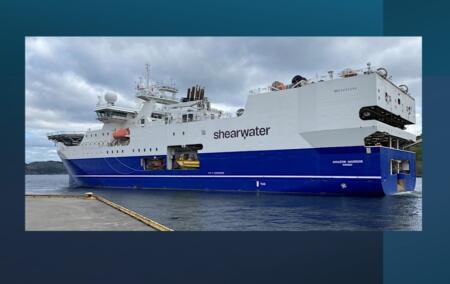
[Image: The Amazon Warrior, a state-of-the-art seismic survey ship that would have been used by Shell and Impact Africa to search the ocean off the Wild Coast for oil and gas deposits. Photo supplied by its owner, Shearwater Geo]
The views of the writer are not necessarily the views of the Daily Friend or the IRR.
If you like what you have just read, support the Daily Friend