

Naza[1] presents itself as an exposé of Israel’s targeting system in Gaza. But true facts, carefully selected and stripped of context, can tell a deeply misleading story.
Imagine a new documentary about the liberation of France in 1944. It opens with the ruins of Caen. Houses reduced to rubble, churches without roofs, streets buried beneath masonry. Then come the photographs of the dead. Civilians. Women. Children.
The filmmakers have interviewed former Allied intelligence officers, aircrew and military planners. Some appear anonymously, their faces hidden and voices altered. They describe the enormous machinery assembled for the invasion of Europe: aerial reconnaissance, target lists, railway junctions, bridges, marshalling yards and the bombers that would attack them.
One former airman remembers knowing perfectly well that there were civilians beneath him when the bombs fell. Another explains that the targets were often surrounded by homes. Then the documentary produces something more disturbing still. Allied commanders had actually calculated, in advance, how many civilians their bombing might kill.
The initial estimate was enormous: perhaps 20 000 dead and 80 000 casualties overall. As the operation progressed, Air Chief Marshal Arthur Tedder revised the likely number of dead down to around 10 000. They knew. Winston Churchill certainly knew. He was sufficiently troubled to write to Franklin Roosevelt about what he called the ‘slaughter of friendly civilian life’. He worried that the bombing might leave behind ‘a legacy of hate’ among the very people the Allies claimed they had come to liberate. And yet the bombing continued. Our documentary cuts back to Caen.
By the end of the battle, 1741 civilians there were dead. Another 1770 died in Le Havre, 883 in Rouen and hundreds more in Saint-Lô and Falaise. Close to 20 000 civilians died during the fighting, predominantly as a result of bombing. Around 300 000 were left homeless or otherwise displaced by the destruction.
Imagine how such a film might be made. Imagine the music. A grieving mother describing the child she lost. The casualty calculations appearing slowly on screen: 10 000 expected dead. Churchill’s own word: slaughter. Then the question hanging over all of it: What kind of military calculates beforehand how many innocent people it is prepared to kill? There is, of course, no such documentary. I made it up. Almost nothing else in the story is invented.
The civilian deaths happened. The casualty calculations happened. Churchill’s objections were real. Allied commanders knew their attacks would kill civilians, debated how many might die, changed some targets to reduce the number and ultimately proceeded because they believed the military objective justified doing so.
The Allies were not bombing France because they wanted to kill civilians. They were attacking railway lines, bridges, roads and other infrastructure because an enormous German army occupied France and they wanted to prevent it reinforcing the Normandy beaches. The bombing formed part of the Transportation Plan intended to isolate the invasion area.
Leave the German army largely out of our imaginary documentary and something interesting happens. Almost every fact remains true, but the story becomes deeply misleading.
Gaza is not Normandy. Hamas is not the Wehrmacht and Israel is not the Allied Expeditionary Force. Historical analogies become silly very quickly when they are treated as exact equivalences. That isn’t what this one is intended to do. The question is narrower: what happens when we apply the same way of presenting civilian casualties to a war whose basic military purpose nobody seriously misunderstands?
I thought about this while reading about NAZA, the new documentary by Yuval Abraham and Rachel Szor, two of the filmmakers behind No Other Land. It premiered at Venice this month, won the Special Jury Prize and received a standing ovation lasting roughly 25 minutes. More importantly, it has been received as a devastating exposé of the machinery behind Israel’s killing of civilians in Gaza. The title comes from a Hebrew military abbreviation for collateral damage. In the targeting process, naza refers to an estimate of the civilians who might be harmed in an attack on a military target. That distinction matters rather more than some of the coverage of the film suggests.
The BFI’s Sight and Sound, for example, describes a designation such as ‘20 NAZA’ as meaning that ‘approval was given to kill 20 civilians. The film contains the particularly shocking allegation that a strike was once approved with a figure of 500.
Maybe. But there is a fairly obvious problem here.
Estimating how many civilians might be killed before attacking a military target is not, by itself, evidence of a system designed to kill civilians. It is something responsible militaries are supposed to do. The United States military has its own formal Collateral Damage Estimation methodology. International humanitarian law requires the underlying calculation too. An attacker must consider the civilian harm expected from an attack, take feasible measures to reduce it and weigh that harm against the concrete and direct military advantage anticipated. An attack must be cancelled if the expected civilian harm would be excessive.
The uncomfortable reality is that the law of war does not say civilians may never die in war. The International Committee of the Red Cross itself acknowledges that incidental civilian harm is often unavoidable. Which brings us back to the 500.
Sarit Zehavi, a former Israeli intelligence officer who says she was involved in developing some of these procedures, argues that the film misunderstands what such a figure represents. According to her, ‘NAZA 500’ on a target sheet is an estimate of potential collateral damage, not an authorisation to kill 500 civilians. A sufficiently high estimate might require a different weapon, evacuation measures, approval at a higher level or cancellation of the attack altogether.
Zehavi is plainly not a neutral observer, and her interpretation should not simply be accepted because it is convenient. The IDF likewise denies that any strike was ever approved on the basis that 500 civilians were expected to die. But the broader distinction does not depend on either of them. A collateral-damage estimate and an authorised civilian casualty allowance are not necessarily the same thing. Before treating the figure as evidence of deliberate mass killing, we need to know exactly what it represented at that stage of the targeting process.
There is also serious evidence that Israeli targeting rules became substantially more permissive after 7 October. Israeli intelligence personnel have described attacks being authorised despite significant anticipated civilian casualties, and independent reporting has raised legitimate questions about whether some thresholds were far too high, particularly when relatively junior Hamas members were targeted.
That is consequential. Having a sophisticated collateral-damage system does not prove that the decisions produced by it were lawful, sensible or humane. But neither does the existence of a civilian casualty estimate prove the opposite. Return to Normandy.
‘Allied planners estimated that 10,000 French civilians might die.’ True.
‘Allied commanders proceeded with operations knowing that thousands of French civilians might die.’ Also true.
‘The Allies authorised the killing of 10,000 French civilians.’ Something has changed.
‘The liberation of France operated through a system of calculated mass killing of French civilians.’ Something has changed rather more.
The underlying facts are the same, but the meaning is different.
This distinction is not an historical curiosity produced by the crude bombing technology of 1944. In 2017 the US-led coalition fought Islamic State in Raqqa using modern surveillance, precision weapons and contemporary rules of engagement. Amnesty International and Airwars nevertheless concluded that coalition air and artillery attacks killed more than 1,600 civilians. Amnesty was highly critical of aspects of coalition conduct. It also documented Islamic State using civilians as human shields, preventing them from escaping and shooting people who tried to flee.
It is perfectly possible, in other words, for a military campaign to have a legitimate military objective, cause enormous civilian suffering, contain individual attacks that may have been unlawful, and still not have the killing of civilians as its purpose. That distinction becomes particularly important in Gaza because Hamas cannot simply be scenery in the story.
The nature of 7 October is not seriously in doubt. Human Rights Watch spent months investigating the Hamas-led assault, conducting 144 interviews and analysing more than 280 photographs and videos, many recorded with pride by the attackers themselves. Its conclusion was that killing civilians and taking hostages were ‘central aims’ of the planned attack. These were not simply excesses committed by fighters after a military operation went wrong. Civilians were deliberately sought out, killed and abducted.
That produces an asymmetry that extends beyond this particular war. It has long shaped Israel’s position vis-à-vis its enemies in the Middle East, and in a broader sense reflects a difficulty Western societies have repeatedly faced in confronting extremist Islamist movements. One side operates, however imperfectly, within a moral and legal tradition that distinguishes between combatants and civilians and treats civilian deaths as something requiring justification and restraint. The other regards the deliberate killing of civilians as a legitimate means to a political or religious end. Pretending that these are simply equivalent forms of violence obscures something important. Hamas deliberately attacked civilians. Civilians were among the objects of the attack.
Israel says that the objects of its attacks are Hamas fighters and military objectives, while civilians are collateral to those attacks. Saying so obviously does not establish that this is true in every case. Intelligence can be wrong, soldiers can commit crimes, and commanders can accept risks to civilians that are indefensible. A particular strike can be disproportionate or unlawful. But those possibilities do not erase the distinction between selecting civilians as the object of an attack and attacking a military objective while knowing that civilians may also die.
Indeed, a system designed to estimate civilian casualties before a strike is at least consistent with that distinction. The important questions are whether the estimate was accurate, whether feasible precautions were taken, whether the military target justified the anticipated harm and whether commanders actually obeyed the rules they claimed to be applying. Those questions are considerably harder than simply asking whether Israel knew civilians would die. Of course it knew. So did Eisenhower.
There is another uncomfortable element to our Normandy thought experiment. Britain was not simultaneously pouring unlimited humanitarian food into German-occupied Europe. It maintained a blockade, despite knowing that civilians were experiencing serious shortages, partly because supplies entering occupied territory could benefit Germany or free other resources for the German war effort. Large-scale Allied relief only expanded as territory came under Allied control.
That is not a template for Gaza. International humanitarian law has developed considerably since 1944, Israel’s relationship with Gaza is different, and even the Normandy analogy has limits: the German army was an occupying force in France, rather than an armed movement deliberately embedding its military infrastructure within the civilian population from which it operated. Gaza has experienced severe food insecurity and shortages, and Israel’s restrictions and military operations have contributed to humanitarian difficulties. Some widely publicised projections of imminent famine were subsequently not borne out at the time predicted, although severe food insecurity and a continuing risk of famine remained. Claims that Israel deliberately created a famine therefore require considerably more than simply pointing to hunger in a war zone. The point is not to decide the Gaza war by analogy with 1944. It is to notice how easily war becomes incomprehensible once the enemy, the military objective and the choices confronting commanders disappear from the story.
Perhaps NAZA‘s witnesses establish that particular Israeli commanders knowingly approved unlawful attacks. Perhaps some of the casualty thresholds they describe were indefensible. Perhaps individual attacks amounted to war crimes. Evidence for those propositions should be examined seriously. But evidence still has to establish the conclusion being claimed. You can estimate civilian deaths beforehand and still not be running a kill quota. Knowledge of something isn’t intention. Collateral damage — as ugly as that term is — isn’t the same as murder. A terrible outcome, on its own, doesn’t tell you anything about why someone produced it.
Think about that imaginary Caen documentary. Show real corpses. Quote Churchill accurately. Use the actual casualty estimates from military files. Interview genuine survivors, genuine bombers. Nothing invented. Nothing false. You could fact-check almost everything and still come away with no idea what actually happened. That’s the danger. You don’t need to lie. You just need to leave enough out.
[1] I have not seen the film. It is not widely distributed. This critique is based on how it has been described by its makers, by critics who have seen it, and by the claims made about its contents.
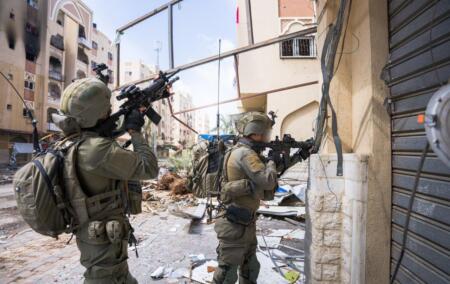
[Image: IDF troops in Gaza]

The views of the writer are not necessarily the views of the Daily Friend or the IRR.
If you like what you have just read, support the Daily Friend