

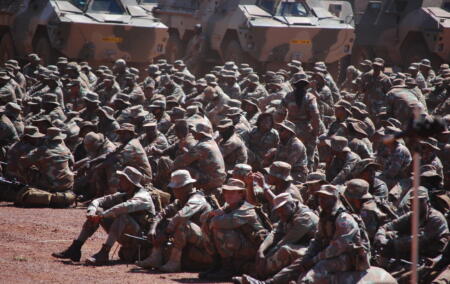
On 16 October, Parliament’s defence committee asked for an urgent meeting between the finance minister, Enoch Godongwana, and the defence minister, Angie Motshekga. The committee, chaired by Molefi “Dakota” Legoete, wanted agreed costings and dates for stopping the department’s salary overspending from 2027/28. It also complained that soldiers on operations lack basic kit, such as boots, uniforms, bullet-proof vests, weapons and working vehicles. Five days later, Mr. Godongwana tabled the mid-term budget policy statement. It was his, and Treasury’s, answer to the committee.
The Defence vote – the money Parliament approves for the department – rises from R57.6 billion to R61.5 billion this year. On paper that looks like an increase of 6.7%. Most of it is not Treasury money. R2 billion is income the department earns, mainly UN and SADC reimbursements for the Congo deployment, plus sales of equipment and spares. R823 million is new, for soldiers who help police fight illegal mining and gangs in five provinces. That is under 2% of the extra R45.5 billion Treasury is spending this year.
Even with the top-up, the vote is R0.9 billion below the R62.3 billion Defence spent last year. The department budgets R37.8 billion for salaries and spent R40.4 billion in 2025/26. By September, it had already used 55% of this year’s salary budget. At that rate the overspend is about R3.8 billion. That is the problem the committee wants solved, but the latest budget does not fund the solution.
Treasury’s defence and state security function, a wider category than the vote, grows from R62.4 billion this year to R65.5 billion in 2029/30. That is 1.6% a year, and it dips to R61.3 billion in 2027/28. Treasury forecasts inflation of 3.8%, 3.2%, and 3.1% for 2027 to 2029. On those figures the 2029/30 budget buys about 5% less than this year’s.
Treasury’s reasoning is easy to follow. Interest on government debt costs R441.5 billion this year, or R1.2 billion a day. Defence gets about R168 million a day. A revenue windfall of R54.1 billion arrived, and the deficit stayed at R301.6 billion because the money went to other spending. Defence was not first in the queue.
But other state entities were treated differently. Moneyweb reported on 22 October that South African Airways received a R1 billion guarantee in August to cover working capital after the fuel price shock. Treasury director-general Duncan Pieterse said the R1 billion took the form of a guarantee, which means it is not cash from the budget. He could not rule out further bailouts. He said the airline had already received about R50 billion over the years. Treasury would only know whether new money is needed once the search for a strategic equity partner is finished.
The airline is one of several state-owned entities to again receive more support that isn’t afforded to defence. The mid-term statement lists a R10 billion guarantee for the Land Bank, R2.2 billion for the Ithala Development Finance Corporation, and further guarantees for the road’s agency, Sanral. Denel, the state arms company, holds guarantees of R889 million for secured contracts. The state’s guarantee portfolio stood at R960.6 billion in June, down from R982.4 billion in March.
Technically, a guarantee is a promise to pay if the borrower cannot. It costs the budget nothing until it is called. By contrast, the R823 million for soldiers is cash. But Treasury’s own statement warns that the fall in used guarantees at state companies overstates the relief, because part of it reflects support the state has already paid. SAA’s history shows that calls come.
Set the figures side by side. The new guarantees named above add up to R13.2 billion, before Sanral, which is about 16 times the new money found for soldiers deployed in five provinces. Even Denel’s R889 million is more than that. The state extends credit to companies that have needed rescue before, but it asks the defence force to find savings inside a vote that is already below last year’s spending.
The state of the air force shows the consequences. In 2025/26, it planned to fly 12,000 hours and flew 6,340, or 52.8% of the target, according to the department’s annual report as reported by DefenceWeb on 21 October. The report blames late contracts and a lack of money for maintenance and spare parts. At the Africa Aerospace and Defence exhibition, Airbus Helicopters and Denel Aerospace signed an agreement to improve the serviceability of the helicopter fleet. A partnership like that can speed up repairs, but it cannot pay for the parts.
A second risk lies with the R2 billion. That income depends on UN and SADC budgets and on a foreign deployment that the South African government does not control. The SANDF’s operating money would shrink with it, while soldiers are also deployed at home against illegal mining and gangs.
The 2015 Defence Review set out the capabilities a South African force needs. Nobody has funded it since, and this budget does not either. A defence force cannot be sized for its mandate and funded for something smaller. Parliament should ask the two ministers for a published list of the capabilities that R61.5 billion pays for and the ones it does not. It should also insist that the salary overspend is budgeted for in February and not discovered again in the adjustments.
The state’s finances are more stable than they were three years ago. That stability has been bought in part by a defence force that is asked to do more with less, and by guarantees that stay off the budget until someone calls them. Mr. Godongwana is entitled to hold that line. But South Africa should know that the cost will show when the country needs the SANDF and finds that it cannot deploy.
[Image: Ricardo Teixeira]
The views of the writer are not necessarily the views of the Daily Friend or the IRR.
If you like what you have just read, support the Daily Friend