

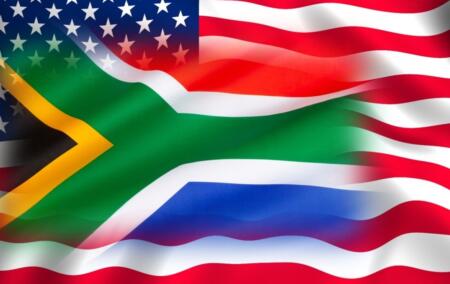
South Africa and the United States (US) both went to the polls in the first week of this month, and both delivered results that were read as turning points.
The US midterms handed Democrats both chambers of Congress, while the South African local government elections cut the African National Congress (ANC) to 30.8%, its worst showing since 1994.
Neither result changes anything between the two countries, but both point to the elections that will.
In Washington, every instrument the US has used against South Africa since February 2025 sits with the executive.
Executive Order 14204, which cut aid to South Africa and offered Afrikaners refugee status, rests on nothing but inherent presidential authority. The September 2026 visa restrictions arise from a Secretary of State’s discretion under the Immigration and Nationality Act. The 12.5% tariff imposed under Section 301 of the Trade Act, the provision Washington uses against trade practices it considers unfair, can be lifted by the Trade Representative on a finding that it is no longer appropriate. The Section 232 duties on vehicles, steel and aluminium, imposed on national-security grounds, are presidential proclamations. Eligibility for the African Growth and Opportunity Act (AGOA), which gives qualifying countries duty-free access to the US market, is a presidential determination.
A Democratic House and Senate seated in January 2027 cannot, short of a veto-proof majority, restore South Africa’s AGOA benefits, end the Section 301 action, or lift the Section 232 duties that cut South African vehicle exports to the US by 83% in a single year.
They can keep Congress itself from escalating measures by shelving bills such as the Bilateral Relations Review Act, and they can use spending bills as leverage. On the measures already in force, they are spectators. The midterms said a great deal about US politics – but nothing about policy towards South Africa.
The same applies to the South African local government election.
The national executive is unchanged and the coalition negotiations in municipal councils will not affect the Cabinet of the Government of National Unity (GNU). The 2026 result has no bearing on who negotiates with Washington before 2029.
What it does confirm is that the ANC’s slide is not a blip. Its share has fallen at every national election since 2009 and every municipal election since 2011, and 30.8% is 15 points below its 2021 municipal result. The Democratic Alliance (DA), meanwhile, finished first in Johannesburg, Tshwane and Ekurhuleni, the first time it has led all three Gauteng metros at once.
Nationally, though, the DA took 24.6% to the ANC’s 30.8%. The gap has narrowed from 24 points in 2021 to six, which makes a DA first place in 2029 a serious possibility, if not yet the likely outcome.
Metro wins flatter a party whose vote is concentrated in cities, and the ANC’s remaining base is rural.
The ANC’s 2027 national conference
The ANC will elect new leadership in December 2027, a year and a half before the national vote and at the lowest point in its post-1994 history. That contest will decide whether a DA-led national government is politically possible. No plausible count gets the DA to a majority in the National Assembly without the ANC, so the question is whether the ANC would serve under it, and that depends on who leads it.
A shrinking ANC looks like a more pliable partner, but its leverage shrinks more slowly than its vote.
Suppose it falls to around 26% of the National Assembly in 2029. Inside a coalition, that would still be a veto under any renewal of the GNU’s sufficient-consensus rule, which requires major decisions to carry partners holding 60% of the Assembly’s seats.
Outside a coalition, it would retain the option of anchoring a majority with the uMkhonto weSizwe Party (MKP), the Economic Freedom Fighters (EFF) and smaller left-wing parties. The ANC, the MKP and the EFF took almost 47% between them this month.
Everything therefore turns on who wins the contest inside the party in 2027.
A leadership in the Ramaphosa camp keeps a DA arrangement conceivable, although as a partnership of near equals, not the junior role the DA plays in the GNU today. A populist or Zuma-adjacent reconciler puts the ANC into a left bloc, and the ANC/DA configuration dies regardless of what the DA polls.
The likeliest result, given the ANC’s habit of electing mixed slates, is a leadership that keeps both doors open into 2029 and lets the vote decide.
The December 2025 National General Council committed the party to defending black economic empowerment and National Health Insurance against challenges from its GNU partners.
Whoever leads the ANC will carry those commitments into coalition talks, and they will set the price of ANC support: the empowerment framework, employment equity, expropriation and South Africa’s genocide case against Israel at the International Court of Justice (ICJ).
That covers most of what Washington objects to, and most of it predates Trump: US trade officials have complained about empowerment rules for at least twelve years. Even the best outcome of 2027, a Ramaphosa-camp leadership willing to partner the DA, would bring those commitments into government with it.
The 2028 Democratic presidential primary
The second election is the Democratic primary in the US. The midterms make a Democratic president in 2029 more plausible, though midterm results are a weak guide to the next presidential race. The comfortable assumption is that a Democratic administration reverses the Trump measures because they are Trump’s.
The racial persecution framing, the Afrikaner resettlement programme and the G20 boycott have no Biden-era precedent and will probably leave with the administration that made them. Two sets of grievances will not, because they were never Trump’s: the economic complaints, and the foreign-policy positions, above all the ICJ case and the closeness to Russia, that Democrats criticised long before he returned.
The US 2014 National Trade Estimate recorded complaints about South Africa’s empowerment scorecard, ownership requirements and 75% local procurement targets. Biden’s 2021 Investment Climate Statement called the equity equivalence alternative onerous and restrictive, and flagged expropriation risk to international investors. The 2026 report says the same things, and this time the Trump-led White House is willing to act on them.
The foreign policy complaints are just as bipartisan. Antony Blinken, as Biden’s Secretary of State, called South Africa’s ICJ case against Israel meritless. The June 2023 letter demanding the AGOA Forum be moved out of Johannesburg carried two Democratic signatures alongside two Republican ones. Democratic Senator Chris Coons demanded an immediate AGOA eligibility review in November 2023 and is now in line to chair the Senate Foreign Relations Committee. On 23 July 2025, six Democrats voted for the Bilateral Relations Review Act in committee.
South Africa is unlikely to come up in a single primary debate, but the primary matters anyway, because Democrats hold two postures on South Africa and the nominee’s foreign policy team will choose between them.
One keeps the economic grievances attached to the coercive instruments, so AGOA eligibility and tariff tiers remain levers for forcing policy change in South Africa. The other lets the grievances live in trade dialogue while tariffs follow global, sector-by-sector rules rather than targeting countries.
That is roughly what Biden did, even after the 2023 Lady R affair, when the US ambassador accused South Africa of loading arms onto a sanctioned Russian ship. The nominee will lean on senior Democrats such as Coons and Gregory Meeks, which is why their record on South Africa matters more than anything said on the campaign trail.
A DA-led national coalition
If the 2027 conference keeps the door open and the 2029 vote puts the DA first, Washington would be dealing with a different kind of government. When President Trump terminated South Africa’s AGOA eligibility on 2 November, effective from January 2027, the stated grounds were corruption and bribery and barriers to US trade and investment, not the racial persecution alleged in Executive Order 14204.
A DA president would take office at the head of a party that has spent twenty years fighting the corruption and maladministration the US objects to.
When the US says South Africa did wrong, a DA president could point out that the party spent the state-capture years opposing and exposing it. The defence is thinner for the period since 2024, when the DA has sat in Cabinet, but no ANC president who emerges from the 2027 conference could offer it at all.
The catch is that the US objects to how the state operates, not just to what leaders say they want. And government procurement, the large state-owned enterprises, and the public service do not change simply because there is a new president. In 2029 the US would see a non-ANC president moving the country in the direction it wants, but it would take several more years before there was concrete proof that the grievances raised against the ANC government had been met.
Foreign policy is where the change would be fastest and most visible. Executive Order 14204 named Iran explicitly, citing commercial, military and nuclear arrangements with Tehran. The DA’s sharpest documented foreign policy intervention was its January 2026 attack on the hosting of sanctioned Iranian Revolutionary Guard vessels in Exercise Will for Peace, and Geordin Hill-Lewis called the relationship ill-considered when he took over as party leader. It is the cheapest significant concession available to any South African government, and the DA is the only one of the four largest parties to have asked for it.
The DA has never demanded withdrawal from the ICJ case, has never called for South Africa to leave BRICS, and its January 2026 statement on military alignment attacked Russia and Iran while not mentioning China at all. A DA-led government would move on Iran and take a colder line on Russia, but it would keep the ICJ case that Blinken called meritless, so the foreign policy file would shrink but not close.
What survives either way
The 25% Section 232 duty on vehicles is a global sectoral instrument in which South Africa is not named, and no change of government in Pretoria touches it. Only a wider trade deal, of the kind Japan and Britain struck to cut their rates, could. The empowerment statutes can only be changed by Parliament, and no coalition with the ANC inside it will vote to change them. That is why equity equivalence, which lets multinationals meet ownership targets by funding local investment programmes instead of selling shares, can be broadened by ministerial notice while the Act itself stands. The 2027 conference decides whether the ANC joins a DA-led government. It does not decide what the ANC brings with it: a junior partner with around 26% of the seats keeps its veto, whoever leads it.
If Democrats win in 2028 and the DA leads in 2029, Pretoria stops being an adversary and becomes a difficult partner. The grievances that are Trump’s own, the persecution claim and the refugee programme, leave with him; Iran drops off the agenda, and the tone of the relationship inverts. The trade file and the ICJ case stay open, because they were never about which party governs. They rest on laws and positions that any coalition with the ANC inside it would inherit.
The elections that will shape this relationship are a South African party conference in December 2027 and a set of American primaries through 2028. Neither settles the matter alone, because a Democratic victory in 2028 and a DA first place in 2029 are both possible and neither is assured. The general elections will have the final word, but the conference and the primaries will decide which outcomes those votes can still produce.
[Image: by martinholverda, by SteveAllenPhoto999]
If you like what you have just read, support the Daily Friend