

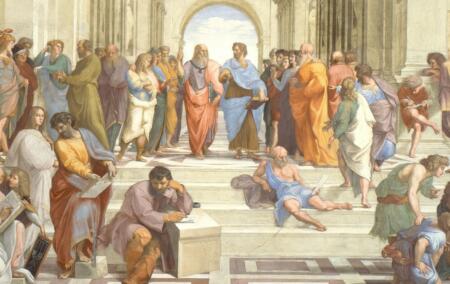
“Man is by nature a political animal”, said the Greek philosopher Aristotle in the Politics.
It’s a line I remember from first year political science. The Politics, assigned reading for the course, is a classic work on the nature of governance and politics, starting from the assumption that humans of necessity need to live in communities. As old as it is, and as antiquated as many of its ideas are, it nonetheless remains a staple of philosophical reflection. It continues to hold out lessons millennia after it was composed.
The bestial reference was served to differentiate humans from other beasts. While other animals were capable of living together, they lacked the facilities for understanding and conceiving higher-order ideals, such as justice. Life in human society, and the political responsibilities that come with it, represents both the means for human survival and the fulfilment of human nature.
I thought about this in the aftermath of the municipal elections. Elections are arguably the most direct expression of the political in modern life, and local level government the preeminent forum of community life. It’s here that people relate to one another in their day-to-day existence, so a great deal is at stake; the state of South Africa’s towns and cities only makes it that much more pressing.
It’s for this reason that the fractured outcomes have seen a number of commentators making appeals to the various parties to put aside their differences, find one another, and cooperate for the greater good. Differences of ideology, political outlook, or over personalities are trivial in comparison with the challenges that loom over the country.
More than that, there is considerable survey evidence going back decades to show that South Africa’s people are in favour of cooperation among political parties for the greater good. Aristotle might have agreed. The Politics evinces considerable suspicion of political factions (parties, in contemporary parlance) within a community, since they were apt to put their interests ahead of that of the people as a whole. “In general,” he wrote, “when the notables quarrel, the whole city is involved.”
Philosophical rumination
In South Africa today, the notables are quarrelling and whole cities are involved. This is not ancient Greece, nor the province of philosophical rumination. It is a reflection of very real divides, and a political culture among society’s elites in which cooperation “in the best interests of the people” is much easier said than done.
For one thing, the nature of those best interests is deeply contested. Communities can rarely achieve a unity of vision, and modern democracy is designed to accept that as a reality, and a legitimate one. It’s in the nature of a modern representative democracy that organisations arise to compete for their distinct visions.
These can be radically different from one another. It should come as no great surprise that the Economic Freedom Fighters or the uMkhonto we Sizwe Party have ruled out cooperating with the Democratic Alliance, and vice versa. The EFF and MKP represent a form of racial nationalism and a command economy. The DA advocates non-racism and a relatively free economy. The African National Congress believes in non-racism that is defined with numerous exceptions, exemptions and carve-outs, and a mixed economy leavened with denunciations of business and appeals for business to save South Africa from the ravages of ANC rule. It’s doubtful these parties would be able to come up with a common diagnosis of a city’s problems, let alone come to anything approaching a joint programme.
Nor are the peculiarities of personalities to be underestimated or dismissed. Much has been made of the personal animus that ActionSA head Herman Mashaba has towards Helen Zille, and his refusal to countenance an agreement that sees her don the Johannesburg mayoral chain.
This may be dismissed as irrational and counterproductive, but it too is an integral part of politics. Personal relationships are foundational to both the human experience and political interactions.
Humans are capable of admiration, ambition, aversion and resentment. These impulses can be as important to political interactions function as they are to personal ones.
Assumption of competition
Modern democratic politics is built on the assumption of competition far more than on cooperation.
Aristotle would probably have baulked at this. For him, as for many ancient thinkers, democracy was a debased political form that allowed some of society’s worst impulses to assert themselves. In his view, again, in line with thinking that endures in remnants today, a community should optimally be guided by a skilled and virtuous leader. His teacher Plato had a similar idea of rule by a philosopher-king.
Yet Aristotle understood that such remarkable people are rare. It was also not advisable to shut the public out of politics entirely, so he argued for what he called a “polity”, a system characterised by widespread public involvement, but where their choices were limited by law. He went on to argue that this needed to be underwritten by a “middle class”, stout, moderately prosperous citizens who would act responsibly. In this, there are some early flickerings of constitutionalism.
It was this, an appreciation of the importance of law and justice, that in Aristotle’s mind elevated humans above other animals. Take this facility away, and humans can degenerate to their level, if not below it. “For man, when perfected, is the best of animals, but, when separated from law and justice, he is the worst of all; since armed injustice is the more dangerous, and he is equipped at birth with arms, meant to be used by intelligence and virtue, which he may use for the worst ends.”
Reality
Many of us are nervously looking at this reality now. South Africa’s political landscape can be a savage place, and not all its bestiary are interested in the rules that would tame it. Constitutional governance is rejected outright by some, implicitly by a few, and selectively by others.
My own hope is that workable cooperation can be created in some jurisdictions, among those prepared to put constitutionalism at the centre of their cumulative offering.
But it is past time to dispense with the idea that South Africa’s politics is, or can be – or indeed, should be – one founded entirely on cooperation. The country is too politically diverse and too divided for that.
Cooperation is not the nature of South Africa’s political animal, though perhaps it is possible to tame the beast’s worst instincts.
[Image: Plato and Aristotle (in blue) occupy the centre of Raphael’s The School of Athens. https://en.wikipedia.org/wiki/The_School_of_Athens#/media/File:%22The_School_of_Athens%22_by_Raffaello_Sanzio_da_Urbino.jpg]
If you like what you have just read, support the Daily Friend