

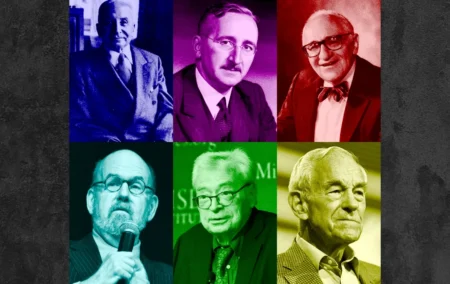
Critics say racism runs through the whole of libertarianism. It doesn’t – I argue in this first of a four-part essay – but it runs deep through one branch, which chose it on purpose.
I went down a rabbit hole after writing my recent column on Hans-Hermann Hoppe. I described him as the bridge by which some libertarians shifted to the alt-right, and conversely, by which white supremacists imbibed palatable rhetoric about freedom and property rights to mask their prejudices.
I have often expressed disquiet at the implicit (and all too often explicit) racism I’ve encountered among libertarians. Individual freedom and the absolute right to reserve admission to private property are very attractive to people seeking a fig leaf for their prejudices.
But since classical liberal principles are based upon the moral axiom that dignity and worth are the birthright of every individual, and that all people therefore enjoy equal rights and freedoms simply by virtue of being human, I thought the racists among us could be noted, censured, and then safely ignored.
I argued with lefties like Imraan Buccus, who declared the entire liberal tradition to be shot through with racism. (He responded to my argument, and I replied again).
Partisan ploy
I stand by these arguments, and the attempt by Buccus to tar all of free-market capitalism and liberal democracy with the same racist brush is in my view a partisan ploy to claim the moral high ground for left-wing ideologies.
This is high ground which the left cannot occupy, since what we call racism today substantially predated the liberal tradition; was most closely associated with the thoroughly illiberal enterprise of colonialism and slavery; and a great many of its own most influential thinkers, including Marx and Engels, and writers, including George Bernard Shaw, Jack London and H.G. Wells, were dreadful racists and antisemites.
By limiting my defence against racism to classical liberalism, however, I glossed over disturbing aspects of the libertarian tradition, even though I once counted myself among them (and still do, really, though I eschew the label).
There is a deep vein of racism that runs through libertarian thought, with which I never fully reckoned. That vein has direct links to the white supremacist far right, from which it drew inspiration and from which it sought political support. It also became a key intellectual influence upon the modern alt-right, or “new right” (I’ll use the terms interchangeably).
This, then, is an attempt to remedy my past reticence to tackle libertarian racism head-on.
It will proceed in four parts. In part one, I’ll recount the indictment against one branch of libertarianism. In part two, I’ll go to the primary sources to reveal the surprising extent to which the indicment holds up. In part three, I’ll describe the main branch that rejected racism. And in part four, I’ll discuss some of the ideas that spring from the tainted branch, including right here in South Africa.
Judge ideas
It grieves me to name some of the giants of the liberty tradition – most notably Murray Rothbard – among the racist libertarians. I am relieved to report, however, that not all libertarians are so tainted. The core of the Austrian School, most of the Mont Pelerin Society, important thinkers including Mill, Mises, and Hayek, think tanks like the Cato Institute, and publications like Reason, consistently reject racism.
I should preface this by saying that having harboured racist views does not invalidate all the ideas someone has expressed. Many racists of the past have been perceptive and influential thinkers nonetheless. Conversely, non-racialism does not automatically redeem otherwise fallacious opinions: the Soviets were not any more correct in their views because they supported (for their own political ends, it should be said) anti-colonial liberation movements.
Judge ideas and principles, not people or their entire oeuvres.
That said, join me for a deep dive into the dark side of libertarianism. I’ll start, in this part, by stating the case for the prosecution.
The alt-right and neoliberalism
There is a widely held view that the alt-right emerged as a rebellion against neoliberalism.
Neoliberalism is a (usually pejorative) term for the late 20th century incarnation of what really is just classical liberalism or libertarianism. It is commonly associated with Ronald Reagan, Margaret Thatcher, and Deng Xiaoping, and draws its economic theories from libertarians associated with the Mont Pelerin Society, including Friedrich Hayek, Milton Friedman, Ludwig von Mises, and James Buchanan.
A canonical definition – appropriately written, given the pejorative nature of the term, by Marxist critic David Harvey – explains neoliberalism as “in the first instance a theory of political economic practices that proposes that human well-being can best be advanced by liberating individual entrepreneurial freedoms and skills within [a state-guaranteed] institutional framework characterized by strong private property rights, free markets, and free trade.”
Luigi Esposito, professor of sociology at Barry University, argues that the alt-right developed “in opposition to two hegemonic ideologies: neoliberalism and political correctness”.
“First,” he says, “calls among many alt-righters for white Americans to regain a sense of racial identity and ‘white pride’ is effectively a rebellion against neoliberal market forces that erode tribal loyalties, national boundaries, and cultural uniqueness by encouraging open borders, multiculturalism, and individualistic forms of agency associated with competition and consumerism.
“Second, the challenge to white identitarianism by neoliberal globalization is compounded by an ideology of political correctness that, although at odds with neoliberalism, has presumably further disempowered whites. Because political correctness emphasizes egalitarianism and how all cultures are equally valuable, any agenda to advance white interests is dismissed as racist and unacceptable.”
He makes the case that “despite their tensions, both neoliberalism and political correctness have inspired alt-right collective action frames related to race realism, anti-egalitarianism, and white genocide.”
So, how does this implicate libertarianism, which its critics describe as a neoliberal ideology, but to which the alt-right is supposedly opposed?
Against the New Left
Any number of left-wing academics will answer that question. Among them, the critiques by historian Quinn Slobodian are fairly well known.
A Canadian international history professor at Boston University, Slobodian disputes the common view that the libertarian wing of the alt-right grew up in opposition to neoliberalism. Instead, he says it grew up inside neoliberalism. (Archive copy of pre-publication paper available here.)
He traces it to a schism in the Austrian School of economists over how to respond to the egalitarianism of the “New Left” that was born out of the counter-culture of the 1960s. This doctrine, based in Herbert Marcuse and the Frankfurt School of critical theory, holds that disparities between groups are the result of systemic oppression rather than individual failings, biological diversity, or cultural variation.
The New Left sought “social justice” by applying class struggle analysis not just to economic outcomes, but also to other social hierarchies, including those related to race, sex and sexuality. This analysis viewed the individual as inseparable from group identity, giving rise to a new form of identity politics in which personal circumstances and outcomes are primarily determined by the degree of oppression of the identity groups to which one belongs. It moved beyond seeking equal treatment under law, and interpreted differences in outcomes as evidence of structural oppression that demanded “justice”.
It is not hard to see why libertarians would be repelled by this dogma. Objectively speaking, it is trivially true that people have different abilities and aptitudes that might influence their socio-economic circumstances, whether or not those differences are based on biological characteristics.
More pertinently, New Left egalitarianism was a collectivist doctrine that presumed the state was a benign actor that could legitimately bring about equality of outcomes.
The racism of libertarians
Slobodian points to one school of Austrian economists, “linked to Murray Rothbard and culminating in Alt Right libertarianism, [who] saw difference as rooted in biology and race as an immutable hierarchy of group traits and abilities”. He notes that Rothbard cited the future co-author of The Bell Curve, Richard Herrnstein, on “the genetic basis for inequality of intelligence”.
In short, he argues that Rothbard was a race essentialist, peddling scientific racism.
He distinguished this from the view of Friedrich Hayek, who attributed differences in outcomes to cultural evolution through learning, and rejected genetic explanations for differences between various population groups.
“For Hayek, a culture was not a population bounded by race or heredity but one with fluid boundaries where adaptation occurs at the margins, often through interaction with (and imitation of) other cultures, and it gradually becomes generalized through a process of the survival of successful traits,” Slobodian writes.
Still, he said that Hayek’s formulation of “primitive” societies as being in need of “cultural evolution”, was, like Rothbard’s views, “highly racialized” – which, by today’s standards is not unreasonable.
Implicating Mises
In Slobodian’s paper, and a companion piece published in the journal of Contemporary European History, the more important precursor of the Rothbardian faction was Ludwig von Mises, Hayek’s mentor, from whom the institute with which Rothbard would become associated took its name.
“Race theory has an ambiguous place in Mises’s work,” Slobodian writes. Like Hayek, he took the diversity of human capacity as a starting point or a given. Unlike Hayek, however, he explicitly associated certain traits with racial groups, writing that “it may be assumed that races do differ in intelligence and will power, and that, this being so, they are very unequal in their ability to form society”.
According to Slobodian, “He left the door open for the scientific study of race for new understandings of the human condition and for explaining ‘the flowering and decline of civilizations,’” and further, that “Mises repeatedly expressed cautious optimism for a potential science of race even as he condemned the race theory that existed.”
He concludes: “The followers of Mises took his rather parenthetical opening to the possibility of race theory and drove the proverbial truck through it.”
Other accusers
In the New Statesman this year, Benjamin Fogel wrote that South Africa’s bantustans were once portrayed as “zones for experimenting with capitalist freedom – ‘decentralisation zones’, as apartheid’s agents tried to sell them to foreign investors”.
As evidence that the right viewed apartheid with “a starry-eyed sort of enthusiasm” as an experiment in libertarian decentralisation, he relied on a quote from Reason magazine from 1980: “It is possible that in the past decade no country has moved further toward a libertarian society than South Africa.” (As we shall see, Reason never endorsed apartheid in any way.)
The left-wing blogger Jack Graham goes further: “The very liberalism advocated by libertarians is inherently based on capitalism, which is inherently based on racism.”
The counter-claim
My counter-claim, which I hope to support in the sequels to this part of the essay, is much narrower.
I wish to argue that racism is not woven through libertarianism, and left-wing historians like Slobodian misrepresent both Mises and Hayek to suggest otherwise.
Instead, I believe racism runs through only one branch – the “paleo-libertarianism” of Murray Rothbard, Lew Rockwell, Ron Paul and Hans-Hermann Hoppe – leaving the classical liberal branch of Mises and Hayek largely untainted.
I intend to show how, why and when the paleo-libertarian branch chose its alliance with the far right, that it leaned on right-wing influences outside libertarianism, and why it represented a clear break from the non-racial principles held by the libertarian mainstream.
But first, in part two, we’ll get to see the surprising extent to which indictments hold up.
[Image: Top, from left: Ludwig von Mises, Friedrich Hayek, and Murray Rothbard. Bottom, from left: Llewelyn Rockwell, Hans-Hermann Hoppe, and Ron Paul. Collage by author from Wikimedia photographs]
The views of the writer are not necessarily the views of the Daily Friend or the IRR.
If you like what you have just read, support the Daily Friend