

There have been so many deliberate departures from traditional presidential protocol initiated by Trump that it is difficult to remember how more prudent presidents used to behave.
For instance, Trump’s occasionally bizarre posts on X and Truth Social, the direct insulting of not only long-term allies but also individual citizens outside of government, and the dismissal of disfavoured news outlets from the White House press room.
It is not clear whether this will become the new normal among future US presidents, but I suspect not − there is a gravitas and history associated with the position which will probably see the next generation of leaders revert to more traditional caution in the public prosecution of governance.
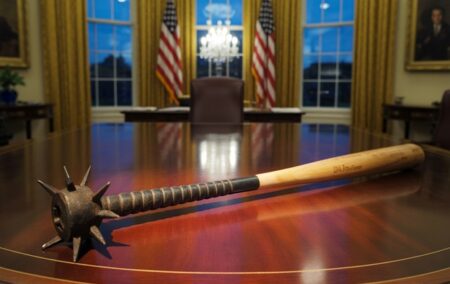
Nothing, however, is quite as startling as the dizzying transformation of the boring trade tool of tariffs into a huge nail-studded political club, to be swung promiscuously at any country, leader, or company that the president doesn’t like.
Remember how this all started? Trump had his minions draw up a list of countries which had a trade surplus with the US and slapped them all with tariffs to balance the books. This might have been the end of it, with the wisdom of such a strategy adjudicated by futures prices and inflation numbers.
But here is what seems to have happened: Trump has realised that tariffs can hurt like hell. And pain can be used in all sorts of ways, well beyond mere trade. It can be threatened, it can be brutally applied, and it can be withdrawn − somewhat like a torturer’s tool.
And so we have the extraordinary spectacle of Trump implementing an additional punitive tariff on Brazil because there is a case being prosecuted against ex-President Bolsonaro for engineering a coup plot in 2022. The Brazilian president has always been aligned with Trump’s agenda, and Trump considers him a friend.
Swinging his club
Think about this for a moment: he is swinging his club directly and aggressively into the face of the judicial affairs of a foreign country. He is saying, “I don’t care what he did − if you continue this legal action against my buddy, it will cost you hundreds of billions of dollars.”
And then there is South Africa. Want to go and play footsie with enemies of the US? Have preferential racial policies? Can’t reduce the farm murder statistics? Wham! Billions of revenue and one hundred thousand jobs gone (that number estimated by South Africa’s Reserve Bank Governor, Lesetja Kganyago).
And Canada − “We don’t like your foreign policy in the Middle East.” Whoosh! Billions wiped off their trading books.
The message isn’t even subtle: you are going to be friends with our friends, you are going to be enemies with our enemies, you are going to model yourself in our image, because if you don’t, you get the money truncheon right in the kisser.
Then there is the reverse bludgeon. Invest in the US and we’ll lower your tariffs. And so we have Saudi Arabia (which actually has a trade deficit with the US and so should have been excluded from the tariffs completely) promising billions in various investments into the US, and South Korea, whose tariffs were reduced on the promise of building a Hyundai plant in the US. Switzerland, now saddled with a threat of 39%, is scrambling to make an attractive “counterproposal”.
In the world of crime, this is close to being an extortion racket. But in politics, it’s legal.
This is all unprecedented and has turned the deeply wonky and arcane world of international trade into a public cage fight, with one fighter much larger than the rest. It is a form of bullying, certainly, but isn’t that what all negotiations are when the holder of leverage sets the terms?
Political obeisance
Let’s assume for a moment that all the naysaying economists are wrong, and this all works out well for the US: prices do not go up, America starts reversing or at least slowing its trade deficit, its revenues soar, and its trading partners benefit from a robust and growing market. If that scenario plays out, then we will have a new sort of master-slave economic world, with non-US vassal states paying political obeisance to the US for fear of losing access to the world’s biggest market.
The upshot? Trade politics would become a misnomer; it will all be about financial politics from here on. “We are rich, we have the buyers, the rest of you will do exactly what we tell you to do across your entire system of governance or else.”
I do not have a strong compass as to whether it will unfold this way, because even the most basic economics would suggest that tariffs imposed on foreign goods equal higher US prices for American consumers, which citizens may not like and may cause them to vote with their feet.
Geopolitics looks very different in the face of this sort of brutal financial ordnance. We shall see if it indeed becomes the new normal, even after Trump has gone.
[Image: ideogram.ai]
The views of the writer are not necessarily the views of the Daily Friend or the IRR.
If you like what you have just read, support the Daily Friend