

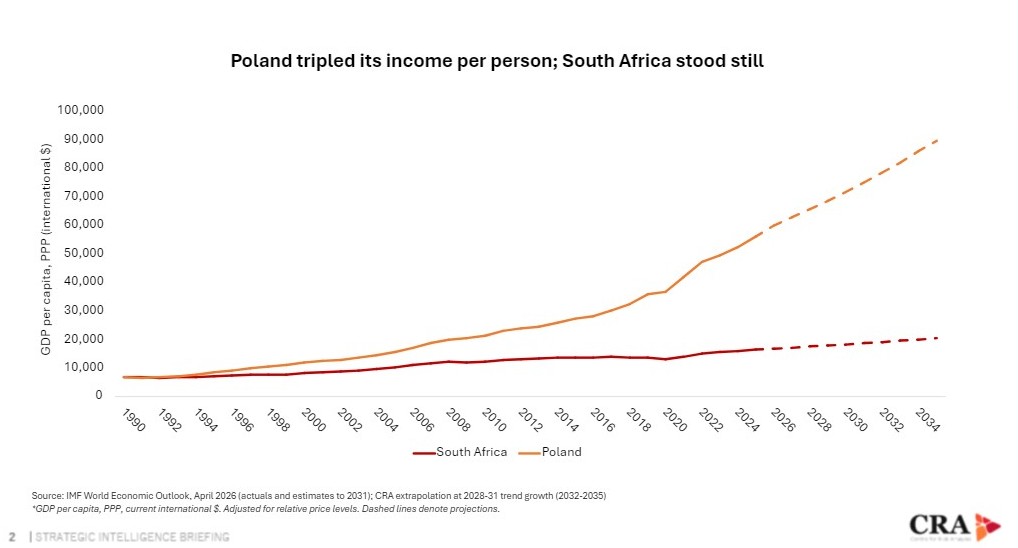
Poland and democratic South Africa started in almost the same place. In 1993, Poland’s gross domestic product per person was $4,700. South Africa’s was $4,400. By last year, Poland’s had reached $18,000. South Africa’s had reached $5,700. While one country tripled its income, the other barely moved.
The gap is the result of choices, and those choices are visible in the data. I saw the argument laid out in detail at the 2026 Summit of the Global Trade and Innovation Policy Alliance, held from 10 to 11 September, where Polish policymakers set out what drove three decades of growth.
The first choice was direction. After 1989, Poland had a clear political path: join North Atlantic Treaty Organisation and join the European Union. That single objective set the rules for everything that followed, from the design of institutions to the pace of privatisation. By contrast, South Africa has spent three decades without an equivalent anchor. Its policy direction has shifted with factional battles inside the governing party, and investors have had to guess which faction is winning in any given year.
The second choice was to open the economy. Poland moved from centralised state control to what Polish economists call goulash capitalism, a fast and often painful shift to free markets. At first Polish products were not competitive. Many failed. But the country accepted the pain of exposure to European competition in exchange for access to European markets, European capital and European technology. Foreign companies that set up in Poland brought standards and know-how that spilled over into local firms, and Polish businesses were pulled into German, French and other European supply chains as genuine partners rather than as low-cost outposts.
South Africa took a different route. Black Economic Empowerment, localisation requirements, and a cautious approach to trade liberalisation were designed to protect and redistribute rather than to expose South African firms to full competition. While the intentions were different from Poland’s, the effect was the same kind of shelter that Poland deliberately gave up. Export capacity – which Poland treated as the main engine of growth – has remained a secondary concern in South African policy for most of the democratic era.
The third choice was about people. Poland went from a country people left to a country people move to, as economic opportunity at home reversed decades of emigration. South Africa has moved in the opposite direction, with skilled professionals leaving in search of the security and income growth their own economy has not delivered.
None of this means Poland has solved its problems. Its population is ageing and its labour force is shrinking. Some of its investment has been buoyed by European Union funds rather than private capital, and its governing coalition can at times struggle to agree on a shared direction. The kind of globalisation that lifted Poland in the 2000s is also breaking down, and Polish policymakers at the summit spoke openly about needing new partners beyond Europe.
That search for new partners is one reason it makes sense that the United States has invited Poland to attend the G20 in November, a recognition of a country whose economic weight and strategic position in Europe have grown to match the scale of the summit. South Africa, which hosted the 2025 G20, came to the same table with a growth record that has not kept pace with its peers over the past three decades, even as it claimed to retain the diplomatic standing that comes with hosting.
The security backdrop makes Poland’s choices matter beyond its own borders. Russia has continued testing the resolve of European states, and the way Europe and its allies respond will help decide whether sovereignty still means something for smaller and middle-sized countries, or whether the next century runs on the principle that might makes right. South Africa, with a foreign policy that has often avoided taking a clear position on Russian aggression, has more exposure to that outcome than its own diplomacy has acknowledged.
The South African government in general and President Ramaphosa in particular have often talked a big game about growth and investment. But growth at a meaningful scale requires a clear direction, sustained exposure to competition and a state that at the very least creates conditions conducive to business growth, investment and job creation, and over time builds export capacity rather than protecting incumbents from it.
Poland made its choice in 1989 and held to it. South Africa has yet to show it has the guts to follow suit.
[Image: by RossHelen]
If you like what you have just read, support the Daily Friend