


South Africa, says President Cyril Ramaphosa, needs to have difficult conversations.
Speaking at the opening of the National Convention, he called for a bold exchange of views to interrogate and unravel some of contemporary South Africa’s pressing questions.
“We seek to ensure,” he continued, “that we give the space to South Africans to define the outcome of the National Dialogue process – so that these thousands of conversations can be drawn together into a clear vision for the country and an agreed programme of action into the future.”
One of those difficult questions that the President identified is this: “Why do so many people live in abject poverty and so few live lives of opulence?”
Happily, this has been discussed and analysed ad infinitum, not least by the National Planning Commission, in which the President played a leading role. In fact, it was one of the leading issues confronting the country at the birth of democracy, again, something in which the President was intimately involved.
The answer can be grouped into two sets of factors. The first of these is historical. This relates to a discriminatory legal regime, uneven access to educational opportunities, and above all the inability of large parts of the population to acquire wealth and pass it on over generations. The second relates to the persistence of these circumstances into post-1994 South Africa, and the failure to provide the necessary pathways out of them. The latter includes sub-standard education outcomes, spatial factors, crime, and probably most pertinently, unemployment.
Nine factors
Let’s emphasise that this isn’t new. The National Development Plan said that South Africa’s failures to get onto a heightened developmental track could be attributed to nine factors:
- Too few people work
- The quality of school education for black people is poor
- Infrastructure is poorly located, inadequate and under-maintained
- Spatial divides hobble inclusive development
- The economy is unsustainably resource-intensive
- The public health system cannot meet demand or sustain quality
- Public services are uneven and often of poor quality
- Corruption levels are high
- South Africa remains a divided society.
Each of these (with the possible exception of the last, which might very well be regarded as the outcome of the preceding eight) speaks to a failing of post-apartheid governance, even if the origins predate it. The overall malaise can be described in one key metric: the lack of economic growth.
Once again, there has been a long-running recognition that this needs to be addressed; 6% per annum was the number punted in the 1990s, and 5.4% in the NDP of 2012. The Government of National Unity was (notionally) committed to fostering growth as an objective.
In January 2025 President Ramaphosa downgraded the growth target further, saying: “We know that to achieve a goal of 3% economic growth will require an extraordinary effort, not just from this partnership but from all stakeholders and all South Africans.”
Hasn’t achieved any of this
The reality is that South Africa hasn’t achieved any of this, certainly not since the global financial crisis of 2008; and this is quite aside from the impact of Covid.
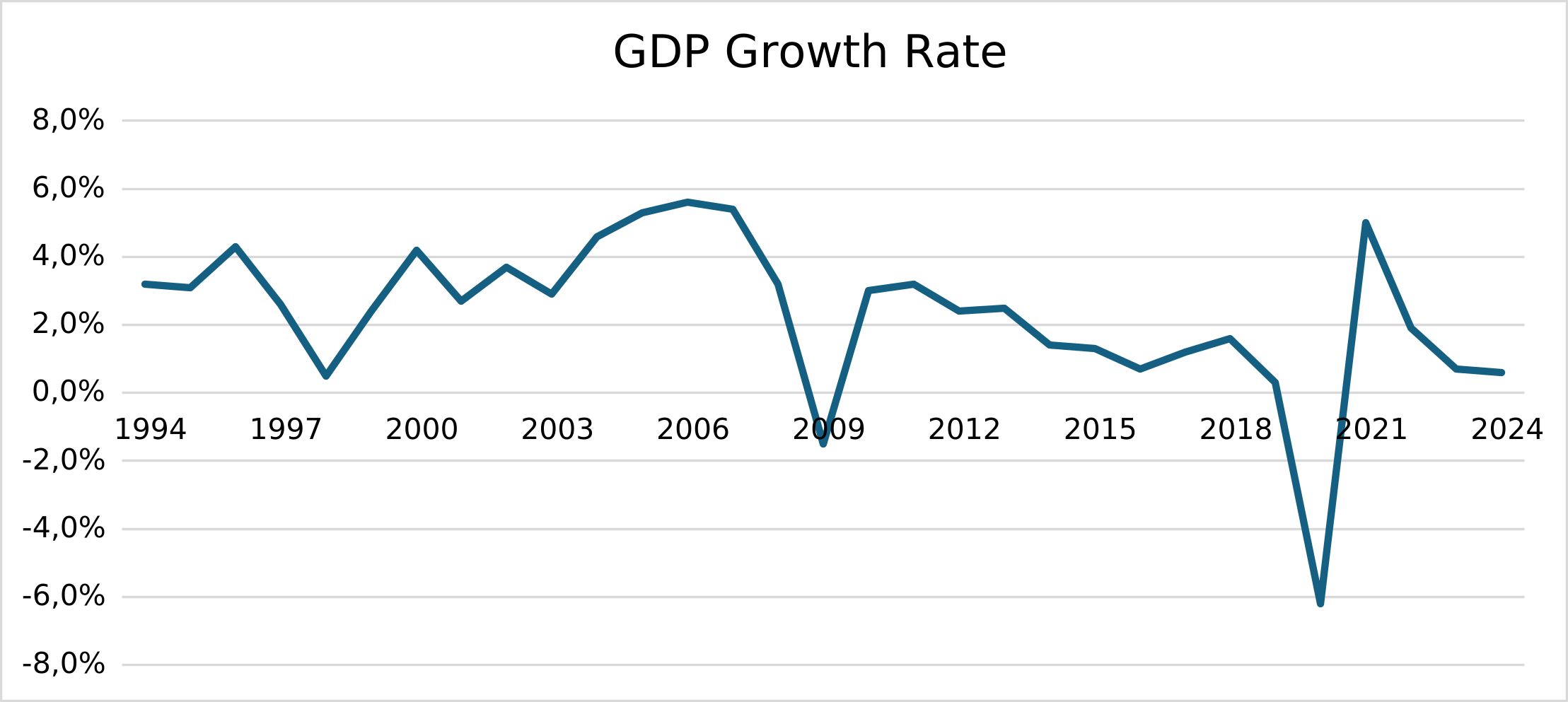
Growth, however, doesn’t happen on its own. One of the key determinants is the rate of investment. Investment is simply the commitment of resources into something durable, the commitment of wealth in the pursuit of wealth. Here, again, the NDP envisaged investment rising to 30% of GDP, this being fairly standard for comparable economies. The record has not been encouraging.
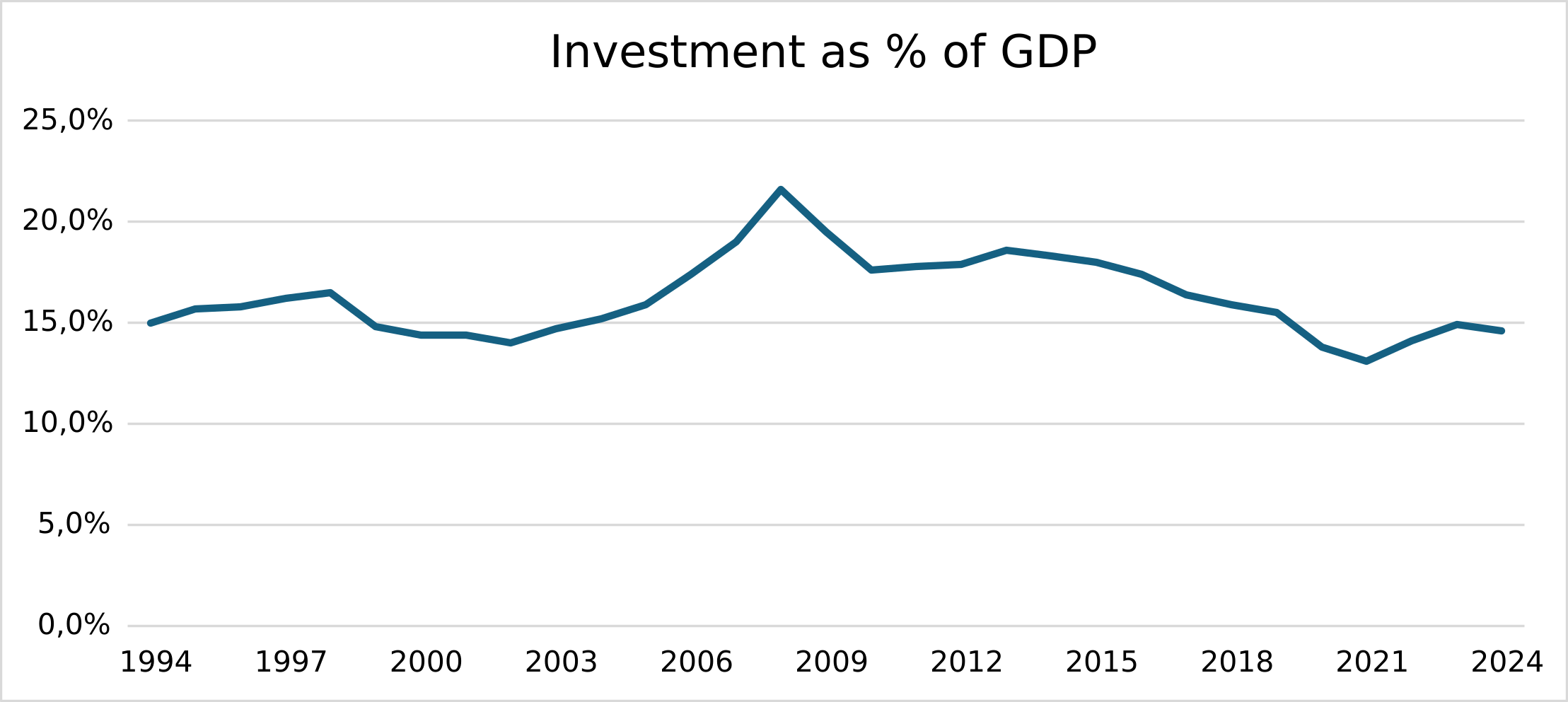
South Africa’s investment record has been indifferent at best. In the post-1994 period, it’s come nowhere near that 30% level. At present, South Africa is achieving less than half of this.
With this background, the concern that “too few people work” falls into perspective. The economic dynamism to generate the opportunities is simply absent. The more conservative estimates – the so-called official rate – are concerning enough. The expanded definition (including those who are not actively seeking work) pushes the rate to over 40%.
Informal sector
True enough, there are voices that have questioned the accuracy of these measures, citing the scale of the informal sector. There is probably some truth to this, but the informal economy remains a relatively small contributor to the overall economy, with limited opportunities for scaling.
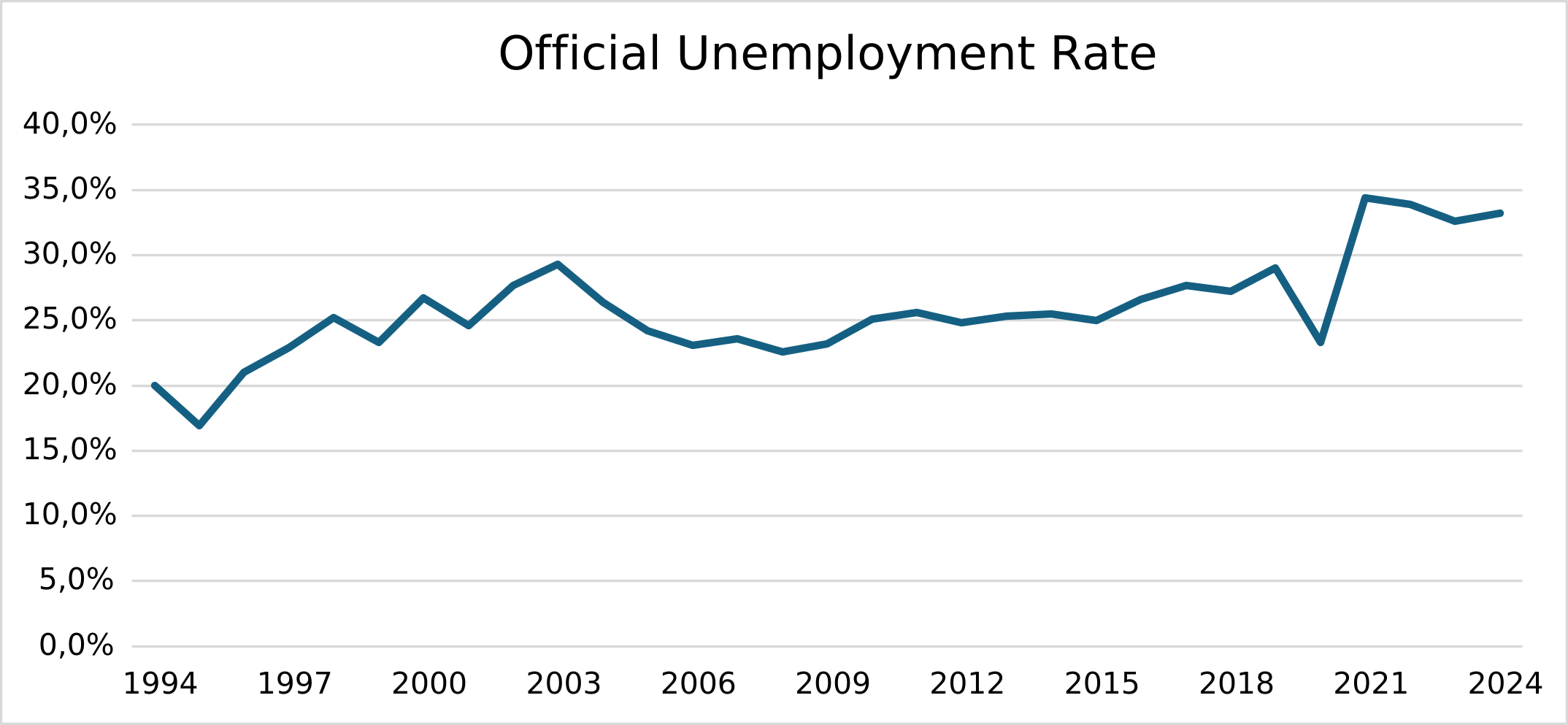
Note: Use of different methodologies means that the pre- and post-2001 periods are not strictly comparable
In other words, there is little enough investment, barely any growth, and few jobs to provide the income and mobility that would enable people to escape poverty. As President Ramaphosa himself said back in 2020: “Without growth there will be no jobs, and without jobs there will be no meaningful improvement in the lives of our people.”
No prospect
So what sort of “clear vision and agreed programme of action” does this necessitate? Unless South Africa can get its investment levels up – and with it, its economic growth rate – there is no prospect of dealing with unemployment. Under these circumstances, expect those trapped in abject poverty to remain there.
Unfortunately, whatever rhetorical commitments or intellectual understandings of the importance of growth and the imperatives of investment – foreign and local – have been made, they have been subject to the prior claims of politics.
As the IRR has argued in its Blueprint for Growth papers (recently honoured through an award at the Africa Liberty Forum), South Africa’s economic failings stem largely from poor policy choices. The most obvious one has been the consistent preferencing of demographic “transformation” – whatever that may mean, since the term is a flexible one – over efficiency. In practical terms, this has meant that stiff demands have been made on businesses to conform to a political vision of the world. (Note that the IRR has been proposing an alternative vision of transformation, “real transformation”, that would encourage a growing economy with an expanding set of opportunities.)
Transformation is most visibly seen in ramped-up demands for race-based empowerment, for hiring according to demographic formulae (South Africa now has, in effect, the quotas that were never supposed to be considered), for localisation of production. Meanwhile, plans to introduce the National Health Insurance system push ahead. It is a project entirely implausible for achieving its nominal objectives. Nevertheless, in collapsing the first-rate access to care that is available (albeit for a price), it stands to be ruinous for the country’s increasingly insecure middle class.
In many instances, what might have been the subsidiary or incidental benefits of policies and programmes – employment created for officials, contracts awarded to favoured businesspeople – have largely become the primary objectives. Thus, for example, South Africa is afflicted with an education system that provides employment to large numbers of people without the aptitude or temperament for the work, and empowers politically connected unionists, all to the detriment of their charges.
Cloying influence of ideology
Or one might point to the cloying influence of ideology, that just makes particular courses of action mandatory and others unpalatable. Unfortunately, the mandatory impulses tend to be damaging, and the unpalatable ones are those on which proper solutions depend.
And then, of course, there is the deep-seated tolerance of incompetence and malfeasance. Much of this has to do with the ANC’s internal politics and its tenuous unity. South Africans are given to seeing this in starkly moral terms, but the damage done is better measured in the breakdown of institutions and the corrosion of the state’s ability to perform its functions.
Cumulatively, this makes South Africa an unattractive destination for investment, placing a chokehold on growth, and a lock on employment prospects. Millions are consigned to lives of poverty.
The rudiments of an alternative course of action are not only clear, but would be simple to implement. The most obvious thing to do is to step away from the choices that are manifestly imposing costs that the country is increasingly unable to bear. Race-based empowerment policy, for example, disincentivises investment by demanding the cession of an equity portion on arrival. The politicisation of the public service in pursuit of party control has eroded professionalism. It can’t be “done better”, it must be done away with.
Not only are the required measures clear, but there is plenty of evidence that such changes would be supported. This is evident in a wealth of polling, and if such changes could show even marginal improvements, support for them would generate a momentum of its own.
Tough issues
Of course, for South Africa to reach its potential, more complex changes would be required. Education and health policy are tough issues; here it is easier to know what doesn’t work than to be certain of what might. Crafting solutions here demands deliberation, but it can confidently be said that any chance of success would need to be built on the solid foundations of a state that can get the basics right, and that has arranged its incentives in the correct order. This does not exist at present.
For any of this to be actioned demands more than the abrogation of governmental responsibility in the form of a National Dialogue, the invocation of “we” as an evasive counterpoint to “I”. It means that government must govern, and leaders must lead.
In 2021, President Ramaphosa conceded: “We will not achieve higher rates of growth and employment if we do not implement structural reforms.” But those structural reforms would threaten the political systems that have thrived on South Africa’s governance dysfunction. This is something that the President has lacked the courage to face up to.
“These are some of the questions that we must be willing to ask and which we must be prepared to answer,” the President told the National Convention.
The reality is that “we” have a generally sound idea of where these questions lead; it is the misaligned answers to them that have failed.
[Image: Gerd Altmann from Pixabay]
If you like what you have just read, support the Daily Friend