

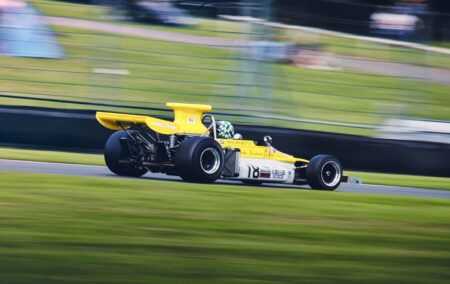
Media platforms have variously reported on Zondo-implicated Minister in the Presidency Khumbudzo Ntshavheni’s confirmation that “South Africa’s”, “the nation’s” bid to bring Formula One (F1) back to the country has been “endorsed”, “approved”, “backed” “supported” by government which is “fully behind” the bid.
The Minister also asserted that “The bid is fully financially supported by the reputable South African private sector”. This is the same Minister who a mere two years ago claimed that the private sector was “engineering the collapse” of President Ramaphosa’s administration!
Other media reports indicate that the cabinet has “cleared the way” for the bid to proceed, that Kyalami has “secured” the return of F1, and that Kyalami is the “preferred bidder” in this process.
Some reports suggest that it is the Department of Sport, Arts and Culture’s “bid to host the F1 at Kyalami”, while others state that the bid emanated from the “CFO of Kyalami 9 Hours”.
Former F1 owner Bernie Ecclestone once told me: “When it comes to F1, never believe anything you read and only half believe what you see.”
So it is perhaps not surprising that the Presidency’s announcement itself, the Executive’s decision, presumably taken by a majority of Cabinet Ministers including those from the DA, and the confusing wording of the media reports raise a number of serious questions and concerns about the exact nature and transparency of this high global profile and local public-interest process in which our government appears to be deeply involved. .
It is one thing to table a “bid” to host F11. It is another thing entirely to be responsible for and to deliver on the obligations of a successful “bidder”, who then becomes the “promoter” of the event. The most onerous of these is the obligation to pay the annual licence fee to the owners of F1 and fund the staging of the event itself.
Excluding the cost of upgrading Kyalami (estimated to be R100m plus), the total funding required to host the F1 for a three-year period could well exceed USD150m: (+/- R2,7 billion). That is why governments, rather than the private sector, are typically the primary funders or underwriters of the event in the host countries.
Sale of tickets
It is also a fact that typically the only direct revenue attributable to the “promoter” of the event is derived from the sale of tickets (“the gate”), and limited hospitality and local sponsorship advertising. This revenue is but a drop in the bucket. Hosting and staging F1 in isolation and as a one-off annual race, as is the case of Kyalami, is a massive loss-making investment.
And so, what exactly does the Minister mean when she states that the “bid” is fully funded by the reputable private sector? Is this just the cost of submitting a bid or is the private sector funding the annual licence fees and the staging of the event itself? And is government financially involved in any way?
Given the deplorable state of our debt-trapped national fiscus, under-resourced government departments and institutions, and bankrupt municipalities, the government should surely not be financially involved in this F1 bid at all. It should give the public the assurance that it will not contribute any funds towards or provide any financial guarantees for this outrageously lavish project.
Kyalami has a proud historical “track” record (unlike the disastrous Phakiso racetrack white elephant in Welkom – an ANC Provincial Government funded project in the mid 1990’s). Its upgrading to F1 standards is obviously possible and is the prerogative of the circuit owners. And of course, funding a loss-making event is their right and that of willing private-sector investors or corporates – although some of their shareholders may raise eyebrows. But it is certainly not the right of government or Minister McKenzie to spend valuable taxpayers’ money in this reckless and wasteful way.
If indeed this is solely a private-sector-funded initiative, why did it need government to get involved and give its approval in the first place? And for that matter, what expenditure has our gung-ho luxury-loving high-flying Minister McKenzie and his Department already incurred in this endeavour?
Who were they?
Kyalami is referred to as the “preferred bidder”. This implies that there were other bidders as well. Who were they, what was the nature and content of their bids and what were the reasons for the preference given to Kyalami?
Hosting the F1 as a stand-alone event at Kyalami in our crumbling City of Gold or as a circuit or street race in another city should be the furthest thing from McKenzie’s mind. It should be immediately dropped from his publicity-seeking, egotistical, elitist agenda. Given the poverty, hunger, homelessness, disintegrating infrastructure and lack of basic services permeating our towns and cities, not to mention our underfunded and struggling sports, arts and cultural associations, his personal F1 crusade and the apparent involvement of the SA government is misguided, unconscionable and perhaps even immoral.
It should also be noted that while the costs of hosting and staging Formula E are a fraction of those of F1, it is understood that despite the Western Cape Government’s and City of Cape Town’s funding of about R50 million, the 2024 event was a loss-making venture for most of those involved.
F1 can certainly be used as a catalyst for industrial, commercial and even residential development, together with motor-racing facilities that provide for all levels and types of motorsport events: a Motor City, including hotels, conference venues, office blocks, car dealerships, engineering and mechanical training facilities – perhaps even a casino – and a karting academy for aspiring motorsport drivers, engineers and administrators.
Hosting and staging F1 in this Motor City would be just one of many regular motor-racing events held there, and the multi-use motor-racing facility would advance the diverse interests of motor sport in our country. The development of such a Motor City would be a massive job-creating generator for our economy. Kyalami simply does not have the potential to do this.
Undoubtedly there would be some increase in tourist inflows, but the numbers are likely to be low on account of Gauteng’s limited tourism potential and Johannesburg’s well-known crime, water and other logistical woes.
Extravagant F1 event
The government and McKenzie’s narrow-minded vision for this extravagant F1 event to be held in isolation at Kyalami provides none of the above benefits, advantages, attributes or legacies for our country. The Minister’s ambition to be a kingmaker in this money-sapping process should be stopped in its tracks before he throws more taxpayers’ money at it.
Should this not be the case, and if this government and the Minister pursue their involvement in “bringing F1 back to SA” in this way, and do not come fully clean with the public about the exact role and nature of their participation, our anti-corruption and other civil society organisations such as Accountability Now, OUTA and others, investigative journalists and local rate payers associations should subject this unfolding bid process and its outcomes to the closest possible scrutiny.
This is all the more so because, although as a spectator sport and media phenomenon, F1 rates right up there with the Olympics and the FIFA World Cup, it does, like its counterparts, offer multiple opportunities for bribery, corruption, extravagant commissions, backhanders and dubious financial favours.
Given the diverse forms of corruption, nepotism and cronyism in our highest political circles, the maximum possible independent oversight and transparency need to be applied to the bid itself and its outcomes.
Compelling case
While a fully private sector-funded initiative to bring the apex of motor racing to Kyalami and Johannesburg has its merits, and absent of government financial participation, needs to be respected, there is definitely a compelling case to be made for the above-mentioned “Motor City” to be developed near Cape Town.
This would not only enable the Mother City to become a motor sports Mecca. It would maximise the undoubted benefits of hosting F1 and other international and local motor racing events, and would ensure that these accrue to the nation at large, and not just the few.
[Image: Stephen Kidd on Unsplash
The views of the writer are not necessarily the views of the Daily Friend or the IRR.
If you like what you have just read, support the Daily Friend