

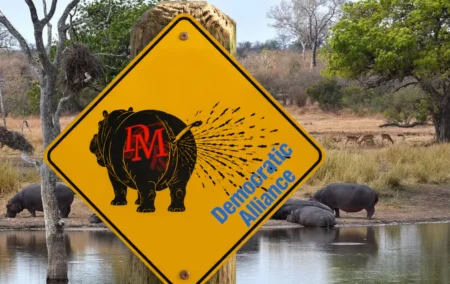
Rebecca Davis and her colleagues at Daily Maverick sure have it in for the Democratic Alliance. Having exposed no wrongdoing, one has to wonder, why?
I opened Sunday’s email from the Daily Maverick with great excitement.
“Who really makes the decisions in the Democratic Alliance?” it teased. I scanned down the article, penned by the redoubtable Stephen Grootes, and found an infographic that promised all the tantalising details.
Imagine my surprise and disappointment when it did not reference the Institute of Race Relations, even once!
How could this be? Just a few short years ago, the scandale du jour was that it was the IRR who pulled the strings at the DA.
“Captured”
In 2019, you could read in Daily Maverick that, “The DA has been captured by the right-wing zealots of the Institute of Race Relations.”
That was a smear on both the IRR and the DA: the IRR because it was mischaracterised (the IRR’s staff, policy fellows and most of its columnists routinely argue against right-wing zealots), and the DA because it was not in any way “captured”, and nobody got rich off the fact that the IRR’s principles and DA policies occasionally happened to coincide.
In 2021, Daily Maverick published an open letter which claimed, again incorrectly, that “the IRR has increasingly identified itself with the Democratic Alliance”. Rebecca Davis, always on the lookout for mudpies to sling at classical liberals, made a meal of it. (The Institute’s Micheal Morris and a month later, its CEO, John Endres, cogently explained just who the “concerned citizens” who penned that letter were, and why they were not to be believed.)
The Daily Maverick’s reporting established the existence of ideological affinity and influence between the IRR and the DA, which suggests the Institute is doing a reasonable job promoting non-racialism and classical liberal principles, but did not establish that the IRR exercised any authority over the DA or directed its decision-making.
(Full disclosure: I wrote a weekly opinion column for Daily Maverick between 2009 and 2020.)
Hurt feelings
After all that energy spent insinuating (with not a shred of evidence of impropriety) that the IRR was not merely a think tank hoping to influence public policy in favour of the ideology it espouses, but a shadowy marionetteer in control of the DA and itself a mere pawn of powerful interests in America, one would think it merited a prominent place in Grootes’s fancy infographic.
But no. Neither the Institute, nor any of its directors, staff, council members, policy fellows or contracted columnists, merited so much as a courtesy nod.
Maybe that is because the graphic was created by ChatGPT (a fact which Daily Maverick chose not to disclose). Every time ChatGPT produces anything, it adds, “ChatGPT can make mistakes. Check important info.”
Perhaps ChatGPT made a mistake. Perhaps the IRR is no longer important enough to rank among the power brokers who really make decisions at the DA. Perhaps Grootes failed to check important info.
Either way, it hurts my feelings that Daily Maverick no longer appears to view the Institute of which I am a council member to be a Machiavellian force of nature, red in tooth and claw, masterfully manipulating the great and good of South African politics.
Insinuation
The people and organisations who did make it to the infographic were drawn from Davis’s recent reporting on the public relations firms and political consultancies with which the DA has interacted – most notably Tony Leon’s public affairs firm, Resolve Communications, and Ryan Coetzee’s political consultancy, Consulum.
In exclusive scoop after exclusive scoop, amplified by analysis after analysis, under suggestive straplines like “CONFLICTS OF INTEREST?”, “LOBBYING SCANDAL”, and “AGE OF ACCOUNTABILITY”, the Daily Maverick journalists, led by the fearless Davis, tore into the DA.
Its crime? It… (let me check my notes…) gave audiences to a public affairs firm led by a well-connected former DA leader, and employed the consulting firm of a former DA campaign manager to advise it on coalition government.
That’s it. Notably, there is no law that says former party officials may never work in politics again upon leaving a political party. There is no law against lobbying. There is no law against experienced political operatives offering their services as consultants to political parties.
On the contrary, one wishes more politicians would employ seasoned consultants, and listen to representatives of the private individuals and companies affected by the policies, laws and regulations enacted by government.
What Daily Maverick alleged
The reporting alleges or implies possible conflicts of interest, but doesn’t explain exactly how those conflicts arise.
It alleges insufficient transparency, although it doesn’t seem to apply the same standard to any other political party.
It suggests close relationships between politicians and lobbyists, as if that is in any way unusual, and as if that does not occur with any other politicians from any other political parties. (Where is the outrage when green NGOs lobby the environment minister, or tax practitioners lobby the finance minister?)
It alleges possible policy influence by commercial interests, as if that is not the job of public affairs firms hired by companies to represent their interests to politicians, and as if politicians are not supposed to listen to the concerns of interested parties.
It raises ethical concerns, as if there is anything unethical about former party officials going on to careers in public relations, political consulting or lobbying, or vice versa, that people who formerly represented commercial interests should be deemed to be corrupt should they go on to serve as members of Parliament.
It insinuates governance risks, without once pointing at a party decision that was improperly influenced by external influence.
What Daily Maverick has not shown
The reporting has not demonstrated any evidence whatsoever of bribery, kickbacks, procurement fraud, unlawful payments, secret commissions, abuse of public procurement, criminal conspiracy, corruption, secret back-channel communication, violation of oaths of office, infractions of Parliament’s codes of ethics, or any other identifiable administrative or criminal offence.
Nor has it produced evidence showing that any DA politician acted on the instructions of an outside agency or their clients in exchange for payment or personal benefit.
The reporting instead invites readers to infer that the pattern of relationships creates a “scandal”, when in fact, it can point to no wrongdoing, and no interactions that are not perfectly normal for politicians of all political parties, including the ANC.
False comparison
Grootes suggests that the DA was hypocritical in refusing to condemn and ostracise Ryan Coetzee over his previous work for the Chinese government, while at the same time being quick to condemn the reappointment of Dina Pule to the Ramaphosa cabinet.
But that’s a false comparison. While I share Grootes’s disdain for Coetzee’s work for an authoritarian government, he was neither accused nor convicted of any wrongdoing. By contrast, Pule was fired from Cabinet after the Public Protector made findings including maladministration and improper conduct against her. She was formally reprimanded by Parliament, and the Speaker told her she betrayed her oath of office and brought Parliament into disrepute. Pule’s conduct was referred for criminal investigation.
Doing contract work for the Chinese government isn’t even in the same ballpark as the malfeasance of which Pule made herself guilty.
Comparing the two, however, leaves readers with the impression that Coetzee and Pule are birds of a feather, and that the DA’s broader engagement with consultants and lobbyists is just as corrupt.
False balance
That the DA is “just as corrupt” is the implication Davis and her colleagues cannot state outright (because they have no evidence of it, and it isn’t true), but it is hard not to conclude that they want to deceive their readers into inferring exactly that.
Perhaps the reason for their persistent vindictiveness towards the DA comes from a misplaced sense that they are obliged to demonstrate balance in their reporting.
They are terrified of being denounced as racist for persistently going after ANC politicians over corruption and state capture, so they want to signal their virtue by proving that they are just as tough on white liberals.
These same journalists will be the first to assert that giving those who are sceptical of the wisdom of urgent climate change mitigation policies a hearing amounts to “false balance”, since the “consensus”, as expressed by the world’s governments, is that such policies are urgently necessary.
Yet their campaign against the DA does not suggest balance.
The Madlanga Commission, the Zondo Commission, the Nugent Commission, the PIC Commission, the Heher Commission, the Marikana Commission, the Cassim Inquiry, the Seriti Commission, the Ginwala Inquiry, the Hefer Commission, the Jali Commission… almost every commission of inquiry has implicated ANC politicians in corrupt activities.
To the best of my knowledge, not a single DA member has been convicted, or even credibly accused, of corruption by any of these commissions.
Perhaps there have been a few cases at less prominent levels of the political hierarchy, but the last time I saw anyone make such an allegation, they were fact-checked into oblivion.
Why?
This raises the question, what do the Daily Maverick journalists think they are doing?
Do they not want the country to be governed by a party that to date has proven to be at least moderately competent in government, and fairly honest about it?
Do they think they are doing the country a service by persistently (and unfairly) smearing the largest party that isn’t the ANC? Do they want to push defecting ANC voters towards MK or the EFF, and would-be DA voters to the FF+?
What is their end-game here?
They can’t just be shills for the ANC, because they’ve been pretty good at reporting on the corruption in government wherever the ANC has been in power.
This can’t be about journalistic balance, because there simply is no equivalence between malfeasance among ANC politicans, and the rumoured hints at impropriety among DA officials.
This doesn’t appear to be about ideological or policy differences with the DA, since none of these articles include substantive policy arguments.
Bad faith
I’m far from uncritical of the DA’s policies. The DA is far from perfect. (And for the record, I’m not writing this because of some secret coordination or quid pro quo arrangement with anyone at the DA.)
The DA merits critique, yes, but from where I’m sitting, it also represents by far the best alternative to decades of misgovernance, corruption, division, xenophobia, violence and economic stagnation under the ANC.
It is the second-largest party by electoral support. It is the only other party with a substantial national organisation behind it. It is the only party with some (albeit limited) experience of actual governance. Its policies are largely moderate, tolerant and liberal. Its politicians are usually honest, occasionally competent, and often open to advice.
You’d have to be an idiot (or irredeemably blinded by identity politics) to support anyone other than the DA in the next couple of elections.
You may disagree with them on principle. But then, make a principled argument for a better alternative. Some DA officials may indeed be corrupt. If so, make a case against them, and you’ll be doing everyone, including the DA itself, a favour.
Exposing wrongdoing, or policy errors, or implementation challenges, or incompetence, is the duty of every journalist acting in good faith.
But it isn’t good faith to go around muckraking for the sake of it, when none of the mud turns out to be criminal, unethical, or even unusual. And bad faith journalism is harmful to the country and its people.
I remember a time when Daily Maverick was better than that.
[Image: Smear Campaign.webp
Caption: Composite illustration created by the author in GIMP, based on a photograph of hippo taken in the Kruger National Park by Pavel Špindler and licenced as CC BY-SA, a faux sign created using ChatGPT, a Daily Maverick logo, and text.]
The views of the writer are not necessarily the views of the Daily Friend or the IRR.
If you like what you have just read, support the Daily Friend