

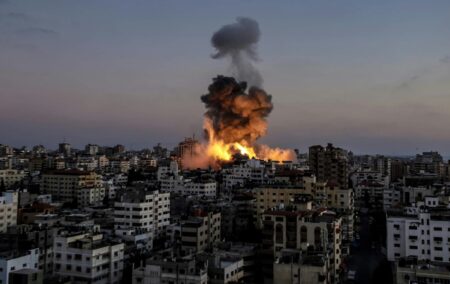
It was a jovial moment days ago when Israel and Hamas agreed to a ceasefire, which would end the two-year conflict that shaped the political and social atmosphere in the Middle East region and beyond.
However, it is quite disappointing that South Africa was never involved in the search for compromise and negotiations in this bloody conflict, which left scores of casualties on both sides. This conflict drastically disrupted the livelihoods of people in the State of Israel and the Palestinian Territories.
It was brave of President Trump to demonstrate decisive leadership to end the Israel-Hamas conflict and bring about peace and hope, which may spread throughout the region. This peace deal has the potential to bring about security and stability across the Middle East, including in other war-torn countries such as Syria, Yemen, Iraq, and Lebanon. It needs to be given a chance to thrive.
South Africa missed a golden opportunity to be one of the peace-advocates, such as the US, Qatar, Egypt, and the United Arab Emirates, which all played a significant role in the realization of the peace deal. The South African government, under the ANC’s majority rule, has adopted an anti-Israel policy, which at times clouds its judgment on the longest Israel-Palestine impasse. It has fixed its thinking and position in this conflict, where it always blames, targets, and accuses Israel of provoking Hamas, which has been declared a terrorist organization by several countries.
The anti-Israel policy adopted by South Africa led to the decision by Pretoria to drag Israel into the UN’s International Court of Justice (ICJ). This decision was a further attempt at vilifying Israel rather than focusing on ways to end the conflict and bring the two warring sides together. The ANC’s focus is misdirected, as it wants to identify the problem, but is not interested in finding a solution to the problem it has detected.
Complex impasses
The Israel-Palestine conflict is one of the most complex impasses in our history, which is shaped by competing national claims, religion, politics, economy, and territory. It is why South Africa must acknowledge these realities and focus on bringing about a permanent end to the conflict: peace and social cohesion between these two groups which must not hate each other.
South Africa is reputable, respected, and known to be a peace-loving master of negotiation. It demonstrated its ability to pursue peace through negotiations with distinction in the early 1990s, following the release of the country’s father of the nation, Nelson Mandela. It was Mandela’s leadership that saved the country from a possible civil war between the white and black populations. Mandela became a symbol of peace, when he created an inclusive government in 1994 and embarked on initiatives to achieve nation-building. It is this experience that has established South Africa as a most respected player in the international community; what a pity that it has squandered this position through its narrow political desire to demonize one side. South Africa’s choice of optics over peace-building has led to it becoming insignificant. It has been left out of the room during peace talks on the African continent.
South Africa should learn from a small but influential country such as Qatar on the global discourse, on how it has been involved in the peace deals in the Democratic Republic of Congo, Darfur, Yemen, Israel-Hamas, and many other complex conflicts around the world. Pretoria should stand out as a master negotiator, not an aggressor interested in the continuation of wars around the world.
South Africa, as Africa’s most powerful nation, could have used its influence to peacefully end the conflict between Hamas and Israel. This could have been easier because it has established key communication channels with Hamas, and Israel is always available through diplomatic channels. It should be easy to sit the warring sides around the table and bring them together without obsessing on who is guilty or who should be punished.
Global discourse
South Africa should reclaim its position in the global discourse rather than grandstanding for mere political and electoral mileage. Our influence could be used to promote peace around the world, especially in Africa and the Middle East regions. These regions are deeply affected by wars, which are a hindrance to economic development and progress. It is widely known that the major prerequisite for national development is security, stability, and safety. No country will develop in the midst of conflict. Peace will always be accompanied by economic fortunes and prosperity, and an end to suffering.
[Image: Mohammed Ibrahim on Unsplash]
The views of the writer are not necessarily the views of the Daily Friend or the IRR.
If you like what you have just read, support the Daily Friend