

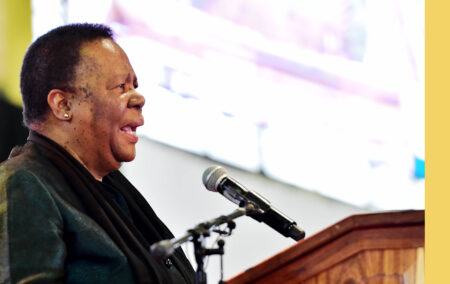
During her tenure as South Africa’s foreign minister, Naledi Pandor, the country faced a lack of trade and economic opportunities, neglected valuable and strategic alliances over outdated alliances, and continued to pursue ideological inconsistencies.
Pandor has come to see herself as the main tenet of the country’s foreign policy ecosystem, even when she is outside the government forum.
As the chairperson of the Nelson Mandela Foundation (NMF), she has used her influence to bring the United Nations Special Rapporteur, Francesca Albanese, to deliver the 23rd Nelson Mandela Annual Lecture last month.
The Department of International Relations and Cooperation (DIRCO) played a vital role in Albanese’s visit. This was a calculated political strategy to strengthen the lawfare campaign against the State of Israel. It went a bit further than that; it was a move by South Africa to pursue its anti-Western agenda.
NMD and DIRCO understood quite well that the US Treasury had previously sanctioned Albanese for “directly engaging with the International Criminal Court (ICC) to investigate, arrest, or prosecute nationals of the United States or Israel.” It is under this backdrop that the US has taken a posture that South Africa has been undermining the national security of the US and that of its allies in recent years.
This political outlook between the United States and South Africa continues to generate severe economic, trade, political, and diplomatic repercussions.
Confrontations
It is short-sighted for our government to align itself with, or befriend, any state simply because it is opposed to Western nations. Countries within the Global South that choose to challenge Western powers are free to do so, but South Africa should not be drawn into these confrontations.
South Africa, through DIRCO, must manage its international relations responsibly and impartially, engaging all nations without hostility or favouritism driven by narrow
political interests or the agendas of specific groups. Our diplomacy should be grounded in principle, not ideology.
We carry a sacred duty to build the nation envisioned by Nelson Mandela—one that eradicates poverty, confronts inequality, addresses landlessness, strengthens good governance, and restores dignity by improving the lives of all its citizens. These urgent priorities must not be overshadowed by unnecessary geopolitical battles that do little to advance the well-being of South Africans.
What has been clear is that South Africa is obsessed with both the US and Israel, as they never had a principled approach when dealing with the current global conflicts. The ANC’s hard stance against the US and Israel has been absent when the Russian government has been attacking Ukraine over the years; their silence can still be heard loudly.
Tyrannical
When the children and women are continuing to be killed and abducted for ransom in Sudan, our government has said nothing. The tyrannical ZANU-PF in Zimbabwe, our neighbours, continues to abuse its own citizens, whose human rights are non-existent. The Christians in Nigeria are being slaughtered daily without our government condemning or acting against such heinous crimes against humanity.
South Africa must adopt a principled, objective, and impartial approach when pursuing global peace. Consistency is essential: the stance we take in one conflict should be mirrored in our response to others of a similar nature.
However, South Africa’s involvement in the Israel–Palestine conflict does not appear to be driven by a genuine search for a lasting and balanced resolution. Instead, it seems to advance an anti-Western agenda and to reinforce alignment with countries such as China, Russia, and Iran—nations that are widely regarded as adversaries of Western political ideals.
[Image:https://www.flickr.com/photos/governmentza/45089663061]
The views of the writer are not necessarily the views of the Daily Friend or the IRR.
If you like what you have just read, support the Daily Friend