

Let’s start with the obvious question: why is the President of the United States spending this much time and hardware on a mid-sized, broke country whose main export these days is people trying to leave?
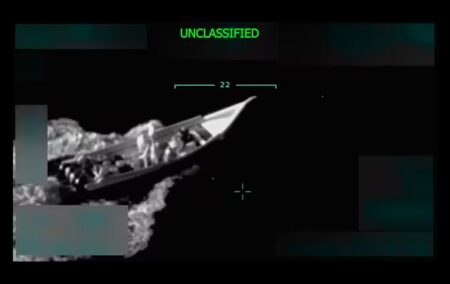
In the past few months, Donald Trump sent a carrier group and thousands of troops into the Caribbean, authorised CIA “lethal operations” on Venezuelan soil, and green-lit a string of airstrikes on boats that have left more than 80 people dead. And then last week, he closed off airspace “in its entirety” over Venezuela, which is normally a precursor to war. All of this for a place that is not invading anyone, doesn’t manufacture fentanyl, and whose navy would struggle to intimidate a medium-sized yacht club.
So, what’s going on? Why this almost theatrical obsession?
The script from Washington is simple enough: this is a war on “narco-terrorists”. Trump promised in his 2024 campaign to stop deadly drugs from crossing the US border, and he has now decided that Venezuelan gangs, corrupt generals, and Nicolás Maduro himself are central villains in that story. Hence the new doctrine: cartels are no longer just criminals, they’re terrorists, and therefore fair game for bombs, drones, and special forces.
On paper, it sounds tough and purposeful. In practice, analysts keep pointing out the awkward bits: Venezuela is mostly a transit hub for cocaine, not a manufacturing powerhouse. More pointedly, the drug killing tens of thousands of Americans is largely synthesised in Mexico and shipped overland. Parking a super-carrier off Caracas doesn’t do much about that.
(If you want your head to really hurt, consider that Trump announced on social media on Saturday that he was granting a full pardon to Juan Orlando Hernández, a former president of Honduras who had been convicted in the United States of drug trafficking charges). That mismatch—massive hardware, marginal target, suspect public script—is why almost every serious observer starts looking for deeper motives.)
OK, then perhaps it is this. In Trump’s first term, the US recognised opposition leader Juan Guaidó as Venezuela’s “legitimate” president, slapped crushing sanctions on the state oil company PDVSA, and put a bounty on Maduro’s head. The endgame was clear: squeeze the regime until the generals flip or the palace gates swing open. It didn’t happen. Maduro grimly hung on.
Fast-forward to 2025 and you can feel the frustration. The new campaign, Operation Southern Spear, re-frames the same cast of characters as a terrorist cartel—the networks like Tren de Aragua and Cartel de los Soles—and then builds a legal bridge from that label to military action. If you’re a certain kind of Washington hawk, this is elegant: you don’t technically declare war on Venezuela; you declare war on “non-state actors” who just happen to live in, work with, and share bank accounts with the Venezuelan state. You get to chase the same political goal—regime change—with a fresher legal theory and better soundbites.
Other commentators have pointed to domestic politics, which, in Trump’s case, are never subtle. Trump has spent years insisting that Latin American migrants are bringing crime and drugs into the US. Venezuelans have become a visible part of that story—big numbers at the southern border, Spanish-language media, conservative fury about “illegals”. So, in 2025, the White House moved to scrap the humanitarian parole for Venezuelans that Biden had granted, exposing hundreds of thousands to potential deportation. Then very loud deportation flights were staged, complete with rhetoric about gang members and “prison dumps”. And finally, it was wrapped in the usual narrative defending “our homeland” from narco-terrorists.
For Trump’s base, this is two for the price of one: you’re tough on crime and tough on immigration, and you get to do it in high definition with videos of missiles hitting boats in tropical waters. It’s politics as Netflix—except the explosions are real, and some of the dead turn out to be fishermen.
Don’t buy that one? How about this. Strategists have been writing for years about how US power looks shakier in a multipolar world. China builds ports and airports and threatens Taiwan, Russia stomps on neighbours, Iran ships oil and drones, and suddenly the Western Hemisphere doesn’t feel so securely “American” anymore. Venezuela, inconveniently, has ties with all three. So here is an unsubtle message to China and Russia and Iran—we can also play this game.
Seen that way, Venezuela’s small size is actually a feature, not a bug. It’s dangerous enough to look dramatic, weak enough that the Pentagon is pretty sure it can’t sink a carrier, and politically isolated enough that most of the world will limit itself to stern press releases.
Which brings us to the obvious question—maybe this is all about oil. Venezuela still has one of the world’s largest proven oil reserves, plus serious gold deposits. Under Maduro, it can’t really exploit them properly; under a friendlier government, those reserves become a long-term commercial prize for US and allied companies. Analysts who have been around since Iraq hear familiar music: the moral language is democracy and drugs; the strategic sheet music is geology and leverage. To be fair, nobody credible thinks this is only about oil. But it certainly doesn’t hurt that if Maduro goes and someone more market-friendly arrives, Venezuela’s barrels will likely point West again.
And finally, the bombing talk: “land targets” in the administration’s language. Here, the obsession looks less like a single, mad lurch toward invasion and more like a carefully lawyered escalation: one boat, then two, then 20; “non-international armed conflict”; “unlawful combatants”; collective self-defence on behalf of Western hemisphere allies.
Remember how this started—nasty words, then sanctions, then blowing up boats, then CIA ops. At that point, commentators started reaching for the obvious words: mission creep. Nobody seriously thinks the US is about to replay Iraq with 150,000 troops on the ground; the force levels simply aren’t there. But limited wars have a way of becoming less limited once the first mistake, misfire, or domestic political crisis arrives.
So, if you’re wondering why the leader of a superpower is visibly obsessed with threatening a struggling petro-state of 28 million people, the answer is this: Venezuela is small enough to bully, has enough resources in the ground to matter, and is cinematic enough to play well on TV. That’s a dangerous combination.
[Image: https://x.com/SkylineReport/status/1994564981543587957/photo/1]
The views of the writer are not necessarily the views of the Daily Friend or the IRR.
If you like what you have just read, support the Daily Friend