

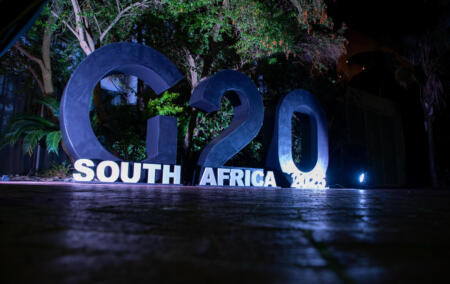
On Sunday 23 November 2025 most G20 leaders exited from their summit in Johannesburg in an apparent rush to return to their own regional and domestic political, economic and social crises.
They were absent from the rather embarrassing unceremonious low level handing over of the G20 Presidency to the USA that, for good and bad reasons, lost no time in distancing itself from the G20’s South African jamboree.
President Ramaphosa’s self-acclaimed brightly burning G20 flame was abruptly snuffed out.
The grandiose of the summit and its voluminous wordy leader’s Declaration, in which they collectively agreed to rescue our planet and its inhabitants from the evils of insurmountable debt, abject poverty, inequality and unemployment, climate change catastrophes and a multitude of other mostly self-inflicted global crises, with a specific focus on Africa, probably faded quickly from their minds as indeed it did from the minds of most South Africans. They see no mileage for them from this kind of grandstanding and pretentiousness from a crop of global politicians that currently preside over a world of turmoil, volatility and insecurity.
In a 45 minute address to the nation on Sunday 30 November, President Ramaphosa attempted to refresh the nation’s memory of that event and to convince a rather sceptical SA audience of the relevance to them of the summit and SA’s yearlong presidency. He seemed blissfully unaware that most of our citizens are not expecting any personal material or financial rewards from what generally came across as a “here today, gone tomorrow” extravaganza.
The President’s list of effusive “thank you’s” – he used the words some 20 times – omitted the SA taxpayers who funded all this presidential posturing and self-congratulatory sycophancy and who really should, through relevant civil society organisations, demand a full independent audit report of the cost to the National, Provincial, Metro and Municipal) Governments of the SA G20 presidency and the event itself. This should include the rushed cleaning up of a few relevant Johannesburg environs.
Minister Buthelezi, Public Service and Administration has told the country that the G20 spent a lot of time – and presumably money – on how to deal with corruption. He reported on substantial progress made in this regard by the G20 Anti- Corruption Working Group.
How strange therefore is it that in his address to the nation of more than 3500 words e extolling the work of the summit, the President never once used the word “corruption”
On Sunday 7 December 2025, in a very similarly worded address to guests at an evidently desperately needed ANC fund raising gala dinner, the President again waxed lyrical about the G20 summit and its benefits to SA citizens. He asserted that the G20 had firmly placed SA as a leading player on the global stage. This to should be regarded with a high degree of scepticism.
It is true that our remarkable transition to democracy in 1994 was appropriately and deservedly lauded around the world and for a while we basked in the global limelight.
But now in 2025and notwithstanding President Ramaphosa’s own elevation of our country’s global image and status, South Africans need to realise that our membership of the G20 is not based on the size of our economy which is globally ranked around 40th or lower in the world, nor does it automatically award us the status of an important respected global player.
Many in the world now actually see us as a nation that “has a great future behind it” and one that has failed to fulfil its potential whether in or out of the G20.
Deceiving the nation about the economy
Over the past months the President has regularly hailed the “green shoots” of economic recovery, the “turning of the corner” and has yet again raised the nations expectations of economic dynamism by telling us “we are turning the country into a construction site with yellow cranes everywhere” and to “watch this space” The President boasts, inter alia, that our GDP is growing, we are off the grey list, the rand has strengthened, our national debt is under control and S&P have upgraded our credit rating.
This is misleading and is just oratorical chicanery.
The overall GDP figures, as shockingly low as they are and whether fractionally up or down, are of little relevance to our citizens because they know that the “per capita” GDP is negative meaning that they are getting poorer by the day and that there is no sign that we can achieve a growth rate that will realistically improve their per capita well-being going forward.
Praising SA for coming off the grey list is akin to congratulating a husband for stopping beating his wife and there is no valid pride in leaving the club of “grey listers” which includes Yemen, South Sudan, Bolivia, Venezuela and other notorious money laundering fiscally miscreant countries.
The rand is only showing some strength against the US dollar because of that currency’s Trump induced weakness. The rand has actually remained unchanged and even slightly weakened over the past year against the all-important GBP and the Euro.
Our Gross National Debt is currently around 6 trillion rand with a debt to GDP ratio of nearly 79% -some economists estimate this to be closer to 90%. This is compares to 3.6 trillion and 69% in 2020..
A bloated government and cabinet, state owned enterprises, municipalities and interest payments gobble up tax revenue, leaving no room for real national debt reduction. There is no realistic plan to reduce this crippling debt which currently strangles our economy and will be an unbearable burden on future generations.
Whilst quick to inform us of the S&P credit rating upgrade, Ramaphos convenient forgets that Moody’s retained their rating implying that they require a lot more evidence of the economic restructuring and reforms and the credibility and accuracy of the predictions currently being bandied about by our government and its Minister of Finance
And where exactly are all these yellow cranes building new infrastructure?
President Ramaphosa, DA leader Steenhuisen, and other members of the GNU Executive who regularly make similar misleading comments about our economy and indeed the successes of their respective departments, need to be infused with a large dose of reality.
Poor political leadership
Our political leaders seem content and want the nation to applaud when they declare that things are “getting better” What they really mean is that things are “less bad” than they were. That is no criteria with which to judge ones leadership and the reality is that in many respects things have actually got worse.
Our nation is characterised by uncontrolled crime, corruption and looting, a collapsed criminal justice system, dysfunctional schools, clinics and hospitals, broken infrastructure and basic service delivery failures. Power outages and water shortages are ever present. Too many of our rivers, dams, lakes and even some beaches are polluted. Our borders are porous and illegal immigrants abound. Our national parliament remains a burnt out shell and our parliamentarians of various levels indulge. e in undignified juvenile schoolboy like brawls.
Race based legislation, quotas, obligatory equity issues, insecure property rights and potential political uncertainty impede foreign and domestic investment and the country is getting closer to the edge of a fiscal cliff. The words “under resourced” are now common place in our political, social and economic rhetoric.
It does not have to be this way. We cannot be a “developmental” state forever when we have the potential to be a “developed” state
Real economic growth is within our country’s reach and is the only solution to our crises of national debt, unemployment, poverty, collapsed infrastructure and service delivery failure. If these crises are not resolved, severe social unrest will be the inevitable consequence
There are values, principles, policies and practices that, if implemented, could unleash our potential to become a thriving nation living in relative prosperity, security and optimism. Many of these are embodied in the manifestos of parties like the DA, ActionSA, Rise Mzansi,BOSA and even the ANC when that party overcomes its fear of offending the SACP and COSATU. However the leadership of these parties, particularly those in the GNU, have neither collective or independently displayed the political will or competence to have them implemented.
These leaders have left us with plans, programmes, promises, prevarications, postponements, reviews, commissions and a ridiculous national dialogue. They have been unable to rid us of outdated ideologies that demand high levels of state intervention and ownership within the economy, over regulation of our society and autocracy. Their words have spoken louder than their deeds.
So only if and when a new kind of government emerges with fresh national political leaders of integrity, reality, courage and genuine commitment to public rather than self-service is will the green shoots grow, the corners be turned, the yellow cranes start working and only then will the futile dialogue cease and the remedial action begin.
No more Zumas’, Ramaphosas’ Steenhuisens’, Mashatiles”, Mashabas’ De Lilles’, McKenzies’, Malemas’, Shivambus’et al. They have occupied our political space for too long and the nation has retrogressed in too many ways under their divisive self-serving leaderships.
[Image: https://www.flickr.com/photos/ioebusiness/54698947449/in/photolist-2rkypoR-VuZLUY-ApARXq-B1gsG3-VuZNEm-2kjJw2C-B1gszj-2rheZLz-2rheZMr-R81Kab-PuDGAi-8c7CQ5-WHAeEL-R81Kc5-69GYKB-bXict3-VWTZab-WbT3oJ-2dfLAbe-q2rA6y-p7NawX-7HHjqD-WMdB1R-2qPdhEN-2hQz6ds-6b7NJJ-6b3LjH-8d4JDu-9Lud2d-p8cv47-fLh5L3-2qPerRo-6b3Kt8-2gmnet4-jmwQGw-2k97wVp-26ijtFG-2k9bni8-2bRStGk-2k97xEL-pNHRf8-2qPfmYx-6b3Pqz-6b3HRX-2k97wWM-PugAfM-5CfoFs-6b7Piy-PugAe4-6b7W4h]
The views of the writer are not necessarily the views of the Daily Friend or the IRR.
If you like what you have just read, support the Daily Friend