

In 2024, a minor grid disturbance in Fairfax County, Virginia caused 60 data centres to simultaneously switch to backup generators, shedding 1,500 megawatts in an instant – roughly Boston’s entire electricity demand. The grid nearly collapsed.
This is Data Centre Alley in the city of Ashburne, home to the world’s largest concentration of data centres, where 200 facilities now consume a quarter of the state’s electricity, and where artificial intelligence is pushing infrastructure to breaking point.
This is the paradox at the heart of the AI revolution: the technology promising to transform civilisation may be constrained by the very planet it inhabits. Data centres consume more than 4 per cent of American electricity, projected to double by 2030. Residential bills are climbing as grid operators scramble to keep pace with demand that materialises faster than power plants can be built.
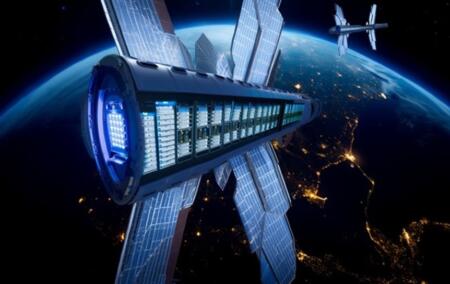
Elon Musk announced in late 2025 that SpaceX “will be doing” data centres in space. He’s not alone. Jeff Bezos envisions gigawatt-scale orbital computing within a decade. Eric Schmidt acquired Relativity Space to launch servers into orbit. Even Google’s Sundar Pichai has declared that space-based computing is “starting to make sense.” But for ambition of this scale, Musk is the one to watch.
The pitch is seductive: unlimited solar power, free cooling in the vacuum of space, escape from permitting battles. But beneath the techno-optimism lies a more fundamental question about the trajectory of human civilisation itself
Energy is wealth. It’s availability correlates almost perfectly with economic development. The Industrial Revolution was an energy revolution – steam power multiplying productivity by orders of magnitude. Every subsequent leap in prosperity has followed the same pattern.
AI represents the latest demand shock. Training a single large language model can consume as much electricity as 120,000 households use in a year. Goldman Sachs projects a 165 per cent increase in data centre power demand by 2030. PJM Interconnection, America’s largest grid operator serving 65 million people, projects it will be six gigawatts short of reliability requirements by 2027. “It’s at a crisis stage right now,” Joe Bowring, the grid’s independent market monitor, told CNBC. “PJM has never been this short.”
The bottleneck isn’t just generation – it’s everything. Transmission interconnections face three-year backlogs. Hyperscalers are turning to salvaged aircraft gas turbines. Microsoft has recommissioned Three Mile Island.
Space offers an elegant escape – in theory. Above the atmosphere, solar panels receive 1,400 watts per square metre of uninterrupted sunlight. Musk claims Starship could deliver 300 gigawatts of solar-powered satellite capacity per year, dwarfing the 59 gigawatts of current global data centre capacity.
The cooling proposition seems equally appealing. Terrestrial data centres can consume five million gallons of water daily. In space, heat radiates into the 3-kelvin void – no pumps, no cooling towers.
Companies are already testing the concept. Starcloud has launched Nvidia chips into orbit. LoneStar Data Holdings sent a kind-of prototype to the Moon in 2025. Google’s Project Suncatcher aims to deploy TPU-carrying satellites in 2027.
But wait, not so fast…
Here’s what boosters don’t emphasise: space is not cold in the way that matters.
On Earth, when your computer overheats, a fan blows air across it. The air molecules touch the hot components, absorb energy, and carry it away. This is convection, and it’s wonderfully efficient. Alternatively, you can pump water through the system – same principle, even better heat transfer. This is how terrestrial data centres stay cool: air conditioning, liquid cooling, sometimes both.
In space, there’s no air. No water. Nothing to touch the hot surfaces and carry heat away. The vacuum that makes space feel “cold” is actually the problem – it’s empty, and emptiness is terrible for cooling.
The only way to shed heat in a vacuum is through radiation: objects glow in infrared light, releasing energy as photons. Everything warm does this. You’re doing it right now, which is why thermal cameras can see you in the dark. The question is how fast you can radiate, and that’s where the Stefan-Boltzmann equation delivers its verdict.
The equation states that radiated power scales with the fourth power of temperature. Double the temperature and you radiate 16 times more energy. Sounds promising – until you realise the implication. At the modest temperatures that keep electronics functional, radiation is painfully slow.
The International Space Station illustrates the problem. Its ammonia cooling loops and eight billboard-sized radiator panels – weighing several tonnes – manage to shed just 70 kilowatts of heat. That’s roughly what 70 kitchen kettles produce. A single Nvidia DGX H100 system draws over 10 kilowatts at peak power; to radiate that heat in space requires more than 16 square metres of radiator surface. Musk’s Memphis “Colossus” facility draws 200 megawatts – nearly a thousand times the ISS’s entire thermal budget.
“If you wanted to spend enough money, you could absolutely put GPUs in space,” physicist Matthew Buckley of Rutgers told The Intercept. “The reason I would say it is an incredibly stupid idea is that you’re going to have to spend incredible amounts of money to keep them from melting.”
To build an orbital data centre, you need a radiator roughly half the size of your solar arrays. At scale, you’re talking about structures that dwarf the computing hardware they support – and every kilogram of radiator must be launched from Earth at a punishing cost.
Even if you solve the cooling problem, you face another: getting the data back down.
Proponents point to laser communication – optical links that can theoretically transmit data at rates 10 to 100 times faster than traditional radio. NASA’s Lunar Laser Communication Demonstration achieved 622 megabits per second from the Moon in 2013. The physics is seductive: infrared light packs data into much tighter wavelengths than radio, enabling vastly more information per transmission.
But physics cuts both ways.
Unlike radio waves, which can punch through clouds with modest signal loss, laser beams are scattered and absorbed by water vapour, fog, dust, and atmospheric turbulence. As infrared signals pass through the troposphere, variations in temperature and humidity cause the beam to wander and fluctuate – a phenomenon called scintillation. NASA addressed this by placing its optical ground stations in remote, high-altitude locations: Hawaii, California’s Table Mountain, New Mexico. But you cannot relocate all the world’s data centre customers to mountaintops.
Then there’s pointing accuracy. A laser’s tight beam – its greatest advantage for bandwidth – becomes a liability when you must aim it across hundreds of thousands of kilometres at a moving target. The discipline is called “pointing, acquisition, and tracking,” and it demands sub-micron precision: equivalent to hitting a coin from several kilometres away while both you and the coin are moving.
Weather poses the starkest challenge. A single cloud passing between satellite and ground station severs the connection entirely. Unlike radio, there’s no graceful degradation – the link simply fails. This forces designers to build redundancy through multiple ground stations spread across different weather systems, multiplying cost and complexity.
For inter-satellite links, lasers work beautifully. SpaceX’s Starlink constellation already uses optical links between satellites, and the technology is mature. But the moment you need to deliver data to users on Earth’s surface, you confront the atmosphere’s unforgiving interference. Google’s Project Suncatcher has been notably quiet about this ground-link problem. For a data centre serving terrestrial customers – the entire business model for cloud computing – the downlink is everything
And yet there’s a genuine technological bet at work – that launch costs will continue declining, that thermal breakthroughs will materialise, that laser links will mature. Google’s Suncatcher isn’t marketing; it’s methodical research into what happens when commercial chips meet the space environment.
The question isn’t whether space-based computing is possible. It’s whether physics, economics, and engineering can converge before Earth’s grids buckle. For now, the servers hum in Virginia, the turbines spin in Memphis, and the grid strains under loads it was never designed to carry. The cosmos awaits, patient and vast. Getting there is the hard part.
And finally, there is this. The human brain only requires 20 watts to operate (not much more than one light bulb), and it’s still much smarter than any AI. Which means that the innovators may yet find ways to build intelligent machines without needing much energy at all.
And then what are we going to do with all those data centres in space?
[Image: reve.art]
The views of the writer are not necessarily the views of the Daily Friend or the IRR.
If you like what you have just read, support the Daily Friend