

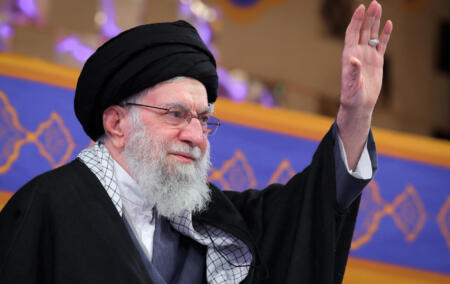
For too long, incremental pressure on Tehran failed to change its conduct at home and abroad. The recent strikes that killed Ayatollah Khamenei were not lawless or reckless. They were justified.
That the strikes on Iran killed the Supreme Leader of the Islamic Republic alone makes this moment historic.
Ayatollah Ali Khamenei was not a ceremonial head of state. He was not a symbolic monarch. For more than three decades he was the ultimate authority in Iran. Supreme Leader since 1989, he survived regional wars, sanctions regimes, internal unrest, reformist movements and international pressure. He presided over the consolidation of clerical supremacy, the expansion of Iran’s proxy architecture and the steady entrenchment of a nuclear programme that repeatedly brought the region to crisis.
His death is the real story of these strikes.
Either way one frames it — targeted decapitation or leadership present at struck military infrastructure — the centre of gravity of the Islamic Republic has been removed. According to statements from US and Israeli officials, confirmed by Iranian state media outlets, Ayatollah Ali Khamenei was killed during the coordinated strikes.
That raises uncomfortable but unavoidable questions.
Was eliminating him part of the strategic objective? If so, that crosses a threshold that even strong supporters of Israel and the US must acknowledge as significant. If his death occurred as a consequence of striking command and military facilities in which he was present, the moral calculus is different but no less consequential.
In both scenarios, the result is the same. The ideological and institutional apex of the regime is gone.
The question is whether that outcome was justified.
What he represented
To answer that, one must be clear about who Khamenei was and what he represented.
He was not merely a conservative religious leader overseeing a culturally distinct society. He presided over a system that systematically suppressed political pluralism. Elections occurred, but only within a narrow band of candidates approved by clerical authorities. The Guardian Council filtered political participation. Ultimate authority rested not with voters but with religious guardianship and security institutions insulated from electoral removal.
Under his tenure, protest movements were met with force. Reformist currents were absorbed and neutralised. Journalists were detained. Women’s rights activism was treated as ideological defiance rather than legitimate political expression. Authority flowed downward from clerical doctrine rather than upward from popular sovereignty.
Externally, Khamenei’s Iran institutionalised proxy warfare as statecraft. Hezbollah’s expansion in Lebanon, Hamas’s entrenchment in Gaza, militia networks across Iraq and Syria, Houthi consolidation in Yemen — these were not spontaneous alignments. They were structured relationships involving funding, training, weapons supply and operational coordination. Through these networks Iran shaped conflicts across the Middle East without engaging in conventional interstate war.
Overlay this pattern with the nuclear question. Iran’s programme advanced significantly under his watch. It was constrained temporarily under negotiated agreement, then advanced again after that agreement collapsed. The 2015 nuclear deal demonstrated that pressure could produce temporary limits. But once that agreement unravelled, enrichment resumed and deepened, expertise accumulated, and infrastructure expanded.
Incremental management
For decades, the international community relied on incremental management. Sanctions were imposed, lifted, reimposed. Negotiations oscillated between breakthrough and breakdown. Each diplomatic cycle bought time, but none produced durable strategic settlement.
Sanctions imposed costs and constrained oil revenue. They complicated procurement and helped bring Tehran to the negotiating table. But they did not dismantle proxy networks or permanently redirect strategic ambition. The regime adjusted and continued.
Authoritarian systems are built to endure economic pressure. They prioritise the coercive core. They shift economic pain downward. Civil society absorbs strain more quickly than security and political elites. Over time, sanctions become background conditions rather than existential threats.
Diplomacy requires reciprocal strategic intent. It requires a counterpart prepared to make durable concessions rather than tactical pauses. Khamenei repeatedly demonstrated tactical flexibility, but strategic rigidity. Negotiations relieved pressure while failing to transform posture.
Critics of the strikes argue that killing a head of state is inherently destabilising. They warn of martyrdom narratives, internal consolidation and unpredictable escalation. They insist that diplomacy, however frustrating, is preferable to assassination.
Removing a head of state is an escalation in itself, with legal implications and precedents that outlast the immediate strike. But moral judgement cannot be paralysed by discomfort.
Khamenei was not an incidental sovereign presiding quietly over domestic affairs. He was the apex authority of a regime that externalised violence as policy. Under his authority, Iran armed and financed actors engaged in sustained cross-border attacks. He oversaw a regional strategy designed to pressure adversaries indirectly. He sanctioned a nuclear trajectory that repeatedly destabilised the security architecture of the Middle East and endorsed a worldview in which hostility toward the United States and its allies was not tactical, but foundational.
Flatten moral distinctions
There is a tendency in parts of Western discourse to flatten moral distinctions between regimes. Cultural relativism often presents itself as sophistication. It insists that all states are pursuing interests, merely shaped by history and context. That flattening erases meaningful differences.
Western democracies are flawed. They have waged misguided wars. They have supported problematic partners. But they are accountable systems. Governments can be voted out. Leaders can be investigated. Journalists can criticise without imprisonment. Courts can constrain executive authority. Citizens retain the capacity to remove leadership through elections.
Iran’s system under Khamenei did not offer that corrective loop. Authority was concentrated in clerical and security institutions insulated from electoral removal. Dissent was suppressed rather than integrated. Accountability flowed upward within ideological hierarchies, not outward to citizens. That is an asymmetry that matters.
If a democratically accountable government wages war, its electorate retains mechanisms to punish or remove it. If a theocratic authority entrenches repression and proxy aggression, there is no comparable internal corrective mechanism.
Sovereignty remains foundational to international order. The prohibition on aggressive war reduces instability. But sovereignty is not morally self-justifying. It presumes some relationship between government and governed, and some restraint in external conduct. When a regime systematically represses its own citizens and sustains cross-border violence through proxy networks, its claim to absolute immunity weakens.
Was killing Khamenei the right outcome, or merely an acceptable one?
Repression and proxy aggression
If leadership removal was intentional, the argument must be that eliminating the central authority directing a sustained strategy of repression and proxy aggression was a legitimate act of self-defence and strategic correction. If his death occurred as a consequence of striking command infrastructure that he occupied or directed, then his death must be evaluated as proportionate to the objective of degrading that infrastructure.
In both cases, the moral logic converges. The Supreme Leader was not a bystander. He was the strategic centre of a regime engaged in sustained regional destabilisation.
There are moments when restraint preserves stability. There are moments when it allows a regime to keep imprisoning, executing and silencing its own people. Under Khamenei’s leadership, incrementalism entrenched these dynamics.
A regime that steadily expands its proxy network while preserving or advancing nuclear capability becomes progressively harder to confront. Once a durable deterrent shield solidifies, the cost of coercion rises sharply, and strategic options narrow.
Continued reliance on sanctions and diplomacy was not neutral; it shifted the balance in Iran’s favour, and Khamenei’s removal disrupts that trajectory in ways whose consequences are still unfolding.
Iran’s constitutional structure requires the Assembly of Experts to select a successor. That body is dominated by conservative clerics closely aligned with the Revolutionary Guard. A hardline succession is possible, perhaps likely in the short term.
Fractures may widen
But succession under external shock differs from succession under stability. Elite fractures may widen. Competing power centres — senior clerics, IRGC commanders, technocratic administrators — may struggle for influence. Indeed, external attack can consolidate authority but it can also expose divisions.
Iran is not a brittle state. It possesses deep institutions and a large, educated population. But the system was built around Khamenei’s accumulated authority over three decades, so his absence creates genuine structural uncertainty.
If a hardline successor consolidates power and regime cohesion holds, the strikes will have produced disruption without transformation. If succession produces internal contestation or unexpected openings, the strategic landscape shifts more fundamentally. That uncertainty itself is significant. It introduces variables that did not exist while he lived.
From a South African perspective, this moment demands seriousness rather than reflex. Pretoria has consistently emphasised multilateralism and sovereignty in international forums. It has often aligned rhetorically against unilateral coercion. That posture reflects legitimate concern about abuse of power in global politics, but it is also shaped by longstanding historical ties and diplomatic alignment with Tehran. Iran supported the ANC during the anti-apartheid struggle and those ties have persisted into the democratic era, with South Africa maintaining relatively close relations even as other democracies have distanced themselves from Tehran.
But (ostensibly) principled multilateralism cannot become procedural absolutism.
If multilateral consensus is structurally blocked by veto politics and incremental tools fail to alter destabilising behaviour, rigid insistence on process risks paralysis. Legal order matters, but arguably less than strategic reality.
Gulf instability
South Africa is also economically exposed to Gulf instability. Oil price volatility feeds directly into domestic fuel costs, inflation and currency pressure. Regional destabilisation is not an abstract Western concern. It has immediate consequences for South African households and businesses.
To treat the killing of Khamenei as an unforgivable breach of order without confronting the order he presided over is selective moralism. As always, history will judge the long-term consequences. Escalation remains possible, though unlikely from a US boots-on-the-ground perspective. Retaliation may intensify, and succession could consolidate hardliners. But moral and strategic judgement cannot be indefinitely deferred.
On balance, removing the central authority of a regime that repressed its population, financed cross-border violence and advanced destabilising capabilities was justified.
Not because assassination is intrinsically desirable, or because war is pure. But because allowing that leadership to continue directing the same trajectory would have deepened risk and entrenched instability.
Killing Khamenei was not comfortable. It was not neat. It was not morally costless.
It was, however, right.
[Image: By Khamenei.ir, CC BY 4.0, https://commons.wikimedia.org/w/index.php?curid=181156095]
The views of the writer are not necessarily the views of the Daily Friend or the IRR.
If you like what you have just read, support the Daily Friend