

Ask most people what an Ombud does at a university, and you’ll get a blank stare. Yet it can be one of an institution’s most important safeguards against abuse of power.
An Ombud is a fire extinguisher that earns attention only when something is burning. It’s an accelerant when it goes rogue.
Things are burning at the University of Cape Town (UCT), as yet another power battle rages. UCT Ombud Nashira Abrahams is standing perilously close to the flames. She is not alone.
An Ombud is, by definition, a “safe space”, an independent, impartial, confidential guardian angel in all but name, tasked with securing just, fair and equitable treatment of everyone within the university ecosystem.
An Ombud is not designed to be a disciplinary officer, prosecutor, investigator or an advocate for a point of view. An Ombud is never meant to be weaponised against one side.
UCT established its Office of the Ombud in January 2011, the incumbent reporting directly to Council and Council Chair. Abrahams took up the position in May 2023.
That reporting-line has worked well in calm weather. It isn’t working well under legal storm clouds gathering over the heads of UCT, Council and Council Chair, Adv Norman Arendse SC.
The storm has put UCT’s rumour mill on steroids, with claims of smoking guns, hit jobs, active solicitation of complaints against UCT Vice-Chancellor (VC) Prof Mosa Moshabela, and “hush-money” payments. Or “golden handshakes quietly taking place behind the scenes”, as Radio 702 talk-show host Thabo Shole-Mashao put it.
UCT and its Council are respondents in two ongoing, unprecedented Western Cape High Court filings. The first is the “Mendelsohn matter”, an application UCT history professor Adam Mendelsohn launched in August 2024. Its legal basis rests on a judicial review of public power.
Mendelsohn argues that Council acted unlawfully, irrationally and without procedural fairness in adopting the so-called “Gaza Resolutions” in June 2024. He claims that key Council members breached their fiduciary duties by not disclosing significant known risks, especially the loss of hundreds of millions of rands in donor funding.
Failure to consult
Court papers also allege failure to consult affected university stakeholders, as UCT’s risk-management policies require.
All respondents deny wrongdoing. Judgment is awaited.
Moshabela filed his own review application on August 5, 2026. He asks the court to set aside four resolutions Council imposed on him on May 30, 2026, recommending that he undergo executive training, a 360-degree review and further scrutiny.
Council did so despite independent investigators exonerating him comprehensively on all 34 “complaints”, or “visitors” as they are known, lodged with the Ombud, and recommending that he face no disciplinary action.
Council itself appointed two senior advocates and a law firm to conduct the investigation.
Moshabela also asks the Court to order UCT to release the investigators’ report. UCT is resolutely refusing to do so, citing privacy and confidentiality concerns. Yet it’s easy to redact names and personal details of complainants to protect privacy and confidentiality – and Moshabela’s legal right to defend himself.
That raises the question of just what UCT does not want the VC to see.
The investigators delivered their report to Council on May 29, 2026. At its meeting the next day, Council reportedly gave members just two hours to have sight of and absorb all the detail in the report’s 200 pages, before debating and voting on the resolutions.
The report, according to sources within UCT, details the investigators’ rigorous inquiry into the 34 complaints lodged with the Ombud against Moshabela, and why they found that only one of those should be put to him.
Without merit
Once they had tested that sole complaint, the investigators found it to be without merit. They exonerated Moshabela by decisively dismissing it. It necessarily follows, say legal experts, that the investigators also exonerated Moshabela comprehensively on the other 33 complaints that they did not put to him.
It is also believed that the investigation report raises evidence of fabricated complaints to the Ombud. As seven senior Council members write in a letter addressed to Council, Arendse and UCT’s registrar on August 8, some complainants “simply do not exist”. Their letter was leaked to the media.
Retired UCT research scientist Wilna Venter has publicly claimed that a complaint was fabricated under her name. She says the first she learned of it was when Fairbridges, UCT’s lawyers, contacted her in March 2026 as part of the independent investigation. She wants an investigation into who used her name to fabricate the complaint.
“(The Ombud) received the complaints and drew up the list on which they appear,” Venter writes.
“My name did not travel there by accident. My name is my own… not anybody’s to spend.”
Crucially, the investigators also recommended that the Ombud’s conduct be investigated. Council has barred Abrahams from further contact with complainants, but has not instituted an independent investigation into her conduct.
On UCT’s website, Abrahams says the Ombud is not the university’s “office of first report” or “entry point” for complaints as that would jeopardise its independence.
She’s right in principle, but not in practice.
The Office of the Ombud’s terms of reference requires the Ombud to inform the Chair of Council, after receipt of complaints or concerns that “visitors” lodged against the VC. Arendse confirmed in his August 2026 statement that Abrahams had alerted him to the “existence and seriousness” of concerns relating to the VC.
If that’s the case, then the office assuring everyone it’s not UCT’s “office of first report” was the entry point for at least some fabricated complaints.
No third option
Complaints that the Ombud channelled were either genuine or manufactured. There is no third option.
The peculiar fluidity of the complaint numbers continues to spark scrutiny. Moshabela’s filing, available on public record, lays out the chronology:
On June 30, 2025, Malcolm Campbell, a Council member delegated by Arendse as the Ombud’s line manager, reported 21 complaints against Moshabela lodged with the Ombud. By December 2025, the number was 39. By February 2026, it was 31, then 34.
Most “complaints” were filed under one catch-all heading, “Evaluative Relationships” – an umbrella term covering questions, concerns, issues or inquiries between people in relationships.
To put these numbers in perspective, the Ombud’s 2024 Annual Report records one “evaluative relationships” issue reported in 2024, zero in 2023 and four in 2022. Gender or cultural discrimination does not feature as an issue in the breakdown figures.
The Ombud reports annually in writing to Council. Its 2023 and 2024 reports are online on UCT’s website. As yet, there’s no 2025 report, although UCT’s past publication pattern would have had it out by mid-July 2026.
Arendse has had difficulty getting the numbers of complaints straight, if his public statements are any indication. His appearance on the Clement Manyathela Show on August 31 was a train wreck for him and UCT.
He puts the number of complaints at “38 or something”, adding “it’s one of 38, it’s 38”, despite UCT documents stipulating 34 and Manyathela correcting it a few times to 34.
Arendse claims that complainants’ names and details have not been put to Council. Moments before calling it “absolutely critical for the independence and integrity of the Ombud’s office that names are never disclosed”, he names Venter.
He also reveals that some complaints alleged sexual harassment without saying whether the independent investigators put these to Moshabela (they did not) or giving the findings.
As an experienced senior counsel, Arendse can reasonably be expected to know the extreme prejudice that such a public, widely disseminated comment represents to Moshabela.
He also claims that the investigators’ report makes “no finding” of fabricated complaints and, in the same breath, claims that Venter is “not the only one” who denies lodging a complaint.
Audibly bristles
Arendse audibly bristles when Manyathela described Venter’s statement as evidence of something “dodgy”. He demands to know if the talk-show host was imputing a motive for him (Arendse) to fabricate complaints.
Manyathela was clearly not. He later describes the interview with Arendse as “a bit weird”.
More weird and dodgy is UCT’s reluctance to say precisely from where the fabricated complaints arose. The silence is deafening. It fans the flames and smoke of those rumoured guns pointing at the VC.
UCT’s Remuneration Committee (RemCom) apparently granted Abrahams a hefty increase last year in a manner critics within UCT say could be “ultra vires”. That’s the legal term for “beyond the powers” or, in common parlance, “dodgy”.
Some Council members say the first they knew of the Ombud’s increase was when Arendse made passing reference to it during the last Council meeting on August 15, 2026. They say it’s most likely more than a year after the increase was made.
RemCom reports directly to Council on increases. Arendse and Dianna Yach, another Council member who is also a respondent in the aforementioned court filings, sit on RemCom.
The timing of the increase at around the same time as “visitors” to the Ombud were lodging concerns about Moshabela could just be a coincidence. However, I’m reliably informed that the increase was well above inflation, the UCT norm and what an Ombud could reasonably expect in the role.
That makes it difficult for UCT to justify the increase while slashing medical aid benefits to retirees.
If the source of fabricated complaints turns out to be the Ombud’s office, that footnote will not be easy to dismiss.
Abrahams took up the post of Ombud a month before Arendse became Chair, and before Moshabela became VC. Whatever went wrong in the interim did not begin with her appointment.
UCT’s terms of reference commit it to providing legal advice to the Office of the Ombud in fulfilling its functions. If individuals whose names were used on fabricated complaints without their consent bring civil claims against the Ombud, UCT would be liable for legal fees to defend those claims under the Office of the Ombud’s Terms of Reference.
Wrongdoing or not
Under UCT’s broader governance framework, that protection disappears if wrongdoing is proven. Unless Council heeds Venter’s call for an urgent investigation into the Ombud’s conduct, it may never be known if there was wrongdoing or not.
In that case, more UCT funds will go towards legal fees, no doubt already a hefty bill, yet an expense which is not individually delineated in the UCT 2025 Annual Financial Statements
None of this proves Moshabela faultless, Arendse, Campbell, Yach, RemCom members and the Ombud at fault, or that every Ombud “visitor” came in bad faith.
Genuine grievances deserve a hearing, and a VC is not above scrutiny. But accountability runs both ways.
An investigation that exonerates the accused, exposes a compromised process, and holds its VC hostage by not transparently releasing its report into complaints against him shows that the Ombud’s Office is not UCT’s only broken machinery.
UCT needs to fix what makes its Council and Ombud office vulnerable. That may include a protected budget, a reporting line to the full Council, and effective checks and balances for genuinely independent complaints channels for both.
UCT has changed the person holding the Office of Ombud twice since inception. It has left intact the wiring that leaves that office exposed to weaponisation by parties it is meant to hold in check.
Until that changes, UCT’s guardian angel is a fallen angel.
*UCT was emailed a lengthy list of questions for comment. Its response was brief: (UCT) notes developments relating to legal proceedings involving the Vice-Chancellor and the university’s Council. As this matter is before the courts, it would not be appropriate to comment on the details or merits of the case. Please refer to the two statements issued by the university on this matter: Update on recent legal proceedings, August 16, 2026, and Recent developments concerning legal proceedings, August 10, 2026
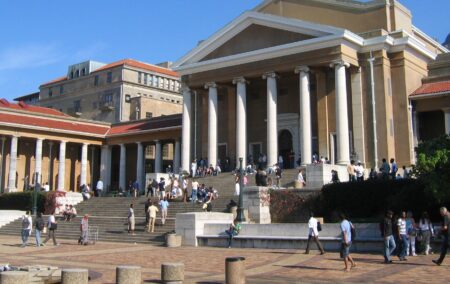
[Image: By Adrian Frith – Own work, CC BY-SA 3.0, https://commons.wikimedia.org/w/index.php?curid=846564]
The views of the writer are not necessarily the views of the Daily Friend or the IRR.
If you like what you have just read, support the Daily Friend