


As fans of the hit Tom Cruise films of the “Top Gun” series can surely attest, air power lends itself to spectacle. Jets roar overhead at high speed, drop devastating amounts of ordnance, which explode spectacularly. Then, just as quickly as they arrived, the jets depart in seconds, leaving behind little but dust, noise and the suggestion of overwhelming force.
Air power has become a feature of modern warfare, and has been displayed at high intensity across Ukraine, Gaza and now Gulf states and Iran. While many have theorised that drones will replace manned aircraft, right now we are still living in the age of the fighter pilot.
In February, the Indian Air Force held its Exercise Vayu Shakti, in the desert test ranges of Pokhran. But to focus on the explosions and spectacle is to miss the point.
What the Indian Air Force (IAF) presented at Vayu Shakti was not merely a demonstration of capability, but rather a demonstration of intent.
I attended the exercise as part of a group of international defence journalists invited to observe the Indian armed forces in action. After attending a series of naval exercises and ship visits, we found ourselves in the desert city of Jodhpur, home to IAF’s 32 Wing, under South Western Air Command. Jodhpur lies close to India’s western frontier, and the border with Pakistan, giving the event a bit of strategic context. This is not an abstract training environment, it is a region where active deterrence is at play, and where airpower carries immediate relevance.
From the outset, the structure of the exercise was precisely calculated and orchestrated. Rather than showcasing individual aircraft, Vayu Shakti was organised around typical mission sets. Aircraft appear not as centrepieces, but as components of a broader system designed to achieve a set of strategic goals.
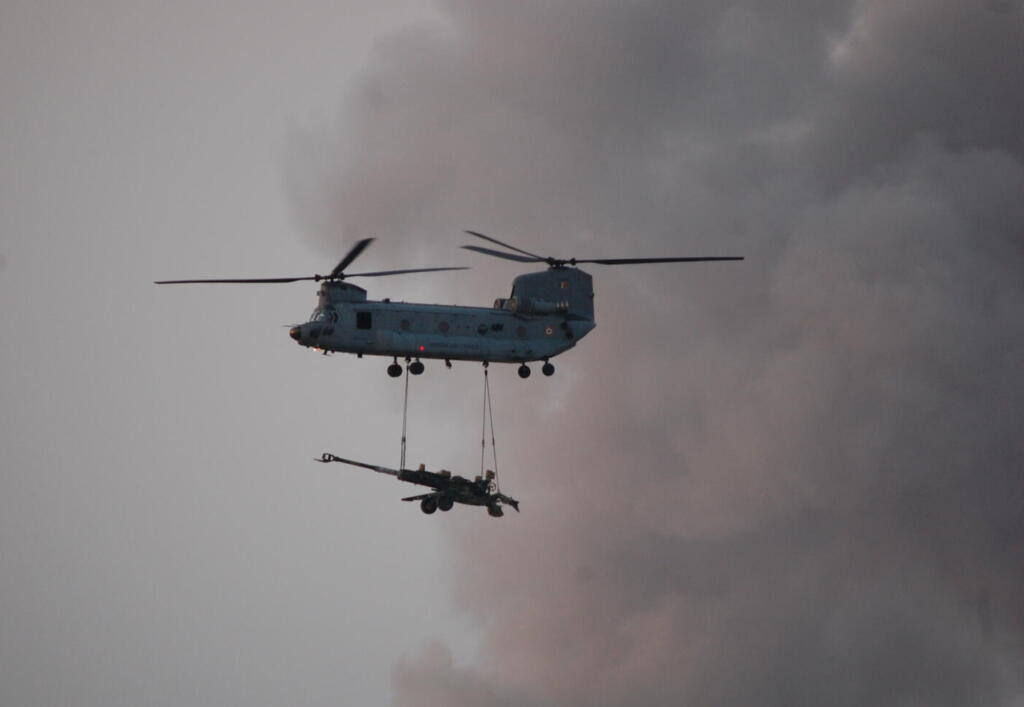
Fighter jets conducted aerial combat manoeuvres, demonstrating both the R73 heat-seeking air-to-air missile, and the French built MICA. Strike aircraft deliver precision munitions against simulated targets, including armoured columns and command bunkers. Air defence systems such as the indigenous Akash, and Israeli Spyder, tracked and engaged aerial target drones, before transport aircraft inserted and evacuated ground troops. At the end, the amount of ordnance dropped totalled roughly 12,000kg.
Taken together, the sequence reflected a layered approach to warfare. It is not about individual platforms, but about how those platforms interact, and achieve synergy.
This reflects the IAF’s own doctrinal framework, which emphasises control of the air, support to land and maritime forces, and the integration of multiple domains into a single operational network with a clear objective: to deliver decisive aerospace power in support of national objectives.
Air power, in the Indian context, is treated as a central instrument of national deterrence. Not simply because it can destroy targets with precision, but because it can respond quickly and decisively across vast distances. That responsiveness has been demonstrated repeatedly throughout India’s recent history.
Deterrence, in this sense, is dynamic and depends on the ability to act quickly, decisively and across multiple domains.
The exercise further reflected a more nuanced understanding of modern conflict, something the IAF openly frames through an operational context of “no war, no peace”. This is a recognition that contemporary security challenges rarely involve declared wars and set-piece battles. Instead, they unfold through limited crises, grey zone operations and persistent tensions with calibrated intent.
Within that framework, air power is used not only to fight wars, but to shape the conditions around them. It supports diplomacy, signals intent and reinforces presence.


A different trajectory
As a South African observer, the contrast was difficult to ignore.
The South African Air Force (SAAF) operates under very different conditions. Budget constraints, ageing platforms and maintenance challenges have combined to reduce flying hours and limit operational availability. According to its 2024/2025 annual report, the SAAF achieved 6,209 flying hours against a target of 12,000. Aircraft that once formed the backbone of the fleet now spend extended periods grounded, resulting in an erosion of capability.
Pilots require flying hours, crews require operational exposure and systems require regular use and maintenance. This is not just a question of numbers; air power, by its nature, depends on constant practice.
For the SAAF, reduced operational tempo has had a cascading effect. Less funding means fewer flights, which results in less training, which delivers reduced readiness. Over time, the force risks losing not only capability but institutional relevance.
By contrast, the IAF demonstrates what sustained utilisation looks like. Exercises such as Vayu Shakti are not occasional events, but are part of a broader pattern of regular training, operational deployment and international engagement with friendly countries.
Another point of contrast lies in doctrine.
The IAF operates with a clearly articulated strategic framework. Its concepts of multi-domain operations, rapid mobility and “no war, no peace” engagement provide a coherent structure for how the force is employed. This clarity is reflected in exercises, training and procurement.
South Africa’s air power discourse, by comparison, has become strategically misunderstood, and overused as a display for parades and presidential speeches. Strategic intent is overshadowed by immediate resource constraints, and long-term planning has given way to short-term survival.
The consequences are no secret. Without a clear framework linking national objectives to air power requirements, it becomes difficult to justify investment or prioritise capability. Ultimately, the difference comes down to ambition, with no one in government able to justify the need for greater funding.
India views airpower as a central component of national strategy, and invests accordingly, not only in platforms but in training, maintenance and industrial capacity.
South Africa, despite its strategic location and historical expertise, has struggled to sustain a similar level of commitment, not to even speak of funding and fleet size.
This is not simply a matter of resources, but as with the wider South African National Defence Force (SANDF), it is a matter of prioritisation and political will.
The Cape Sea route remains one of the world’s most important maritime corridors. Southern Africa continues to face a range of security challenges, from maritime crime and transnational drug smuggling to regional instability and insurgent groups. Air power could play a significant role in defending sovereignty, and potentially be a decisive factor should it be needed.
Yet without sustained investment and clear strategic direction, that potential remains underutilised.
As Vayu Shakti drew to a close, the sun had set, the flares and fires had burned out and the desert range fell quiet. The aircraft had dispersed; the targets lay destroyed and the spectacle ended.
What lingered was not the memory of explosions, although the ringing in my ears persisted, but the impression of coherence.
The IAF presented itself as a force that understands its role, aligns its capabilities with its strategy and applies its resources accordingly. It is not without challenges. No air force is. But it operates with a clear sense of purpose, pursued with discipline.
For South Africa, the lesson is not to replicate India’s scale, something which is not in the realm of possibility. The lesson lies in alignment: between purpose, funding and strategy.
Look beyond the spectacle and a more uncomfortable question emerges. Not what South Africa can afford, but what it intends its air force to be?
[Images: Ricardo Teixeira]
If you like what you have just read, support the Daily Friend