

The South African Constitution is very clear in its treatment of the rights of children. [A “child” means a person under the age of 18 years.] This age group covers most school-going citizens.
A child’s best interests are of paramount importance in every matter concerning the child, according to section 28(2) of the Bill of Rights.
A matter which concerns most children of school-going age is the content of the history curriculum taught in our schools. At present there is a draft new history curriculum, at least ten years in the making, available for public comment until mid-May 2026. It has drawn much adverse comment both in the media and in submissions made to the Department of Basic Education, which is currently considering the advisability of adopting the draft curriculum. It is appropriate that more comments on the draft be submitted by all those who care about a future for the children of South Africa in which peace is secure, progress is sustainable and prosperity is shared equitably.
Anybody seeking inspiration on this topic need look no further than the 25-page memorandum submitted by the SAIRR, which roundly criticizes the draft curriculum. Richard Wilkinson has also forcibly expressed his opinions on the suitability of the draft. He has appealed to anyone who will listen for reinforcement of the criticisms he has raised.
In response, Accountability Now has made a brief submission to the Department of Basic Education in the following terms:
“The Minister of Basic Education has said:
‘Our history curriculum should not exclude key events or perspectives on political grounds, nor should it impose any particular ideology on learners. I am committed to ensuring that the curriculum equips learners to think critically about our past, so that they may form their own opinions’.”
These are wise words which do not yet find application in the methodology adopted for the preparation of the draft new curriculum for teaching history in our schools in South Africa.
Ideological bias has no place in curricula for teaching history in a constitutional democracy under the rule of law, which has a justiciable bill of rights of the kind that is in Chapter Two of the Constitution of the RSA.
Human dignity
Those learning history in our schools are entitled to have their human dignity respected, and they can claim the protection by the state of their psychological integrity as provided for in Sections 10 and 12 of the Bill of Rights. Everyone in SA must be treated as equal before the law in terms of Section 9.
The draft curriculum must, in law, be prepared with the duty of the state to respect, protect, promote and fulfil these rights, along with all other rights referred to in the Bill of Rights, in mind. The draft in its present form does not, by any stretch of the imagination, do so. This renders the draft, if its thrust is retained, vulnerable to legal attack on the basis that it is inconsistent with the Constitution and accordingly invalid in terms of Section 2 of the Constitution.
May we suggest for your consideration that both responsiveness and accountability, watchwords of the constitutional dispensation in place in SA, are not served by the draft in its present form and that those responsible for its preparation should return to the drawing-board with a view to working within the lines drawn in the Constitution, our supreme law. The Constitution does not adopt any political ideological stance, and nor should the history curriculum.
Any failure to prepare a constitutionally compliant new curriculum may result in messy litigation in which public-interest litigants seek relief, based on the failure to take the legal parameters in place into account in the preparation of the draft. This email may be placed before the courts hearing the case(s) as being relevant to the question of liability for punitive costs on the part of those who seek to persist with the current odious draft, in the face of the considerations raised in this email, and those raised by Richard Wilkinson in the media.
In the final analysis, the question is whether the “paramount” best interests of the children who study history in school are served by the new curriculum.
“United in our diversity”
It is contrary to the requirements of the Constitution if the new curriculum does not respect, protect, promote and fulfil the rights enshrined in the Bill of Rights. The best interests of all children must be served by its introduction in our legal system, which regards our becoming “united in our diversity” as a value worth upholding and mentioning in the Preamble to the Constitution itself.
Conduct that is inconsistent with our supreme law is invalid. The draft history curriculum risks being struck down as illegal and unconstitutional, should those in authority persist in promoting it in its present form.
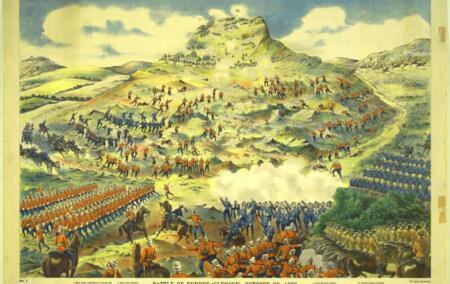
[Image: A Depiction of the Battle of Talana Hill by G W Bacon & Co London in Bacon’s South Africa War Prints. This edition inaccurately showed the British wearing their blue and red dress uniforms. https://picryl.com/media/battle-of-talana-hill-redcoat-bacons-south-africa-war-prints-b36b0c]
The views of the writer are not necessarily the views of the Daily Friend or the IRR.
If you like what you have just read, support the Daily Friend