

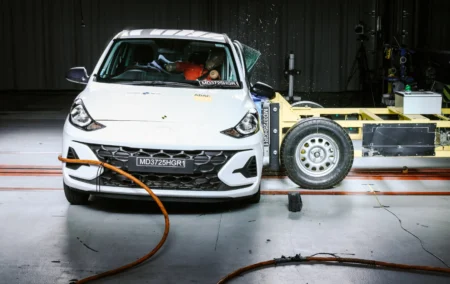
The controversy over safety ratings for low-end vehicles in South Africa is a symptom of a conflicted government.
Much has been written about the Global New Car Assessment Programme (NCAP) safety ratings of cheap cars in South Africa, since the Automobile Association raised the alarm about the zero-star rating of the Hyundai Grand i10.
The NCAP rating signals that the Grand i10 falls short in a number of areas, including weak chest protection for the driver in the frontal impacts, weak chest protection in side impact tests, an unstable bodyshell and footwell, no standard side or curtain airbags, and lack of electronic stability control.
Although the Grand i10 has taken the most flak for its poor performance in safety tests, many other entry-level cars perform poorly on these tests.
“The AA believes that South African and African consumers deserve the same level of vehicle safety offered in other global markets and should not be subjected to reduced standards,” the organisation said in its statement. “The AA also reiterates its longstanding position that South African and African consumers should not be offered vehicles with lower safety standards than those sold elsewhere in the world.”
Valuable lives
Most of the reporting on the subject has followed this line: South African lives are not less valuable than those of Europeans and Americans, and if South African manufacturers can make safe cars for rich markets, and foreign manufacturers can meet rich-world safety standards when required, then vehicles destined for the South African market ought to be equally safe.
A representative example is this article in a local paper which reports on the fact that the Hyundai Grand i10 does in fact meet South Africa’s safety standards, such as they are, as set by the National Regulator for Compulsory Specifications.
The writer is clearly not satisfied with this explanation, true though it is, and lays the blame on both the government’s low standards, and on Hyundai for not meeting higher standards than it is legally required to meet.
Affordable cars
A very good explanatory article published by a car dealership says that South Africa does not implement stricter standards for cost reasons. “South African transport policy does not enforce European-spec minimum safety standards. The reason? Because it wants to ensure that there are very affordable new cars for lower-income buyers.”
That may be true, but it exposes the conflict in government policy, which slaps imported vehicles with a 25% import tariff, plus an ad valorum tax for vehicles over R250,000 (which excludes only the very bottom end of the market), plus 15% VAT.
If the government was concerned about the price of vehicles for South Africans, then it wouldn’t impose an industry master plan that hopes (but fails) to protect a vehicle manufacturing industry that exports safe cars to rich foreigners, at the expense of South African taxpayers and vehicle buyers.
Trying to make up for raising the price of both imported and locally manufactured vehicles by slashing safety standards does not strike me as regulating in the interest of South African citizens.
So if anyone places a low value on South African lives, it isn’t the manufacturers of motor vehicles, but the South African government. (Whenever you see something wrong with the world, you can almost always trace it back to a boneheaded government.)
Higher prices
That higher safety standards increase the price of motor vehicles does raise an important point, however.
Countries with long data series, like the US, show that new car prices, in real terms, are about five times higher today than they were 80 years ago, and more than 50% higher than they were 40 years ago.
Much of that increase has to do with improved features and better fuel economy, but some of it is directly attributable to regulated safety standards. Every airbag, every crumple zone design, and every kilo of high-strength steel, costs money.
In rich countries, research shows that the additional cost of mandated safety features is fairly low, adding only a few percentage points to the price of a vehicle. This additional cost is more than recovered in fewer accidents, lower insurance premiums and less expensive injuries.
In poor countries, by contrast, this additional cost can price many people out of the new car market. As a result, they turn to the second-hand market, which consists of vehicles that met older (and hence far lower) safety standards, and are often in poor condition.
Older vehicles
In South Africa, it is not unusual to see 10-year-old and 20-year-old cars on the road, simply because most people cannot afford to buy new cars with all their fancy safety features.
By NCAP standards, people might complain about a lack of curtain airbags, but those of us who have never been able to afford a brand-new car have never owned a vehicle with anything more than front airbags in any case, and sometimes not even that.
Raising safety standards for new cars simply won’t help the majority of South African motorists.
Paradoxically, it could make them less safe, since higher regulated safety standards could price newer, safer cars out of their reach.
Some of the ever-rising rich-world safety standards are hardly relevant at all in South Africa, since they involve advanced safety features like autonomous driving sensors that are only available in very expensive models in the first place.
Full disclosure
The answer in a highly diverse middle-income country like South Africa is not to demand ever-higher safety standards from the government.
It is merely to demand full disclosure from manufacturers.
By all means, continue to badger car makers over safety concerns, and continue to publicise Global NCAP safety ratings, but accept that there are many people who simply do not (or cannot afford to) prioritise safety in the way a comfortably well-off person might do.
In a genuine free market, manufacturers who build safer cars will attract buyers who can afford a premium price for some additional margin of safety. Competition will drive innovation, and gradually reduce costs.
Consumers with tighter budgets will make choices about acceptable trade-offs – just as they do with every other purchasing decision in their lives.
Red herring
The argument about the relative value of lives is a red herring, useful only for virtue signalling.
People who can’t afford nice houses are also more vulnerable than those who can. They are more exposed to natural disasters, more exposed to crime, and more exposed to unhealthy living conditions. That doesn’t say anything about the relative value of people’s lives, nor does it signal that the government must impose expensive building standards on housing for the poor.
The hard reality is that safety, like any other feature of a product, is an expense. It comes at a cost. Higher levels of safety are accessible only to those who can afford that cost.
If we want to make entry-level vehicles in South Africa safer, we should focus on increasing the income levels of the poor, enabling them to buy safer cars of their own volition. Promulgating standards that the poor cannot afford, and that excludes them from the new car market, doesn’t help them.
Meanwhile, if the government really is concerned about the affordability of vehicles, it should stop levying import tariffs on them, and stop protecting the vehicle export industry. They only enrich the few at the expense of the many.
[Image: A Hyundai Grand i10 undergoes a side-impact crash test, with unfortunate results. Photo supplied by Global NCAP]
The views of the writer are not necessarily the views of the Daily Friend or the IRR.
If you like what you have just read, support the Daily Friend