

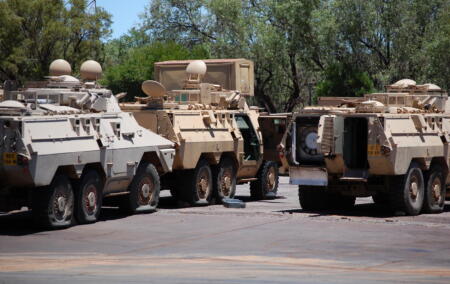
The Minister in the Presidency, Khumbudzo Ntshavheni, recently announced that President Cyril Ramaphosa’s Cabinet has formally endorsed the South African National Defence Force’s (SANDF) “Journey to Greatness” 30-year plan to rebuild South Africa’s armed forces and eventually reach a defence budget of 1.5% of GDP. Although this may seem like a step in the right direction, recent government spending behaviour has not encouraged enthusiasm for this bold ambition.
The National Treasury’s Defence allocation for 2026/27 is R57.6 billion, representing a nominal decrease from the previous year’s adjusted appropriation and estimated real terms cut of 5.7%. Defence spending, currently at 0.7% of GDP, is projected to fall further to 0.69% by 2028/29. So, while the strategy points one way, the money points in another. The lack of enthusiasm is backed by previous acknowledgements of structural failures that were not followed up by fiscal action.
The 2015 Defence Review identified ageing equipment, skills haemorrhage, and a defence industrial base in deliberate decline. A decade later we sit with less spending and more plans. The Journey to Greatness risks becoming a well-written document that substitutes for action rather than enabling it.
A comparison with Germany’s Zeitenwende, its 2022 promise to re-emerge as a leading European military power, is instructive. It provides a clear example of what political will in defence looks like: the spending followed the strategy.
The Zeitenwende speech was delivered to the Bundestag by Chancellor Olaf Scholz on 27 February 2022, three days after Russia’s invasion of Ukraine. He framed the war as a historic turning point and announced a decisive shift in German defence policy, signalling a break from the country’s post-war posture of military restraint.
By 2025, Germany had become one of Europe’s largest defence spenders in absolute terms, moving towards the North Atlantic Treaty Organisation’s (NATO) 2% GDP benchmark with the support of a €100 billion special defence fund.
However, Germany’s rearmament did not simply reassure its European partners; it also unsettled them. France has raised concerns about industrial leadership and strategic autonomy. These concerns are not trivial, and a large military, even a friendly one, reshapes regional power balances regardless of intent. What has kept German rearmament from becoming a destabilising force is its embeddedness in joint European Union (EU) and NATO structures. Without those structures, the implications of rearmament would be far harder to manage.
The Southern Africa Development Community (SADC) has no equivalent of those EU and NATO structures. Although there exists a Mutual Defence Pact and Standby Force framework, there is no binding collective defence treaty equivalent to NATO article 5, no integrated command structures, and no binding mutual assistance obligation that would contain a future destabilising force in southern Africa or compel neighbours to come to South Africa’s aid. In Europe, the structure exists to manage the consequences of rearmament, but in southern Africa, it does not. South Africa cannot rely on a regional framework to absorb security shocks, and it cannot assume that a capable neighbour will always be a benign one. That cuts both ways. A stronger SANDF would itself reshape regional power balances, and southern Africa lacks the institutional architecture to manage the consequences. This is a tension South Africa cannot avoid. A weak SANDF leaves the region exposed to threats it cannot contain; a stronger one introduces frictions it cannot easily institutionalise away. Of the two, managed friction is the more tolerable risk.
South Africa is nowhere near Germany’s problem, but the regional signalling function of defence spending is real. A rising budget communicates capacity and commitment; a shrinking one communicates the opposite. South Africa’s defence trajectory is being read in Gaborone, Harare, Maputo, and Kinshasa. It tells SADC partners something about Pretoria’s willingness to backstop the region’s security structure. As the SANDF’s ability to honour peacekeeping commitments deteriorates, that vacuum will be filled by someone else, or by no one.
Another lesson from Germany is that delay has compounding costs. Decades of underinvestment in the Bundeswehr produced not just capability gaps but structural damage. Defence industrial capacity withered, skills were lost, and procurement systems lost effectiveness to the point where Germany struggled to spend its new money quickly even after the political will arrived. South Africa is already well into this stage. The Journey to Greatness plan acknowledges that smaller defence sector role players are at risk of collapse, and firms that, once gone, cannot be reconstituted on a political timetable. There is a point past which underfunding becomes irreversible within any planning horizon that matters.
Germany’s Zeitenwende was triggered by a visible external shock. South Africa is unlikely to get an equivalent. However, with illicit mining syndicates operating with effective impunity, SADC stabilisation operations stretched beyond comfortable limits, and an army increasingly deployed as a substitute for a police service it was never designed to replace, the threats are real despite lacking the clarity of a conventional invasion.
The South African government seems to be waiting for a crisis before closing the gap between the Journey to Greatness and its balance sheet. It should rather act before the institutional damage becomes irreversible.
Germany acted late, responding in reaction to a war in Europe with serious spillover effects. The difference, however, is that Germany had the industrial base, the allied framework, and the fiscal capacity to recover. South Africa is eroding all three.
[Image: Ricardo Teixeira]
If you like what you have just read, support the Daily Friend