

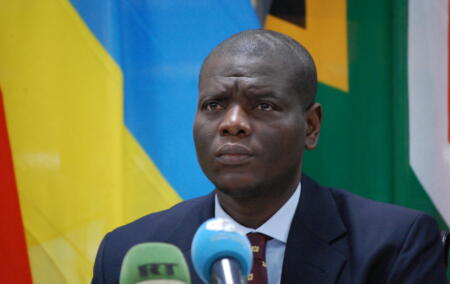
It is concerning to hear the Minister of International Relations and Cooperation, Ronald Lamola, insinuate that the ongoing anti-immigrant protests are being coordinated by foreign powers allegedly displeased with South Africa’s decision to bring a case against the State of Israel before the International Court of Justice. While he has not mentioned the names of those political actors, it is clear that he refers to both Israel and the United States.
Such a serious allegation requires credible and verifiable evidence. In its absence, the claim risks being perceived as a political narrative rather than a substantiated assessment of the situation. It also reinforces a familiar tendency within political discourse to portray the ANC-led government as a victim of external forces and imperialist interference, thereby diverting attention from legitimate domestic grievances that may be driving public discontent.
This is a familiar tactic employed by political leaders around the world who seek to deflect accountability for domestic challenges. Rather than addressing the underlying causes of public discontent, they often attribute protests and opposition movements to foreign interference, thereby shifting attention away from their own governance shortcomings.
In 2011, Russian President Vladimir Putin accused then US Secretary of State Hillary Clinton of encouraging protests that erupted following allegations of electoral fraud in Russia’s parliamentary elections. A similar narrative emerged in 2021 when widespread demonstrations took place across Russia demanding the release of opposition leader Alexei Navalny, who was imprisoned at the time and later died in custody. Russian authorities once again pointed to alleged foreign influence rather than engaging with the grievances expressed by protesters.
Prior to the Israel–Iran conflict, Iran experienced widespread nationwide protests driven by public frustration over economic decline, deteriorating public services, and political repression. Thousands of Iranians took to the streets to express their dissatisfaction with a government they believed had failed to address the country’s mounting challenges. Rather than confronting these grievances directly, the Islamic Republic accused the United States and Israel of infiltrating and orchestrating the protests. This narrative served as a convenient means of deflecting attention from domestic failures and avoiding accountability to a population that had increasingly lost confidence in its political leadership.
A similar pattern can be observed in the remarks of Ronald Lamola. By suggesting that foreign powers are behind the ongoing anti-immigrant protests, he appears to be diverting attention from the substantive concerns being raised by ordinary South Africans. Such an approach enables political leaders to evade difficult questions about governance, service delivery, unemployment, crime, border management, and social cohesion.
The reality, which Lamola and his colleagues in the ANC are well aware of, is that many of the concerns expressed by protesters are genuine and deserve serious engagement. However, a culture of accountability has often been lacking within the governing party. This is not a new phenomenon. In the past, senior ANC leaders such as Gwede Mantashe dismissed service-delivery protests as the work of a so-called “third force,” suggesting that demonstrators had been mobilised or paid to advance hidden political agendas. Such claims frequently served to discredit public grievances rather than address the underlying issues that gave rise to them.
Blaming foreign political actors for our domestic challenges only worsens the situation, as it allows our own politicians to evade accountability for failing to fulfil their political mandates. Accountability, openness, and transparency are fundamental pillars of any functioning democracy. If we are to develop and progress as a society, political leaders must embrace ethical leadership and remain willing to be held accountable for their decisions and actions.
Kgwadi is a political scientist, columnist, and research fellow at the Middle East Africa Research Institute (MEARI).
[Image: Ricardo Teixeira]
The views of the writer are not necessarily the views of the Daily Friend or the IRR.
If you like what you have just read, support the Daily Friend