

South Africa’s post-liberation government leant heavily on the model for post-colonial economic redress in Malaysia. It chose wrong.
When the ANC went shopping for a development model in the 1990s, it did not have to look far. Malaysia had spent two decades running a state-led programme of racial economic redress, and was growing at a rapid clip near 10% per year.
To a liberation movement inheriting a racially skewed economy, it looked like the perfect template.
Academics were asking openly whether Malaysia’s New Economic Policy was “a model for post-apartheid South Africa”. ANC delegations toured Kuala Lumpur. Broad-based black economic empowerment emerged bearing an unmistakable resemblance: equity ownership targets, procurement preferences, licensing conditions and employment quotas, all allocated by race.
Thirty years on, we can audit the model against its control group. Because Malaysia has a twin, and the twin ran the other experiment.
Two experiments
Until August 1965, Singapore and Malaysia were one country. Singapore was expelled from the Malaysian federation after two years of racial and political friction, leaving a small island with no natural resources, no agricultural land, and a departing British military that accounted for a fifth of its economy.
The lazy version of this story omits that the twins were not quite identical. Singapore started richer, with a GDP per capita of $516 in 1965 against Malaysia’s $326, and it inherited a working port, a convertible currency and a British legal system. Conversely, Malaysia had all the land, all the resources most of the coastline, and most of the people.
But both were poor, both were highly diverse post-colonial societies with a restive Chinese-Malay ethnic balance, and both faced a choice about what the state should do with its power.
Malaysia’s answer
Malaysia answered that question in 1971. After the race riots of May 1969, it launched the New Economic Policy, a sweeping programme of preferences for the bumiputera majority.
Bumiputera, which translates to “sons of the soil”, represents roughly two thirds of the population, and includes the previously disadvantaged ethnic Malays as well as numerous indigenous population groups. The bumiputera excludes the formerly privileged Malaysian Chinese and Malaysian Indians.
The preferences include equity ownership targets, quotas in university admissions and public employment, and preferential licensing, procurement and state contracts.
Officially, the New Economic Policy expired in 1990, and was to be replaced by growth-oriented policy reforms. In practice, successor policies have kept racial preferences and affirmative action at the centre of Malaysian economic life for more than half a century.
Singapore’s answer
Singapore answered the same challenge differently.
It is important to be clear here: the difference between the twins was not that of a state-led developmental economy versus a free market economy, in the simplistic sense.
For all its wealth – it ranks in the top 10 alongside the US, Norway and Switzerland in nominal GDP per capita, and at purchasing power parity it ranks third behind only Monaco and Liechtenstein – Singapore is not some libertarian fantasy island. Far from it.
It is an authoritarian, deeply interventionist state. The government owns most of the land. Some 80% of Singaporeans live in state-built housing. The Central Provident Fund is compulsory saving on a massive scale. The Temasek state-owned investment company and the GIC sovereign wealth fund make the city-state one of the world’s largest state capitalists, more akin to the Nordic model than a non-interventionist market economy.
Lee Kuan Yew, who served as Singapore’s first prime minister for over 30 years, jailed political opponents and sued journalists. His Economic Development Board was an industrial policy and economic planning agency by any definition.
The difference was what the state did with its power.
Singapore built capable, clean, meritocratic institutions and used them to enforce universal rules: open trade, secure property rights, contract enforcement, and monetary discipline through a central bank that manages its currency against a trade-weighted basket and has never inflated away its citizens’ savings.
Malaysia built institutions whose central function was to allocate economic rewards by race and, inevitably, by political connection. One state enforced rules that applied to everyone; the other exercised executive discretion in favour of a previously disadvantaged majority.
The audit
This allows us to evaluate an economy with racial economic empowerment and one without, regardless of the size and scope of the government’s intervention in the economy. And the results are not even close.
Singapore’s GDP per capita in current US dollars has grown from $516 to about $98,800 – a 191-fold increase that has overtaken the United States. Malaysia went from $326 to roughly $13,100: a respectable 40-fold rise, but one that leaves it with a prosperity of less than one-seventh of its former partner.
Adjusted for purchasing power, the relative difference is smaller, with $151,000 for Singapore and $38,800 for Malaysia, for a ratio of 3.9:1.
It is true that Singapore’s headline GDP per capita is flattered by its status as a financial entrepôt, and national income per resident is somewhat lower. The gap, after appropriate adjustment for this difference, remains almost as stark, however.
The currencies tell the same story. The Malaysian ringgit and the Singapore dollar were interchangeable at par until the early 1970s and traded at near parity until about 1980. Today one Singapore dollar buys about 3.15 ringgit. The ringgit has lost roughly two thirds of its value against its former twin.
Much like the decline of South Africa’s rand against hard currencies (a US dollar bought R3.50 in 1994), this is, in large part, a market verdict on the divergent governance models of Malaysia and Singapore.
Or take corruption, the disease that racial preference programmes reliably incubate. On Transparency International’s latest Corruption Perceptions Index, Singapore scores 84 out of 100 and ranks third in the world, ahead of New Zealand and every country in Europe bar Denmark and Finland.
Malaysia scores 52. Its defining scandal, 1MDB, saw a sitting prime minister loot a sovereign wealth fund of billions and end up in prison – the terminus of a system in which political connection had been the currency of economic advancement for two generations.
South Africans, whose own state capture commission produced weighty volumes but light consequences, will recognise the pattern. We score even below the global corruption perception average of 42, and our chief state capturer and his henchmen have yet to be collared by the crippled arm of the law.
Brain drain
Malaysia also paid a subtler price. The system of racial preferences told its Chinese and Indian citizens – its most commercially productive minorities – that the rules would never be neutral.
It is hard to be sympathetic to groups that once enjoyed structural privileges, of course, but one cannot stop them responding to the redress policies of today.
Up to 2.5 million Malaysians emigrated, in a brain drain the World Bank has documented as a structural economic problem tied directly to stagnant productivity, weak high-skilled job creation, and limited growth in the domestic economy.
Many went, with grim irony, to Singapore, which was happy to let everyone who arrived play by the same rules as the locals, regardless of their ethnic origin.
Meanwhile, the fruits of the NEP flowed disproportionately to a small, politically connected upper crust – the academic literature unsparingly describes a “Bumiputera corporate elite considerably marred by profiteering, patronage and rent-seeking”.
Substitute the conservative, African nationalist ANC for the conservative, Malay nationalist UMNO (United Malays National Organisation), and “BEE beneficiary” for “UMNO-connected businessman” and the similarities between the models are crystal clear.
Not quite a basket case
To be fair – and one must be – Malaysia is not quite a basket case. It is not Zimbabwe, and isn’t as bad as South Africa.
It actually managed to sustain about 5% GDP growth over the last couple of decades, unlike South Africa, whose economic expansion can’t even match its own population growth.
A detailed comparison of GDP per capita growth rates between Malaysia and Singapore shows two countries that are in principle capable of matching each other, though Singapore draws ahead more often than Malaysia does, and Malaysia’s peaks are lower and its troughs are deeper.
The unemployment rate in Singapore is around 2%. Malaysia’s is around 3%. We need no reminder of South Africa’s grim statistics.
Malaysia’s poverty rate has fallen dramatically, and it remains an upper-middle-income country. The NEP’s defenders credit the racial preference policy; sceptics note that Thailand and Indonesia cut poverty comparably in the same decades without racial quotas, which suggests the broader economy did the work for which Malaysia’s defenders would like to credit the empowerment policy.
The lessons
South Africa adopted the weaker twin’s model and achieved worse results than either. The lessons practically write themselves.
First, empower people, not categories. Singapore redressed disadvantage through universal instruments – housing, education, employment in a growing economy – available to every citizen. (See the Institute of Race Relation’s alternative to BEE, called Economic Empowerment for the Disadvantaged.)
Malaysia empowered by race, and like in South Africa, the benefits remained limited to those with good political connections. BEE replicated the Malaysian result with depressing fidelity: a narrow, enriched elite, a vast underclass majority, and a supine, compliant, relatively stagnant industry in between.
Second, trust institutions before ideology. Singapore’s civil service is professional, well paid and ruthlessly meritocratic. Cadre deployment is the precise inversion of this principle, and Eskom, Transnet and two hundred municipalities stand testament to its catastrophic failure.
Third, enforce rules, not outcomes. Investors can live with an interventionist state; they cannot live with a discretionary, capricious or foot-dragging regime. Secure property rights and impartial contract enforcement did more for Singaporean workers than any quota did for Malays.
Fourth, defend the currency. The Monetary Authority of Singapore never printed its way out of trouble, and the result is a strong currency, capable of buying what Singapore cannot produce on its own limited plot of land. By contrast, South Africa’s inflation target has been relatively high for decades, and its monetary expansion rate higher still, without a commensurately positive impact on economic growth. A government that treats monetary discipline as negotiable is levying a stealth tax on the poor.
Fifth, punish corruption at the top. Singapore jails ministers. Malaysia jailed a prime minister only after the loot became internationally unignorable. South Africa holds interminable inquiries and publishes voluminous reports.
Measure against results, not intentions
None of this requires Singapore’s authoritarianism and interventionism, which I do not endorse, and which South Africa’s Constitution largely (and rightly) forbids.
Botswana proved for decades that clean institutions and property rights generate prosperity in a liberal democracy.
What it does require, however, is a willingness to measure policies not against intentions, but against results, and then, if the results are unsatisfactory – as they inarguably are in South Africa – to change the policies.
To be specific: ditch race-based empowerment and racial targets in hiring, and replace them with a non-discretionary, equal-opportunity programme of individual empowerment for the economically disadvantaged.
Then work on implementing the other lessons: build capable institutions that support free trade and investment, enforce competitive rules that consistently apply to all investors, and punish government corruption at all levels.
Anything else – from labour-intensive public works, to smart cities, to a state bank, to inclusive growth – is a distraction.
Thirty years ago, the idea of copying Malaysia did not look like a terrible idea. Too statist, too interventionist, perhaps, but at least all the indicators were positive. It looked like the ANC could have its cake and eat it too.
Thirty years on, however, South Africa’s government should have the honesty to admit that it was mistaken. We clearly copied the wrong country.
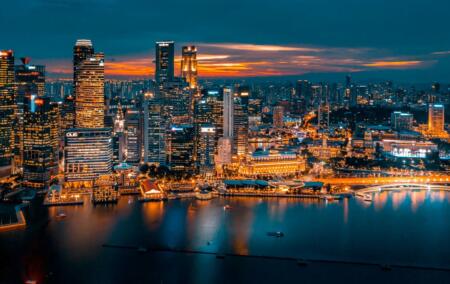
[Image: A view of the Singapore skyline at night. CC0 photo by cronus2010 from PxHere]
The views of the writer are not necessarily the views of the Daily Friend or the IRR.
If you like what you have just read, support the Daily Friend