

The suffering of children in Gaza is real and terrible. But the recent UN report moves too easily from civilian death to deliberate targeting, and in doing so blurs distinctions that serious moral and legal judgement require.
No decent person reads of dead children in Gaza with indifference. The image of a child pulled from rubble, or lying in a hospital corridor, or carried by a parent who has already understood what others are still pretending not to see, does not require much political sophistication to understand. It is an obscenity.
It is one of the permanent horrors of war that those least responsible for it so often pay the highest price. For that reason, allegations about the killing of children deserve to be treated seriously. But seriousness is not the same as credulity. In fact, the graver the allegation, the more careful we ought to be.
The recent report by the United Nations Independent International Commission of Inquiry on the Occupied Palestinian Territory, including East Jerusalem, and Israel, does not merely say that large numbers of Palestinian children have been killed or injured in Gaza. It argues that Israeli authorities and security forces have deliberately targeted Palestinian children, and that this has resulted in genocide, crimes against humanity and war crimes.
The Commission says that between 7 October 2023 and 7 October 2025, at least 20,179 Palestinian children were killed, around 30% of the overall death toll, and that more than 44,000 were injured. It also points to the use of heavy munitions in densely populated areas, the blockade and its humanitarian effects, attacks affecting healthcare and education, psychological trauma, displacement, and the treatment of Palestinian children in detention.
Israel has rejected the report, calling it defamatory and arguing that it ignores Hamas’s conduct and the wider context of the war.
Suffering of children
These are grave claims, and they should not be answered by indifference to Palestinian suffering. The difficulty with the report, as I read it, is not that it discusses the suffering of children. The difficulty is that it appears to move too readily from terrible consequences to conclusions about intention. It treats the scale and character of child suffering as evidence not merely that the war has been devastating for children, and not merely that some Israeli actions may have been unlawful, but that Israel has deliberately targeted children as children.
A civilian death in war may be lawful, unlawful, reckless, negligent, criminal, or murderous. These are not minor variations on the same thing. They are different moral and legal categories. A child killed by a bomb aimed at a legitimate military target is not the same as a child deliberately shot because he is a child.
An attack that fails to take adequate precautions is not the same as a policy of extermination. A commander who wrongly assesses proportionality is not the same as a soldier who intentionally murders a civilian. None of these distinctions lessens the grief of the bereaved. But without them, judgement becomes impossible.
The phrase ‘targeting children’ is especially dangerous because it carries one meaning in ordinary speech and another, much broader meaning in much legal-political discourse. To most readers, the phrase suggests soldiers aiming at children because they are children, it suggests a policy of child murder. But in reports of this kind, the phrase can become elastic enough to include bombing, siege conditions, hunger, displacement, trauma, the destruction of schools, the collapse of medical care, and the general ruin of childhood in a war zone.
Serious wrongdoing
Some of these may involve serious wrongdoing, some may require investigation, and some may turn out to be unlawful. Some may be the predictable effects of brutal urban warfare. But they are not all evidence of the same thing. To place them under one heading is rhetorically powerful, but analytically dangerous.
The central question, then, is what would actually prove deliberate targeting. A finding of that kind should require more than terrible outcomes. It would require evidence that children, or civilian children specifically, were the object of attack.
That evidence might take the form of orders, rules of engagement, repeated patterns of conduct inconsistent with any plausible military objective, direct testimony showing that soldiers were instructed or permitted to kill children as such, or specific incidents in which the claimed military justification collapses under scrutiny. Reckless disregard for civilian life may prove recklessness.
Disproportionate attacks may prove unlawful conduct. A pattern of attacks may, in some circumstances, help establish intent. But one cannot simply move from foreseeability to purpose. Knowing that children may die in an attack is not the same as attacking in order to kill children. That distinction is not moral hair-splitting. It is one of the foundations of the laws of war.
History is useful here, not because it excuses anything, but because it disciplines judgement. Even in justified wars, civilians die, and proportionality questions remain. The Allied liberation of France in 1944 is a simple enough example. It was part of a war that had to be fought and won.
Yet Allied bombing and shelling killed French civilians whom the Allies were trying to liberate. German forces occupied towns, used roads, railways, bridges and urban infrastructure, and fought from places where civilians lived. None of this means every Allied action was wise, lawful or proportionate.
Some bombing decisions remain historically and morally debated. But the example shows the basic point: civilian death, even in large numbers, does not by itself reveal whether civilians were the object of attack.
Urban war
The same lesson appears more sharply in urban war. Manila in 1945 was not Gaza, and no historical analogy should be pushed too far. But it remains a reminder of what happens when civilians are trapped inside a city turned into a battlefield.
Once fighting moves through houses, streets, hospitals, schools, rooftops and cellars, the boundary between civilian and military space simply vanishes. Shells miss. Buildings collapse. Fire spreads. In fear and confusion, soldiers make wrong calls. Intelligence is patchy. Civilians move in unpredictable ways, doing whatever they think might keep them alive. Combatants use civilian structures because cities are made of civilian structures. None of this makes civilian death acceptable, and it makes easy judgement dangerous.
Mosul and Raqqa are closer modern examples. In both cases, Western-backed forces fought ISIS in dense urban environments. ISIS used tunnels, booby traps, civilian buildings, human shields and propaganda around civilian death.
The campaigns were necessary, but they were not clean. Civilians died in large numbers and whole districts were destroyed. The lesson is not that every coalition strike was lawful. The lesson is narrower: urban war against a jihadist enemy embedded among civilians produces civilian death, even when civilians are not the intended target.
This is the setting in which Gaza has to be understood. Gaza is not merely a tragic civilian space upon which Israeli power descended from nowhere. It is also a battlefield chosen and shaped by Hamas. Hamas began this war with the mass murder of Israeli civilians, the taking of hostages, and the deliberate theatrical cruelty of 7 October.
Since then, it has fought from one of the most densely populated territories on earth, using tunnels, civilian infrastructure, fighters who do not reliably distinguish themselves from the population, and a political strategy in which civilian suffering becomes diplomatic pressure on Israel.
Hamas’s conduct
But this point cuts both ways. Hamas’s conduct makes Israel’s task harder. It does not make Israel’s choices disappear. The fact that Hamas embeds itself among civilians does not resolve whether a particular Israeli strike was proportionate. It does not answer whether sufficient precautions were taken.
It does not tell us whether a school, hospital, apartment block or refugee camp was attacked on the basis of sound intelligence or wishful thinking. It does not justify everything done in the name of military necessity. It means that the analysis has to include both sides of the battlefield: Hamas’s method of fighting and Israel’s method of responding.
This is where much commentary fails. Some defenders of Israel speak as though Hamas’s barbarism settles every later question. Some critics of Israel speak as though Hamas’s role is a preface, to be mentioned briefly before returning to Israel as the only real actor in the story. A serious account has to hold both of these thoughts together.
Hamas bears responsibility for turning Gaza into a battlefield and for embedding war inside civilian life. It is also worth stating plainly that Hamas’s violence against civilians is not incidental.
Whatever softer language appears in later political documents, its actual practice has included the deliberate murder, kidnapping and terrorising of civilians. The 7 October attacks were not a battlefield accident; Human Rights Watch described Hamas-led abuses that day as war crimes and crimes against humanity, including deliberate attacks on civilians and hostage-taking.
Hamas’s original 1988 covenant also includes openly eliminationist and antisemitic language, including the well-known religious passage about killing Jews. This is not a movement whose hostility to civilians has to be inferred from Israeli talking points. It is visible in doctrine, rhetoric and conduct.
But none of this makes Israel’s choices disappear. Hamas helped create the battlefield; Israel still bears responsibility for the force it chooses to use within it.
The fog of war is often invoked lazily, as if it means little more than ‘mistakes happen’. But the phrase points to something real. War is not fought with perfect information. Soldiers and commanders act under pressure, often tired, frightened, and confused, relying on intelligence that may be partial, outdated, or simply wrong.
Military significance
A building may be a home, a weapons store, a command post, a tunnel entrance, or all of those things at once. A man in civilian clothes may be a non-combatant, a fighter, a scout, a courier, or someone simply trying to survive. A child may be exactly what he appears to be, and still be standing near a target whose military significance is not visible to a later observer.
This does not mean anything goes. It means that later judgement must take seriously the uncertainty under which decisions were made.
The laws of war exist because war is brutal, not because it is clean. They require distinction, proportionality and precautions. They do not require armies to avoid all civilian harm, because that would make war against an enemy embedded in civilian space impossible. Nor do they permit armies to dismiss civilian harm as irrelevant.
The question is not simply how many civilians died, but what was being targeted, what military advantage was anticipated, what civilian harm was expected, what precautions were feasible, and whether the expected harm was excessive. These are uncomfortable questions that matter.
On this point, the UN report seems to rely on several kinds of evidence. It points to the number and proportion of children killed. It points to the use of high-payload munitions in densely populated areas. It points to the effects of blockade, hunger, displacement, psychological trauma, and the destruction or disruption of medical and educational life. It also refers to specific incidents and patterns of alleged conduct by Israeli forces.
These matters should not be waved away. They may prove a great deal. They may support arguments about recklessness, disproportionate attacks, collective punishment, unlawful deprivation, or failures of precaution. They may support the investigation and punishment of particular soldiers or commanders. But the evidentiary gap remains: these facts do not automatically prove a policy of deliberately targeting children.
The use of heavy munitions in densely populated areas may be deeply troubling, excessive in particular cases, or evidence of poor judgement and insufficient regard for civilian life. But the use of a powerful bomb in a dense urban area does not, by itself, tell us what the target was, what intelligence was available, what military advantage was anticipated, what alternatives existed, or what precautions were feasible. Those questions cannot be skipped because the outcome was objectively horrific.
Not irrelevant
The same is true of hospitals, schools and shelters. The fact that such places were struck is not irrelevant. These are precisely the places where scrutiny should be most severe.
But the legal and moral question is still not answered by the label on the building. Was it being used for military purposes? Was that known or reasonably believed? Were civilians warned? Could they leave? Was the expected military advantage serious enough to justify the expected civilian harm? Were less destructive means available? These are the questions one needs to answer before turning an attack into proof of deliberate child murder.
The human-shields allegation needs the same care. If Israeli soldiers forced Palestinians, including children, to enter buildings, move ahead of troops, remain near military positions, or expose themselves to danger for a military purpose, that would be a serious violation and should be punished.
The point is not that such conduct is impossible. Armies are made of human beings, and human beings in war sometimes do unlawful and ugly things. The point is that the allegation needs specific evidence. Who was compelled? By whom? Under what order or threat? For what military purpose? Was it an isolated abuse, a recurring practice, or a policy?
Merely showing that civilians were near Israeli soldiers, or that civilians were present in buildings later entered or attacked, cannot establish the allegation. In Gaza, civilians and combatants are often in the same spaces. That is part of the tragedy and part of the difficulty.
This is where the report’s breadth becomes a weakness. It gathers together battlefield deaths, humanitarian deprivation, destroyed schools, psychological trauma, displacement, alleged shootings, detention practices and the general destruction of childhood, and then places them under the heading of deliberate targeting.
But these are different kinds of conduct, and they require different evidence. They involve different levels of intent. A starvation allegation is not the same as a sniper allegation. A collapsed school year is not the same as a murder order. Trauma is not the same as targeting.
Duties
None of this places Israel beyond criticism. A democratic state fighting a terrorist army in a dense civilian environment still has duties: to take feasible precautions, to investigate wrongful deaths, and to punish soldiers who abuse civilians. It must explain itself where it can. It must remain aware that military necessity can become a language in which too much is excused.
Some Israeli actions may deserve criticism. Some may deserve investigation. Some may deserve punishment. The point is not that Israel is incapable of wrongdoing. The point is that wrongdoing needs to be named accurately.
This is especially important for those of us broadly sympathetic to Israel because we see it, however imperfectly, as part of the Western and democratic world. That sympathy should not produce blindness. If anything, it should require seriousness. Israel is not Hamas with better weapons. It is a state, and states have duties that terrorist movements do not recognise.
But seriousness also means refusing to accept every accusation made against Israel by institutions and activists who have long struggled to judge it with restraint. The imbalance is not imaginary. Year after year, Israel attracts a level of UN condemnation wildly out of proportion to its size and conduct, when compared with states such as Iran, North Korea, Syria, China or Russia. UN Watch, admittedly a pro-Israel watchdog, has tracked this pattern for years. In 2025 alone, it counted 15 General Assembly resolutions against Israel and only 11 against the rest of the world combined, including one each on Iran, North Korea and Myanmar. Across the decade from 2015 to 2025, it counted 173 resolutions against Israel, compared with 80 against all other countries combined. The point is not that Israel should face no resolutions. It is that a system which returns again and again to Israel with such disproportionate energy has forfeited the right to be treated as a neutral moral referee.
Civilisation is not defended by pretending war is clean. It is defended by insisting on distinctions even when those distinctions are unpopular. The charge that Israel deliberately targets Palestinian children is one of the gravest accusations imaginable.
Not propaganda
It should not be smuggled into public understanding by expanding the meaning of ‘targeting’ until it includes almost every consequence of war. Nor should it be accepted merely because the underlying suffering is real. Dead children are not propaganda. They are dead children. But neither are they, by themselves, proof of a policy of deliberate murder.
The tragedy of Gaza deserves moral seriousness. That means grief, scrutiny and a willingness to investigate Israeli conduct. It also means refusing to let Hamas disappear from the analysis. It means refusing to collapse urban warfare, civilian death, military error, recklessness, unlawful attack and genocide into a single accusation.
Because children have died, evidence matters more, not less. Because the accusation is so grave, it must be proved, not merely felt.
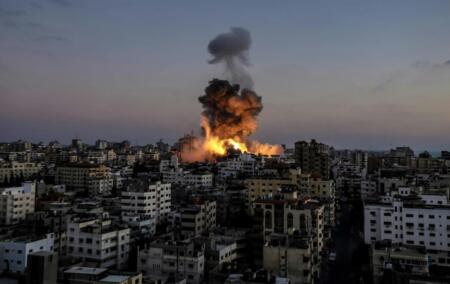
[Image: Mohammed Ibrahim on Unsplash]
The views of the writer are not necessarily the views of the Daily Friend or the IRR.
If you like what you have just read, support the Daily Friend