

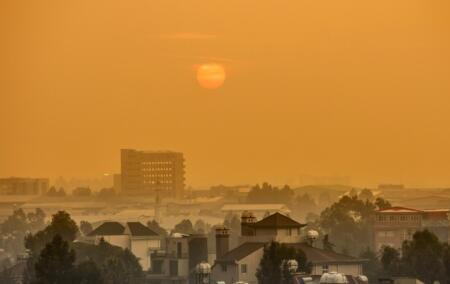
As smoke from wildfires in Canada and 68 large blazes burning across at least 15 states blanketed the eastern United States, from the Great Lakes to Washington, D.C., millions of Americans faced hazardous conditions, and orders to stay indoors.
Summer extremes converged on three fronts at once: a smoke-choked east, rising water in the south, with flooding in Texas, and fast-spreading fires in the west.
Yesterday, firefighters were battling 68 large fires nationwide, up by nearly two dozen from a day earlier. The National Interagency Fire Center said some 17 new blazes broke out in the Pacific Northwest after a run of lightning strikes made it the most active fire region in the country.
The smoke from wildfires in Canada has turned skylines from Minneapolis to Washington orange-brown and pushed dangerous air quality into the Midwest, Northeast and Mid-Atlantic. Over 100 million Americans, nearly a third of the population, were under some level of National Weather Service air quality alert, ranging from warnings against exercising outdoors to instructions to stay inside out of the smoke.
The cross-border effects are also causing a row between Canadian and US officials with President Donald Trump threatening new tariffs to cover the cost of the smoke damage, which he claimed was “incalculable”.
Wildfires are common in Canada, but reports say the number of outbreaks has rapidly increased in recent weeks.
This had been predicted by the National Interagency Fire Centre (NIFC) in the US and Natural Resources Canada, because of sustained hot weather at the end of June across northern Ontario, and below-average rainfall.
This hot weather is being caused by a heat dome – an area of high pressure that gets stuck, trapping warm air and the smoke underneath.
Extreme and long-lasting heat draws more moisture out of soils and plants – this dry vegetation acts as fuel for fires.
But this hot air can also become unstable causing the risk of storms which can produce strong winds – causing the fires and smoke to spread.
The NIFC said record-low snowpack in the Mountain West and drought were pushing fuel conditions to the type of dry and fire-prone levels normally not seen until mid-August.
Climate scientist Jonathan Overpeck, dean of the University of Michigan’s School for Environment and Sustainability, said rising temperatures were driving disasters through the same basic mechanism, even though the effects could look opposite.
A warmer atmosphere pulled moisture out of soil and vegetation more aggressively, which had left Canada’s landscape drier and more fire prone. At the same time, a warmer atmosphere could hold more water vapour before releasing it, which was producing the kind of intense, heavy rainfall now battering Texas.
Overpeck said: “What climate change is doing is it’s rolling the dice so that you’re going to get drier conditions and more wildfires at the same time as you’re going to get more rain.”
Sources: Reuters, BBC
[Image: by wollwerth]