

Commentators still view election results through racial lenses. It is time to analyse voters by their economic interests, not their skin colour.
As the results of the 2026 local government elections trickled in, a familiar refrain echoed across newsrooms and commentary desks. Journalists looked at voter turnout numbers, glanced at map boundaries, and immediately reached for the oldest, laziest narrative in South African politics: skin colour determines the ballot.
According to this view, South Africa remains locked in a perpetual “racial census”, to use a phrase offered by Michael O’Donovan, writing for the SABC.
When turnout drops in a township, headlines proclaim that black voters have abandoned the polls. When queues stretch around a suburban community hall, analysts report that white voters have turned out in force. It is a neat, predictable story. It is also not very accurate, and moreover, corrosive of race relations.
“Black wards”
Consider the coverage from News24 on election night. Under the headline Black wards stay home as SA votes for new municipal councils, the report highlighted a turnout differential of 10 to 15 percentage points between what it labelled “predominantly black” and “predominantly white” wards.
The article quoted elections analyst Wayne Sussman, who declared it concerning that “more and more black South Africans feel it is not worth their time to vote”.
A similar line came from O’Donovan. He asserted that post-1994 elections have largely been proportional to the demographic mix of a given neighbourhood.
This style of analysis suffers from a fatal analytical flaw: it conflates geography with racial identity, and suggests racial identity is the primary motivator of voting choices.
Geography is not race
To understand why this framing fails, one must look at what these voting districts actually represent. When a commentator labels a ward in Soweto or Tembisa as a “black ward”, or a ward in Sandton or Constantia as a “white ward”, they are using racial shorthand for economic reality.
South Africa’s historical spatial layout means that leafy suburbs contain a high concentration of affluent and middle-class households, while sprawling townships contain a high concentration of working-class and impoverished households.
But three decades after the end of statutory apartheid, those suburbs are no longer exclusively white, nor are they exclusively support bases for the Democratic Alliance. Equally, those townships are no longer exclusively black, nor are they captive fiefdoms of the African National Congress.
When analysts substitute race for class, they obscure the true dynamics of the electorate. A wealthy black executive living in Bryanston has far more in common politically and economically with their white neighbour than they do with an unemployed youth in Alexandra.
They care about suburban security, reliable electricity, stable property values, efficient municipal billing and potholes. The youth in Alexandra cares about basic sanitation, housing allocation, access to the local clinic, and job opportunities. That’s a totally different set of issues.
Missing important insight
By insisting on describing these two voters by their shared skin colour rather than their vastly different material interests, commentators contribute to the perpetuation of racial identity politics.
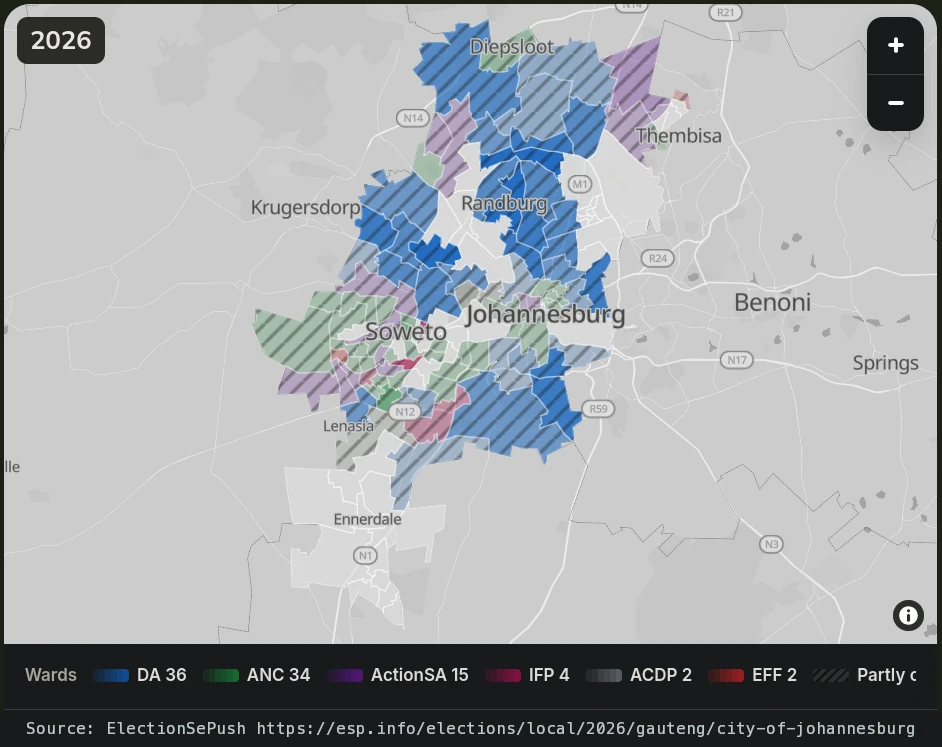
Not only that, but they miss important insights. An analysis that says black voters stayed home has nothing to say about the remarkable insurgency of ActionSA in places like Soweto, Cosmo City and Thembisa.
If South Africa is ever to make genuine progress as a non-racial society, we must stop referring to race when we really mean to distinguish between wealthy and poor, or urban and rural, or suburban and township electoral wards.
Continuing to view geographic voting patterns as racial blocs keeps the country chained to the identity politics of the past. It treats individual human beings not as rational actors evaluating their material well-being, but as passive members of racial collectives.
A middle-class election
Not all commentators fell into this trap. Writing for EWN and speaking on CapeTalk, political analyst Tessa Dooms offered a far more perceptive reading of the polls.
I don’t often have occasion to agree with Dooms, but I must commend her analysis, which explicitly rejected racial determinism, describing Wednesday’s vote as a “middle-class election”. (We’ll let the Marxist implications of a class-based analysis slide, for the sake of this argument.)
She observed that the turnout gap in 2026 was not driven by racial solidarity or racial apathy, but by relative prosperity and poverty. In Cape Town, for instance, turnout reached over 55% in historically prosperous voting districts, compared to 43% in coloured working-class areas and 31% in poorer black townships.
Dooms pointed out that middle-class South Africans showed up at polling stations because they have begun to feel the direct brunt of collapsing municipal service delivery. They have private assets to protect, rates to pay, and a clear sense that local government failures directly threaten their quality of life.
Conversely, residents in poorer communities stayed home not because of their race, but because years of systemic neglect have crushed their faith in the voting process altogether.
As Dooms noted, poorer voters have watched political power shift between parties without seeing tangible improvements in their daily existence. For many in informal settlements and underdeveloped townships, abstention was a rational response to a political system that has consistently failed to deliver clean water, working sewers, or safe streets.
This analysis recognises a fundamental truth of modern South African politics: how people vote has more to do with their material well-being than with their racial identity.
The empirical reality
This insight should come as no surprise to anyone who has paid attention to empirical research over the past decade. The Institute of Race Relations (IRR) identified the strong correlation between material well-being and political support many years ago.
Long before the current election cycle, IRR survey data demonstrated that as South Africans rise into the middle class, their political preferences shift dramatically away from traditional liberation loyalties and toward parties that promise sound administration, economic growth, and accountability.
Bread-and-butter issues – jobs, crime, service delivery, and municipal competence – consistently rank at the top of voter priorities across every racial demographic.
When the ANC was delivering housing, water, electrification, primary healthcare facilities and jobs – which it did for the first 15 years of its tenure in government – its support went up. Poor voters saw the ANC delivering for them, and didn’t trust anyone else to prioritise them in the same way.
When it stopped delivering those things, about the time Jacob Zuma became president, ANC support began to fall. If people truly voted their skin-colour, rather than their quality of life and material prospects, this correlation wouldn’t have been so clear.
The 2026 election results provide more confirmation of this shift. DA Federal Council leader Ashor Sarupen announced (perhaps a little prematurely) that internal data modelling showed more than one million black South Africans voted for the DA in this election, surpassing the vote tally of the Economic Freedom Fighters among black citizens. IRR polling from 2025 similarly tracked DA support among black registered voters rising from 5% to 18%.
When that many black citizens vote for a party historically defamed by its opponents as a defender of white minority interests, the “racial census” model collapses. Many voters are not voting their racial identity, but are voting for perceived governance outcomes and economic self-interest.
Focus on issues, not race
The gradual replacement of identity-based voting by issues-based and interest-based voting is a magnificent development for South African democracy. It signals that the electorate is maturing faster than the commentary class.
When voters cast their ballots based on whether their taps run, whether their roads are paved, and whether their municipal councils are corrupt, political parties are forced to compete on performance rather than rhetoric. A party can no longer rely on struggle credentials or racial grievance to guarantee victory. It must deliver results.
It is high time that the media followed the electorate. It is true that race still matters in South Africa, and that racial sensitivities cannot be ignored. But when it isn’t necessary to generalise by race, journalists and commentators should abandon this crude, divisive style of analysis.
Instead of treating geographic election wards as racial monoliths, analysts should focus their attention where they belong: on income levels, material interests, service delivery track records, and policy proposals.
Describing voters by their economic reality rather than their skin colour is not merely a matter of linguistic precision. It is a prerequisite for building a truly non-racial republic.
South Africans are demonstrating at the ballot box that they are increasingly interested in good governance rather than racial solidarity. Commentators should catch up.
PS. I know I said I’d explain why the DA’s use of Greenpeace Africa’s numbers on the costs of outdoor pollution should embarrass the party. I’ll get to that soon.
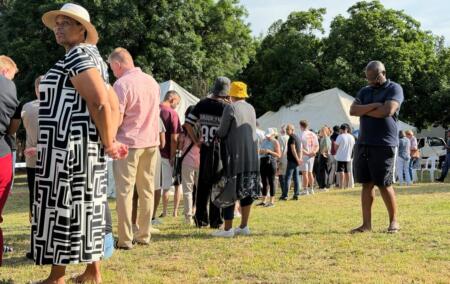
[Image: Voters of all races queue outside a polling station in Bryanston, Johannesburg, during the 2026 local government elections. John Endres]
The views of the writer are not necessarily the views of the Daily Friend or the IRR.
If you like what you have just read, support the Daily Friend