

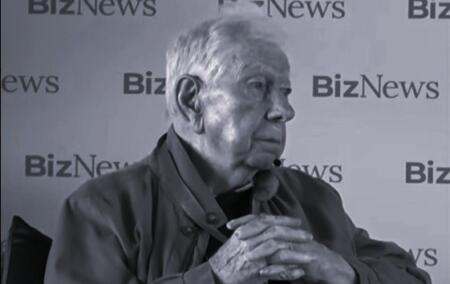
RW Johnson, “Bill” to his many friends and relations, was educated at Natal University and thereafter, as a Rhodes Scholar, at Oxford University. He was a fellow in politics at Magdalen College, Oxford, for 26 years and remained an emeritus fellow.
Bill was an exceptional academic, journalist and author, with the breadth of knowledge and the acumen to probe well below the surface of events – and the courage to keep challenging accepted wisdoms.
He was a prolific writer. Between 1970 and 2020, he authored 12 books, most of which focused on South Africa. However, they also spanned topics ranging from The Long March of the French Left (1981) to ShootDown: The verdict on KAL007 (1986), an account of a Boeing 747 shot down over Soviet territory en route from Anchorage to Korea.
Bill also wrote hundreds of perceptive articles for many different publications. He was a South Africa correspondent for the London Sunday Times for many years and wrote often for the London Review of Books.
In 1995 he returned to South Africa to found the Helen Suzman Foundation (HSF), which he ran until 2001. In this time, he established Focus, the HSF’s journal. This provided a platform for rigorous critiques of government policy. It also highlighted the need for effective checks and balances on executive power and warned of the dangers to democracy in a one-party dominant state.
In a 1996 book, Launching Democracy in South Africa, he and Lawrie Schlemmer, one of South Africa’s foremost social scientists, provided invaluable insights into South Africa’s first all-race election. Together, they revealed many uncomfortable facts that most commentators had preferred to avoid. These included the fear that beset many voters in the run-up to the poll; the chaos that attended the casting of the ballots, and the unlawful conduct that eroded the validity of the count. Without this book, these fundamental defects would not have been brought to light.
He often used opinion polling to question prevailing narratives on the extent of popular support for race-based affirmative action, land reform and other types of redistribution. He also probed voter preferences on economic policies and found significant endorsement, for example, of the business-friendly policies needed to help counter the unemployment crisis.
His election polling was particularly important in providing vital insights into shifting levels of support for the ANC and other political parties. In 2017 he analysed the preferences of self-declared ANC voters in the run up to the Nasrec conference, which had pitted Jacob Zuma against Cyril Ramaphosa, and found extensive support for the latter. His pre-election survey of the 2019 national election provided one of the most accurate forecasts of its outcome.
Advance the liberal cause
Bill’s main reason for leaving behind a stellar career at Oxford and returning to South Africa was to help advance the liberal cause within the country. “Liberalism” is a word with many different meanings and has left-leaning and “progressive” connotations in the United States, for instance. For Bill, however, the primary focus of liberalism in South Africa was on three core ideas: maintaining individual civil liberties, protecting free speech, and “creating equal opportunities that were accessible on the basis of merit, not race”.
In 1998, in a book entitled Ironic Victory, which he co-edited with another well-known liberal, David Welsh, Bill unpacked the many pressures being brought to bear on crucial institutions. These included the press, the schools, the universities, the criminal justice system, the police, and the judiciary. Difficult questions regarding race-based affirmative action were probed as well, rather than brushed aside.
Bill repeatedly cautioned that the ANC’s policy of “cadre deployment” aimed to give the ANC control over all “levers of power” within the country. Under this strategy, he went on, “nothing was off limits to the ANC”. The ruling party wanted control not only over the public service but also over the judiciary, along with “education, sport, recreation, science, and technology in general.” This meant, for example, that “no university or sporting body or scientific association was beyond its remit”. The ANC also wanted to control NGOs, business associations and churches too. “Nothing is ruled out,” he warned.
South Africa’s Brave New World, published in 2009, was a perceptive and searing account of how ANC policies had spread dysfunction, unleashed corruption and “poisoned everything” – from a once vibrant mining industry to education, electricity supply, and the fight against AIDS. The book also criticised the ANC’s relations with Zimbabwe, where land seizures, economic collapse, and political violence had repeatedly been applauded, rather than condemned, by President Thabo Mbeki and other ANC leaders.
In How Long Will South Africa Survive? The Looming Crisis (2015), Bill warned of collapsing governance, escalating corruption and spiralling public debt. At the end of this book, he wrote: “South Africa can either choose to have an ANC government or it can have a modern industrial economy. It cannot have both.” That warning has proved particularly prescient.
Abusing its dominance
Bill helped support the liberal cause in many other ways as well. He was a key part of a network of liberal individuals and organisations that had long pushed for an end to apartheid and were increasingly critical of how the ANC was abusing its dominance.
One of those liberal organisations was the IRR. The IRR published his 2011 report, Preventing Electoral Fraud in Zimbabwe, which exposed the massive, and often ludicrous, fraud used in the compilation of a recent Zimbabwe voters’ roll. This included “large numbers of 110-year-olds, all born on the same day … and not a few child voters, some of them as young as two years old”.
Bill served on the IRR’s Council from 2012 to 2014. In 2011, at the IRR’s invitation, he delivered the prestigious Alfred and Winifred Hoernlé Lecture on “The Future of the Liberal Tradition in South Africa.”
In this address – the 42nd in a series dating back to 1945 – Bill pointed out that liberalism was South Africa’s oldest political tradition. Over time, liberal views had so permeated “universities, NGOs, churches and other institutions,” along with the general population, that they had become second nature to many people. This was a key factor behind South Africa’s “miracle” transition.
However, the ANC’s rejection of liberalism had always been strong and was growing in intensity. By 2011, after nearly 20 years of its rule, South Africans faced “unmanageable corruption” and “a state which is both semi-criminalised and also failing”. People were repeatedly “affronted…by big-man displays of arrogance and self-aggrandisement”. At the same time, the state had “unravelled” to the point where different regions were seeking their own futures.
Added Bill: “It is sad that these are the fruits of liberation but they should never make liberals regret that they struggled so long and hard for non-racialism and equal rights.”
Reason for hope
He predicted that the challenges to liberalism would grow worse in the future. He also stressed, however, that there was reason for hope. South Africa had gone through “successive waves of [British] jingo nationalism, Afrikaner nationalism and African nationalism.” Hence, “no further nationalist wave is possible. As the last of these waves fades away, only the liberal alternative will remain.”
No prediction could ever be certain, he went on. “But with even reasonable luck, liberalism will simply be the last man still standing when the contest is finally over.”
[Image: Screenshot from https://www.youtube.com/watch?v=JZbUhDYaovc]
If you like what you have just read, support the Daily Friend