

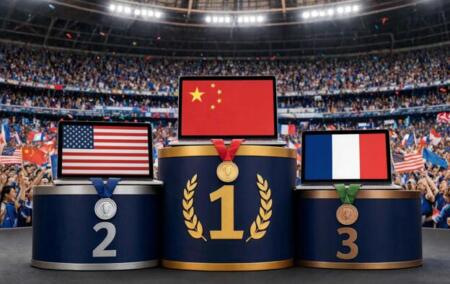
Even people with only a light interest (or even disinterest) in AI know that there is a leaderboard. Sometimes OpenAI is on top. Then Anthropic releases a new model and they grab the lead. Somewhere behind them SpaceXAI and Meta and Google, all huffing and puffing to stay in the race.
It has been like this for a few years, but in January a dark horse came into view. It was DeepSeek from China. It was open weight (AI’s flavour of open source). It was startlingly inexpensive. And it was, in the patronising words of some Western analysts – impressive, quite good, a fine effort, surprisingly capable for its price, a jolly good show. But certainly not as good as the US models. Most analysts and commentators (including David Sacks and DeepMind’s Demis Hassabis) have insisted that the Chinese open-weight models (there are seven of them in the race) were many months behind the US leaders.
On 16 July,a Chinese company called Moonshot announced an open weight model called Kimi 3 and the world tilted. Not because the model jumped to #1 on almost all of the technical benchmarks, thereby relegating all US models to straggler status, but because it changes everything up to and including geopolitics. One smart wonk (sorry, can’t remember who, I read hundreds per day) had a near-biblical interpretation of this change in the leaderboard. He called it the day that history forked. Hyperbole? Maybe.
But let me count the ways.
For a start, both OpenAI and Anthropic were planning to go public this year, at valuations expected around $1 trillion. Now there is chatter that the companies are (since the Kimi 3 announcement) worth no more than half that, and perhaps less, with AI mega-investor Dave Blundin pegging the value at $250 billion. I am not sure what to even think about that – a loss of $750 billion in value in a day because of one Chinese AI company’s model announcement. Perhaps even enough to scuttle the listings of both companies.
Can OpenAI and/or Anthropic grab the lead back? Yes, of course, and they probably will for all of a minute or so before getting lapped again by the Chinese (perhaps even SpaceXAI or Meta will get their brief moment in the sun at some point).
Then there is this. OpenAI’s top tier model is 3.5x more expensive than Kimi 3 and more than 5x more expensive than Anthropic. Who in their right mind would pay this much more for the same service?
But wait, there’s more. Kimi has a lightweight option that allows you to download the model onto your computer. For free. Which means you can own a top-tier AI model without paying a cent in subscription fees. But there’s even more! If you have it on your machine, your data stays with you – it never goes outside your network. If you are an enterprise worried about data leakage, or even an individual seeking privacy, this is a huge deal. And, of course, you do not pay for tokens, ever.
And Kimi is not alone. Within days of their announcement Alibaba announced their new model – similar capabilities. And our old friend DeepSeek is rumoured to be getting ready to release their new model, reputedly a monster.
I’m not even finished yet. Many casual observers have concluded that the Chinese stole the American IP. Perhaps there was some of that a few years back (it seems as though everyone was stealing from everyone via a reverse engineering technique called distillation), but reports are now entirely different. Kimi is its own creation with demonstrably home-grown Chinese IP (If anything, the US labs are now seeking to copy the Chinese – they have built astonishing stuff even without having access to Nvidia’s export-controlled top-of-the-line chips).
What are we to make of this?
Not to put too fine a point on this, it is clear that the US monopoly in the ‘best’ AI is over. It is also clear that soon all of the foundation companies will soon be trying to sell a commodity – no one will have a better product, at least not for more than a very short time. And if no-one has a better product there are few strategies left. Customer care? Brand? National pride? Free product with enticing paid extras? A move up the stack to applications (as Anthropic has done with the recently announced Claude Design which is going to kill the erstwhile stock market darling Figma)?
I wrote a column some time back asking the serious-not serious question of how you could crash the US economy. Build a better AI product and give it away for free. Poof, trillions in US investment goes up in smoke. A little extreme, I suppose, because there are smart strategists and thinkers in both the US and China leading these companies, so there is unlikely to be any quick victory.
Unless the slow-down-and-be-cautious narrative gaining traction in the West wins. The regulators. The “no-datacentres” activists. Then the US will lose this race very quickly, because the Chinese are not slowing down at all – they are, as they say, balls to the wall with massive state support. Of course one may reasonably ask, so what? The Chinese already own multiple technology spaces, so what’s the big deal?
I claim this is different. AI improvements are exponential now, particularly as it becomes self-improving. Follow this line of thought and the logic leads here – the country which is a little bit ahead will be a million times smarter, richer, healthier, stronger by next year. By next month. By tomorrow. That is how exponentiality, famously ill-understood by humans, works.
If China has a colonising technology of the power of AI that is a million times smarter than the West can offer, then we will all be genuflecting at the feet of the CCP. Their military, their worldview, their politics, their understanding of human rights and freedom of speech and freedom of expression. Their way.
In our lifetimes.
Is this alarmism? Perhaps it was before Kimi 3. Not anymore.
Steven Boykey Sidley is a professor of practice at (ex-JBS, University of Johannesburg) and a partner at Bridge Capital and a columnist-at-large at Daily Maverick, Daily Friend and Currency News. His new book “It’s Mine: How the Crypto Industry is Redefining Ownership” is published by Maverick451 in SA and Legend Times Group in UK/EU, available now.
[Image: reve.art]
The views of the writer are not necessarily the views of the Daily Friend or the IRR
If you like what you have just read, support the Daily Friend