


Canadian Gordie Howe was one of the greatest hockey players ever. Known as Mr. Hockey, Howe played 25 years with the Detroit Redwings, leading them to four Stanley Cup titles. He retired from professional hockey in 1980 at the age of 52. Howe died in Ohio in 2016.
In 2012 the United States accepted a Canadian offer to build and pay for a new bridge to supplement the existing 98-year-old span that connects Windsor, Ontario with Detroit. The new bridge wasn’t just Canadian generosity, America’s northern neighbor needed a bigger, faster connection to Michigan as 30% of its US exports go through Detroit. The United States is by far Canada’s biggest market accounting for 75% of all Canadian exports.
Then prime minister Stephen Harper thought it a no-brainer to name the bridge after Howe, a revered sportsman in both Michigan and Ontario. As long-time travelers to Michigan know, a steady stream of trucks traverse the Ambassador Bridge daily. Five to seven thousand trucks per day use this vital trade corridor, most carrying components for auto plants on both sides of the border. A pioneering 1965 bi-lateral auto pact championed by President Lyndon Johnson brought bi-lateral tariffs to zero, promoting integration of US and Canadian vehicle manufacturing. The successful auto pact was the precursor of the North American Free Trade Agreement (NAFTA) and the subsequent US Mexico Canada Agreement (USMCA) of 2020.
The Gordie Howe Bridge that cost Canada $6.4 billion should have been finished years ago but billionaire tycoon, Mattie Maroun, the owner of the Ambassador Bridge, opposed its construction. Legal challenges from Detroit resident Maroun dragged on for years. The Syrian American entrepreneur who made his fortune from gas stations and trucking died in 2020.
A gala ribbon-cutting US Canada ceremony opening the bridge was to have taken place on July 24th. But after President Trump threatened new tariffs on imports from Canada, the Canadians cancelled the event and held their own ribbon cutting, absent American officials, in Windsor.
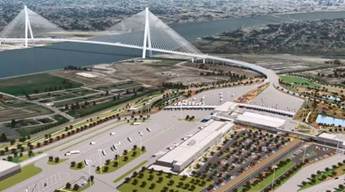
President Trump has long been skeptical about the Gordie Howe bridge, perhaps because his nemesis Barack Obama was president when the 2012 agreement was signed. Even in his first term Trump demanded trade concessions from Canada, which in most years is America’s second biggest trading partner. He has called the bridge agreement a bad deal and has demanded that half of bridge tolls go to the United States despite the original plan specifying that Canada would get all toll revenue until the construction debt is paid off. The president is scheduled to be in the Detroit area July 27th, the day traffic is due to begin crossing the new span. Bridge tolls will be half what has been charged on the Ambassador Bridge.
Canada – United States relations have been strained ever since President Trump’s second term began in March 2025. The auto industry in Canada and the US has been disrupted by tariffs and uncertainty that has threatened to upset the flow of auto parts and vehicles between Detroit and Windsor. Trump angered the Ottawa government by suggesting Canada should become a US state. Currently, there is a punitive US tariff on Canadian steel and aluminum. And new tariffs scheduled to go into effect in mid-August would place a 25 to 50% levy on Canadian wine, hockey sticks, cement, plywood, toys and paper products. The Trump administration wants Canada’s dairy producers to end their restrictive quota on American cheese. Canadians, dismayed by hostility from their southern neighbor, have responded by cancelling traditional winter vacations to Arizona and Florida and cutting back on shopping excursions across the border. Most Americans outside of the Midwest, appear to be unaware of the gravity of the US Canada trade dispute and how the stubborn US stance over the Gordie Howe Bridge has been a terrible way to treat a good friend.
The views of the writer are not necessarily the views of the Daily Friend or the IRR.
If you like what you have just read, support the Daily Friend