

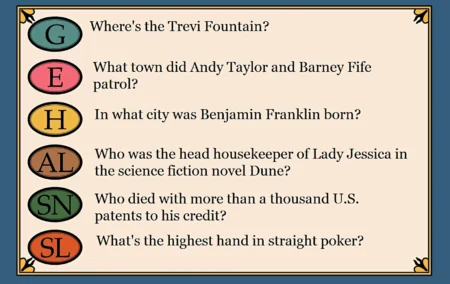
Maybe I’m just a curmudgeon, but I’m often startled by the lack of general knowledge of younger people. Am I right? Are they stupid?
People acquire knowledge throughout life. The amount people have read, seen and learnt increases as they age. That may explain the apparent gap in general knowledge between generations.
I think there’s more to it than that, though.
There is remarkably little research on inter-generational general knowledge.
Pew Research has done a few surveys that touch on the subject, and they find that while older people consistently perform better on various current-events-adjacent topics, the difference is not as pronounced as one might think. The US National Assessment of Educational Progress found that history scores at Grade 8 level were increasing up to about 2014, but then began to decline. A little.
The Cato Institute published a survey earlier this month, which found that a majority of Gen Z respondents got six out of seven basic civics questions wrong.
Appalling
Still, I can wholly relate to the anonymous author of an article published last year, entitled, “I’m 60, my boss is 25 – her general knowledge is appalling”.
His boss, he wrote, thought the Red Army, where a particular Russian had been employed, was a band. He quotes a contemporary who runs a current affairs magazine, employing mostly recent graduates.
“They’re much cleverer than us,” he said, “More analytical, more academically rigorous, more liberal, more empathetic, all the good stuff. But they know absolutely nothing. Without their outboard brains, their phones and their laptops, they barely know their own names.”
Look, I get that younger generations won’t know the ins and outs of Cold War-era geopolitics in the way that I do. Why would they? I don’t know the ins and outs of Depression-era life like my late grandparents did.
But sometimes I’m unpleasantly surprised by the ignorance among people in their teens and twenties, of elementary facts about history, geography, politics, literature, and even current events. So much so that I think there’s something more to it than just a lack of life experience.
Scheduled programming
Consider how people my age and older consumed information. We read books. We read newspapers. We watched entire movies that weren’t about superheroes. We watched scheduled, unskippable television programming, which included extensive news bulletins that dad insisted on watching.
We were fed on a steady diet of facts, whether they pleased us or not.
Now consider the average 20-year-old. They have a device in their pocket that will instantly give them answers to any question of fact they might have. Their media consumption is exclusively based on what social media algorithms think they would enjoy. When they see something they’re not particularly interested in, they hit “next”.
I’ve had to actively resist the temptation to fall down the same slippery media consumption slope. It takes much less effort to have Google, X or Meta feed you a neverending smorgasbord of content, elaborately tuned to one’s specific interests and biases.
About ten years ago I realised I hadn’t read a book, an actual book, in years. I spent all my time reading blogs and news media online. I now make time to read books before bed. I also make time to read more long-form journalism on weekends.
Reading books (albeit on an electronic device) gives me the time and mental breathing room to digest ideas and to place them in context in my memory. It is altogether a different – and more edifying – experience than the frenetic scrolling of online media.
I’ve also curated my news subscriptions to cast a wide net. I’m interested in news from all over the world, and not just from South Africa, America or the UK. I’m interested not only in current events, but also in art, history, and various sciences. I’m interested in varying political and cultural perspectives, not least to understand the minds and (entirely human) concerns of my ideological opponents.
Narrow feed
We didn’t have to do any of this 40 years ago. Two or three newspaper subscriptions and regular television programming covered as wide a scope of information as you could want, whether you were interested or not. (Let me correct myself. …as wide a scope of information as the church and state allowed.)
And most people – younger people – don’t do this today. They’re exposed to a narrow, targeted, personalised feed of information. Unless they seek out news about, say, the USSR, competing claims to Crimea, the Iranian Revolution, Chile under Pinochet, Argentina under Perón, or Somalia under Siad Barre, they’re not likely to come across it by default, in the way older generations did.
We used to have reasons to need to remember facts about the world, its history, its geography, its biosphere and its place in the universe. We couldn’t just look things up on the spur of the moment, when it was needed in a conversation.
The need and impulse to develop a broad general knowledge has dwindled now that we have all the world’s knowledge at our fingertips. We’re also no longer exposed to the means to develop a broad general knowledge in the way we once were.
For generations that never were exposed to a broad, uncurated information diet, that means developing a good general knowledge now requires additional effort, and that is effort that most people just don’t have time for.
Remember the past
They’re not stupid. Their grasp of recent events, digital culture, entertainment news is every bit as good as older generations were au fait with history, politics, geography and international affairs.
But their particular knowledge, on average, appears to be a lot shallower and narrower.
Some of it has to do with the fact that there is no longer a mono-culture. We all listen to different music, watch different videos, and interact with different people on social media. Everyone’s algorithm is different, so the body of “common knowledge” is much narrower.
I can’t help thinking of the effect this has on people’s thinking, though. As George Santayana wrote: “Those who cannot remember the past are condemned to repeat it”.
Surely, without a good mental model of the world and its history, it is impossible to reason with any confidence about political choices made today? That means today’s political choices are made on the basis of vibes, more than rational thought based on hard-won experience.
This may explain why Millennials and Generation Z are turning towards socialism, while at the same time believing their fellow citizens are untrustworthy and selfish, and the governments that would administer social benefits are irretrievably corrupt.
It’s woolly thinking that apparently dismisses, or never learnt about, the numerous socialist experiments of the past century, all of which failed with tragic consequences.
They don’t know what happened to the Somali Democratic Republic under Siad Barre or Argentina under Perón.
Idiocracy
If all you content consumption is based on what algorithms think you would enjoy, then you’re going to end up intellectually neutered, with a poor general knowledge and a weak grasp of how the broader world works.
Your particular knowledge of topics that interest you will be amazing, but your general knowledge will suffer.
I’m not saying that the old days, with three SABC channels, the Sunday Times, Rapport, The Star, and Beeld, were better. They plainly were not. And the fact that you can, at the drop of a hat, do a deep-dive into a topic or learn a new skill, just by pulling out your phone, is truly life-changing.
But to become and remain well-read – which was once considered the highest of accolades – has become harder, not easier. It requires effort and self-discipline. And the days of making sly allusions to literature, lyrics or movies that everyone has seen, are well and truly over.
For all the abundance of the information age, today’s people appear to have great particular depths of knowledge, but less intellectual breadth. Which goes a long way towards explaining many of the world’s present leaders, and the idiocracy that we’re hurtling towards.
Note: Ivo is unavailable for a few days, and won’t be responding in the comments. Usual programming shall continue, comment away 🙂 – R
[Image: trivialpursuit.webp]
[Caption: At Trivial Pursuit, I’ll back my generation against twenty-somethings any day. (Image copyright Hasbro.)]
The views of the writer are not necessarily the views of the Daily Friend or the IRR.
If you like what you have just read, support the Daily Friend