

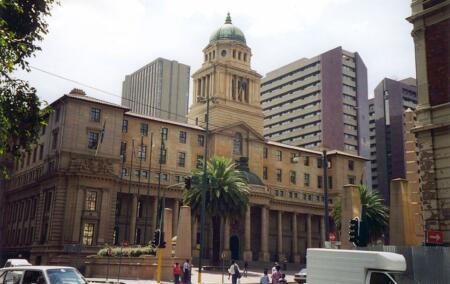
It’s a measure of the state of South Africa’s municipal sphere that Treasury has cut off equitable share funding transfers from the fiscus to 69 municipalities in the run up to an election. It says even more that those targeted are not only desolate, out-of-the way dorpies, but sizeable urban centres, including Johannesburg, the now much tarnished City of Gold.
Municipal government has been constitutionally assigned extensive developmental and administrative responsibilities. This is in contrast to numerous peer countries, where the local sphere operates either as matter of established practice, or as a subordinate tier under a central administration. The ANC had been opposed to a federal system of government but viewed strong municipalities as important for articulating and responding to local needs and aspirations. For much the same reason, municipal government needed to be established “wall to wall”, across the full extent of the country. There was a strain of genuine idealism in this.
There was also considerable political triumphalism, and personal opportunity. While municipalities were to have considerable power – including to raise revenue – this was to be exercised under the direction of the party. In the late 1990s, the ANC was riding high and outside the Western Cape and KwaZulu-Natal, it was confident that it would dominate the overwhelming majority of localities. To ensure that voting weight would counter the effects of segregated geography, a process of consolidation was undertaken. As South Africa moved from the interim to the current system, the number of municipalities in the final system reduced by close to two thirds. In some of the metropolitan areas, notably Johannesburg, the drive was to abolish sub councils under a “megacity”.
Local government would also provide bountiful opportunities for well remunerated employment and lucrative business opportunities. As with the state as a whole, people aligned to the ANC were to be brought in, while demographic considerations would weigh heavily on appointments and promotions.
It’s fair to say that the hopes invested in this system have been significantly disappointed. The 69 municipalities censured by Treasury represent no fewer than a quarter of the total. In March this year, President Ramaphosa referred to 35 as being “in distress”, and about 63% – close to two thirds – were “at risk”. This sits behind a deteriorating quality of life, the constant drain of resources that households and business experience as they try to compensate for governance failings, the firms that fail, and the investment that never materialises in the first place. This is common cause.
There is equally little dispute in the diagnoses of these circumstances. On the one hand, there are the numerous headline-grabbing factors that contribute to failings in individual municipalities: inept, unskilled and politicised administrations; corruption; and political instability in municipal leadership (both in contestation among party factions, and in the turnover of fragile coalitions).
On the other hand, there are the system-wide structural problems. The municipal system produced jurisdictions of vastly uneven potential. Many lack the revenue base that would undergird even modestly successful municipalities. Consequently, there is heavy dependence on intergovernmental transfers, and probably no prospect of changing this in the foreseeable future.
So, what is possible?
Here again, recommendations for action abound, and have remained fundamentally unchanged over the years. The most recent report of the Auditor General into local government summarises these well: build capable institutions through coordinated intergovernmental support; professionalise and capacitate local government; and instil a culture of ethics and accountability.
These are essentially calls for municipal leaders to respect the existing system and to follow its demands conscientiously. Do this, and many of the municipality-specific problems would be addressed. But as the Auditor General has also noted, commitment to doing so has been “lacklustre”.
In some respects, a start has been made. The National Framework towards the Professionalism of the Public Service and the recent amendments to legislation governing the public service has recognised the baleful state of public administration by stressing the need for merit-based appointments, limiting political influence and demanding better consequence management.
However, this is unlikely to be enough on its own. Municipal leaders confront patterns of dysfunction that are effectively now generations old. Political manipulation of administrations may be widely rejected in the abstract but is baked into the political calculus of much of South Africa’s political class. The idea that what is needed is better cadre deployment rather than a principled abandonment of it is one that remains influential. Similarly, a commitment to merit-based staffing is undercut by demands for racial and gender representivity.
As long as these imperatives remain embedded in staffing policy, local government will find itself trying to navigate self-imposed obstacles for which residents are penalised. They need to be abolished and disavowed.
On top of this, the failure to maintain a professional ethos has allowed criminality to take root. This may take the form of opportunistic corruption or the penetration of municipal institutions by syndicates, such as the so-called “mafias”, crooked contractors feeding off municipal failures in areas such as water and sanitation provision.
Corruption corrodes institutions and drains resources and resilience from the communities. Dealing with it is a necessary part of building robust municipalities, while robust municipalities will be increasingly able to resist criminality in future. Here again, the problem has been allowed to entrench itself, and to take on a lethal aspect. The recent murder of Emfuleni whistleblower Martha Mani Rantsofu is a stark reminder of this.
Targeted law enforcement will thus be foundational to municipal success; both a capacity for forensic investigation and physical protection are needed. Honest officials need to be protected from hitmen, while effective prosecutions must be brought against kingpins. This is necessary, literally, to give local government a fighting chance.
The viability of municipalities cannot be disentangled from the management of their finances. Cumulative municipal expenditure is close to R700 billion, a resource envelope that represents a significant ask from residents and for which they receive, in the main, subpar returns. Contrary to common assumptions, the proportion spent on personnel, overall (though with some important exceptions), is at around 24%. This is not in itself exorbitant.
Inadequacies in municipal financial management are evident elsewhere. Again, in common with the state as a whole, costs are raised by preferential procurement demands. Equally importantly – in view of the discontent around service provision, arguably more importantly – are the skewed patterns of spending on municipal assets.
Total capital expenditure comes in at around R79 billion a year, or over 11% of the total. This is widely seen as inadequate in itself; looking at the details reveals some uncomfortable trends. Well over half of this, R46 billion, is in new assets. Renewal and upgrading of assets – adapting them to be durably fit for purpose, stood at around R33 billion.
On an asset register worth over R800 billion, repairs and miniatous comes in at around R38 billion, or something under 5% (a little over 5% in some years). The Treasury recommendation is 8% of asset value – and this is also believed by some analysts to be insufficient.
Thus, a Treasury analysis observes: “Municipalities are not adequately providing for repairs and maintenance while they are not prioritising renewal and upgrading of existing assets. This is evident in the reported service delivery failures due to ageing infrastructure and lack of maintenance. Therefore, investment in existing infrastructure and repairs and maintenance must be informed by the condition of the assets regardless of the provided norms.”
Municipalities have significant powers of the purse. But this assumes a degree of economic activity (about which more later), and the ability and willingness to collect it. On the latter issues, South Africa’s municipalities have been dogged by an enduring “culture of non-payment”. Treasury put aggregate consumer debts at some R467 billion at the end of last year. Of this, a staggering R407 billion (equivalent to 87%) had been owed for more than 90 days. These included not just private households, but businesses and even government departments. Debts of this nature and magnitude have been treated as essentially uncollectable.
Escalating costs for bulk water and electricity purchases (this is itself the consequences of unreliable systems) have squeezed income from the sale of services. This has led to a growing reliance on property rates. A real danger is arising that South Africa’s towns and cities will become increasingly unable to sustain themselves, relying on shrinking rates bases. Unable to fund themselves, services and infrastructure will degrade further, and the economic foundations will steadily erode, driving a cycle of decline that will become ever more difficult to arrest.
Responding to this requires taking responsibility for the prudent management of both the income and expenditure streams. Proper credit control is essential, however hard and politically unpopular that is. Reforms to procurement systems – dispensing with BEE premiums and adopting a value for money approach and acting against malfeasance – will be indispensable too.
More importantly, municipalities need to work from the understanding that their funding is reliant on local economies. This means that priority needs to be given to dealing with matters that will produce the most significant returns. In brief, this means focussing in the first instance on core infrastructure – water, roads and power – and ensuring that municipal responsibilities like billing are functioning well.
Funds for key services must be ringfenced and not subsumed into general revenue, and requirements from Treasury for dedicated maintenance budgets need to be instituted – a minimum 8% of asset value is a logical starting point, though one that needs to be increased over time.
Naturally, unfunded budgets (such as that passed by Johannesburg this year) need to be recognised for the unlawful and impermissible recklessness they represent.
There is an increasing awareness on the part of the government that service failings, notably in water, are less a function of funding or resource availability than of poor governance. Where state capacity is lacking, private-public partnerships, the mandatory contracting out to private providers, or even privatisation should be undertaken. This has been set out in Anlu Keeve’s recent study on infrastructure. Elements of this would be familiar to the recently released National Water Plan. And as observers have noted, the ultimate test will be whether it can be implemented.
Finally, local government has run up against some of its inevitable structural limitations. Scholarship on the municipal malaise has for years warned that one size does not fit all, and therefore solutions need to recognise the enormous diversity of the conditions under which individual municipalities exist and function – or fail to function. However, the municipal system is based on an assumption that substantive standardisation is possible, and that a level of viability can be attained. It is hard to sustain that view now.
The emerging reality is that many jurisdictions lack the rates base, the skills profile or (at least for now) the economic potential to sustain local government as it is now envisaged. There is a real prospect that some will never be viable, requiring ongoing support for little return.
Here again, there is some official recognition of this, through the recent white paper on local government. Its prescriptions, however, point to another round of consolidation (and centralisation). The idea seems to be to move from a two-tier system that exists in the non-metropolitan areas to a one tier model. Local councils would be abolished and their functions and resources concentrated in district level institutions.
This risks compounding rather than ameliorating the problems, since such an arrangement would likely entail aggregating functional and dysfunctional jurisdictions, stretching already limited financial and human resources. This is aside from the increased distance from local communities that such larger units will create.
South Africa would do well to be cautious about proceeding down this path. Local municipalities that are operating passably should be retained, encouraged to continue their work, and provided with strictly conditional support where manageable weaknesses are identified.
There are, however, some that have little prospect of viability. Serious consideration needs to be given to their abolition, and the assumption of a limited basket of responsibilities – infrastructure and basic services – by district councils, or where these are failing, under a form of semi-permanent administration. The prospect of reestablishing a full municipality could be on offer in the event that certain conditions (such as sufficient taxable economic activity) could be shown to exist. The principle here is that form follows function.
To be sure, the very diversity of governance options that this would introduce would also likely be the strongest argument to be made against such reform, since it would entail depriving large numbers of South Africans of local democracy. It would probably require a constitutional change. This is not to be undertaken lightly. But the scale of the problem and the costs it is imposing on South Africa demand that extraordinary options be open to consideration.
Any durable solution will begin with getting the politics right. This means leaders who will prioritise the institutional integrity of the municipal organisations under their authority ahead of any party or factional interest. Thus far, there is little to suggest that this is fully appreciated.
Meanwhile, Treasury announced that the suspended funds were being released. This, Minister of Finance Enoch Godongwana said, was meant to protect service provision. He added: “I wish to make it clear that the decision to release the remaining transfers does not mean that the affected municipalities have satisfied the requirements of the Municipal Finance Management Act, the Municipal Regulations on Financial Misconduct Procedures and Criminal Proceedings, or the requirements previously communicated in my letters addressed to the respective mayors and the press statement released by the department earlier this month.”
Treasury was expecting measurable improvements to financial performance in the coming months. It’s an aspiration that has been more than two decades in the making.
- This article, which draws on work done for a forthcoming study on local government, was produced with the generous support of the Konrad Adenauer Stiftung.
[Image: https://commons.wikimedia.org/wiki/File:Johannesburg_City_Hall.jpg]
If you like what you have just read, support the Daily Friend