

Despite being greeted by gushing global goodwill, ANC leaders chose policies hostile toward this era’s primary growth driver, global integration.
From before Nelson Mandela’s 1990 prison release until SA’s hosting of the G20 last year, ANC leaders strode international stages presuming the status of social justice nobility. That era has ended and most South Africans have little to show for it. Rather, we will long be paying for the party’s self-serving policies.
As our economy has long lacked noticeable forward momentum, much inertia must now be overcome. Our youth unemployment crisis chokes growth in household incomes, while a majority of black South Africans are poor, overindebted, or both.
During the ANC’s more than three decades in power, global poverty plunged due to the rise of Asia. Nothing humans have ever done quite compares. Less than half a century ago, the prevalence of poverty across Asia and Africa was similar.
Targeted exporting
The phenomenally rapid rise of Asia could not have happened had Asian companies targeted Asia’s low-income consumer markets. Even today, the growth of Asian economies remains highly dependent on value-added exporting to affluent Western consumers.
SA should have adopted the fundamentals of this extremely successful growth model, adapted it for local conditions, and then served as this region’s role model. Instead, the ANC sought to outwardly project a liberation movement’s moral sense of purpose while domestically managing a patronage network that prioritised the interests of political elites and their cronies.
Squandered peace dividends
The 1990s began with the Soviet Union crumbling. Across desperate jurisdictions, voters and politicians rejoiced as, in many cases, reduced military spending – the so-called peace dividend – funded the expansion of social projects and foreign aid.
Looking back now, such funding resembled hush money to quiet those left behind – over two billion people got on board the upliftment escalators that intense global integration offered. Asia broadly advanced while Africa, being routinely represented at international summits and conferences by ANC liberation heroes, focused on attracting capital, extracting resources, and singing their own praises.
Global economic growth has subsequently become increasingly dependent on companies and countries achieving ever greater efficiencies through specialising within nodes of international supply chains. This requires a persistent commitment to competitiveness. Instead, the ANC exploits disparities to justify legislative initiatives, such as BEE, which preclude SA companies from being sufficiently competitive to integrate into international supply chains. That is, the ANC has consistently rejected the blueprint which led to the world-changing rise of Asia.
Liberation movement economics
As the ANC’s rise to power triggered skepticism regarding the ability of a former liberation movement to manage a complex economy, the ANC was careful to avoid hyper-inflation and a credit crisis. However, the objective should always have been to create an economy where the vast majority of those groups that had been previously disadvantaged would-be middle class or affluent. Progress toward this key objective will remain elusive until we achieve much greater export competitiveness.
Economists and central bankers have extensive playbooks to overcome hyper-inflation and tame credit crises. Achieving and sustaining high volume upliftment requires a broad and persistent commitment to governance fidelity. While competitiveness is the price of admission, international supply chains often meaningfully reward countries that adopt commercially astute economic policies while avoiding unnecessarily antagonistic international relations.
Immense benefits have accrued to competitiveness-focused countries over the past four decades. Japan’s successes inspired the four “Asian tigers” and they in turn inspired other countries, most notably China. Unfortunately, it is difficult to reconcile a competitiveness focus with the ANC’s patronage-based internal structures or its redistribution-focused policy mindset. Thus, their policies have shifted much income to politically favoured elites while entrenching rampant poverty and unemployment.
A significant consequence of a world economy that propels massive upliftment through international supply chain integration is that it punishes countries that embrace isolationist policies. Isolationist biases are unaffordable for affluent countries and more perilous still for countries with a high prevalence of poverty and unemployment.
A large majority of black South Africans will remain poor with meagre upliftment prospects until our policymakers choose to much more meaningfully integrate into the global economy by adding value to exports destined for affluent markets. This remains possible but the terms of engagement are shifting.
Shifting trading patterns
While today’s international trading system has delivered strong global growth alongside rapid economic development, it is no longer sustainable. The central problem is that its primary beneficiary, China, has become extremely proficient, and aggressive, at gaming the system.
There have long been a multitude of ways to cheat a system designed to encourage free trade. That most countries cheat around the edges has not been a serious problem. Conversely, China’s economic growth is not sustainable without running massive trade surpluses. Its accelerating trillion-dollar-plus pace relies substantially on subsidising its domestic manufacturers in strategic sectors; this threatens to bankrupt foreign competitors. Major industrial companies, particularly those in Europe, are acknowledging how vulnerable they have become.
Political leaders in many large-economy countries are now reassessing international trade fundamentals. The wars in Ukraine and Iran are also weighing on trade patterns.
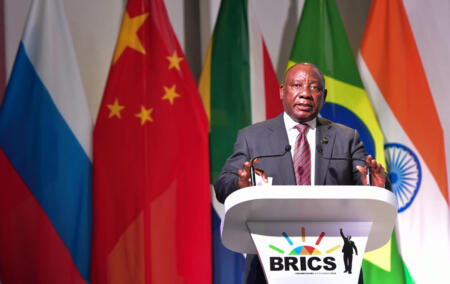
Being a member of BRICS has not triggered jobs growth in SA. Excessively warm relations with Russia, China, and Iran are not cost-free.
The ANC came to power amid an ideal backdrop. International politics supported peace dividends to fund redress of historical inequities while global integration fueled tremendous upliftment. That era is over while here in SA we are nearing two decades of stagnation that have left our consumers drained.
It is pleasing to imagine the benefits of sustaining high growth. We should more frequently contemplate the extent to which our economic and foreign policies must be reconceived.
[Image: https://www.flickr.com/photos/governmentza/42745158585]
The views of the writer are not necessarily the views of the Daily Friend or the IRR.
If you like what you have just read, support the Daily Friend