
The apartheid state’s assassination of ANC chief representatives abroad has been raised in recent testimony before the Khampepe Commission of inquiry into the sabotaging of prosecutions that should have followed the Truth and Reconciliation Commission (TRC) after 2003.
The gunning down of Dulcie September, plenipotentiary for France, Luxembourg, and Switzerland, outside the ANC’s office in Paris in 1988 is the most high-profile because it occurred in a Western capital, and so overshadows that of Joe Nzingo Gqabi, who held the brief for Zimbabwe, outside his home in Salisbury (now Harare) in 1981.
But while the murder of September followed a complicated chain of command, that of Gqabi offers – I argue, following years of research – the sole known instance where it was most likely Prime Minister PW Botha who gave the kill order in person to the assassin.
At the time of September’s assassination, the presence of a large yet secret office of state arms firm Armscor alongside the South African legation in Paris, and the involvement of the SDECE, the French secret service, in arms-embargo-busting by French companies including Thompson CSF (today Thint of 1990s arms scandal infamy) which September was investigating, made the case an international hot potato.
My reconstruction of her murder, assisted by former Vlakplaas commander Colonel Eugene de Kock, is that she was shot by two French mercenaries who were members of the Presidential Guard in the Comoros: former paratrooper Jean-Paul Guerrier (nom-de-guerre “Captain Siam”) and possibly fellow merc Richard Rouget; Guerrier has since disappeared, but Rouget, who lives in South Africa, has denied the charge.
The two gunmen were hired by the notorious Civil Co-operation Bureau (CCB), an ultra-secret project of SADF Special Forces (the “Recces”), with its killers disguised as civilians, operating behind a plethora of front companies.
The September operation, De Kock affirms, was run by CCB Deputy Director Dawie Fourie. This means Fourie would have reported to his boss, Colonel Joe Verster, who in turn would have reported to Recce chief Major-General Joep Joubert and on via the Chief of the SADF Lieutenant-General Jannie Geldenhuys to Defence Minister General Magnus Malan and thence PW Botha.
By 1988, the actual gathering of intelligence on September’s movements would have been done by the agents of the CCB’s Region 5 (Europe & International) under Lieutenant-Colonel Eeben Barlow, who would go on to found mercenary outfit Executive Outcomes in 1993.
Target profile
But the target profile of September would have been compiled by a special-sub-committee of the apex State Security Council (SSC) called the Counter-Revolutionary Information Task-team (Trewits by its Afrikaans acronym), by 1988 under Brigadier Bob Beukes. Though former SSC Secretary Johann Mostert denied this in a 2025 interview with me, Brigadier Jack Cronjé told the TRC that Trewits’s primary task was to identify targets for elimination.
Trewits was overseen by the Co-ordinating Intelligence Committee (KIK) under Brigadier “Tolletjie” Botha of Military Intelligence’s shadowy Directorate of Covert Collection (DCC); KIK divided operations into those conducted by the police (SA and Swaziland) and those by the military (the rest of the world including France).
If one follows Kevin O’Brien’s excellent 2011 study, The South African Intelligence Services, KIK in turn reported to the Joint Security Staff (Geveilstaf), the “operational executive co-ordinator of the security community”, and the command component of the SSC’s all-powerful National Joint Management Centre (NJMC) headed by Deputy Minister of Law and Order Roelf Meyer.
The actual September kill order would thus have originated within the murky chambers of the Geveilstaf where the fate of activists was determined by a coterie of generals headed by Geldenhuys, whose decisions on high-value assassinations must of necessity have been vetted by Malan and PW Botha.
Complex clandestine machinery
However, this complex clandestine machinery for targeting opponents of the state simply did not exist at the time of Gqabi’s assassination only seven years previously. On the blood-letting end back in 1981, what in March 1986 would become the CCB was still in embryo as an ultra-secret Recce entity called D40, which had been founded in April 1979, while on the target-designation end, Trewits would only become operational on 12 January 1987.
In my 2020 book, Death Flight, I reconstructed in detail, with participants’ real names for the first time, the evolution of D40 via an interim incarnation as Barnacle into the CCB; the early phases of the clandestine unit had been essentially totally unknown to the Truth Commission in the late 1990s.
By July 1981, D40 was still a tiny unit of only 33 men, reporting directly to the General Officer Commanding Special Forces, Major-General Fritz Loots. It was commanded by ex-Rhodesian Selous Scouts reconnaissance soldier Major Neil Kriel assisted by an adjutant, plus four officers overseeing primary operations (deep reconnaissance in Angola and Mozambique), urban operations (spying and raids in Zimbabwe, Botswana, and Zambia), intelligence, and logistics.
Operational intelligence came from ex-Rhodesian Special Branch cop Major Winston Hart’s eight-man Departure squad, reporting to the Special Tasks Team of the SADF’s Chief of Staff Intelligence (CSI). D40’s urban operations were run by a man called “Major Brian” by military historian Peter Stiff in his 2001 book Warfare by Other Means, and the man testified anonymously in the early 2000s trial of biochemwar chief Brigadier Wouter Basson as “Mr Z.”
Painstaking triangulation
But by painstaking triangulation of sources I have identified him as former Bulawayo Special Branch Detective Inspector Graham “Gray” Branfield, who had resigned in 1980 and gone on to qualify as a Recce operator with the acting rank of major.
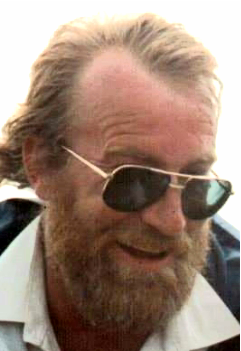
[Image: Personally directed by Prime Minister, later President, PW Botha, Major Graham “Gray” Branfield led two other assassins in gunning down top-ranking ANC leader Joe Gqabi in 1981.Michael Schmidt’s collection]
With an operational base on the farm Daisy, right next to the Security Branch’s Vlakplaas death-squad base, Major Branfield ran a clandestine network (that for ease of use I will call Daisy) of double-agents in Zimbabwe, Botswana, and Zambia, divided into small teams. So Branfield straddled two operational units, Daisy and D40, with Departure in a support role.
Under the aegis of the Recces’ Operation Mixer, Branfield was set to tracking Gqabi, and Daisy located him after two weeks. “Four teams were selected,” writes Preller Geldenhuys in his 2016 book Rhodesian Air Force Operations, “varying in numbers from one to three people, and included CSI… operatives as well as contacts within Zimbabwe, ex-Special Branch officials [ie: Branfield’s teams] who were in positions to conduct surveillance and monitoring observations.”
“Quarry”
Men including Branfield were flown in from a forward base at Musina in the then Northern Transvaal into Zimbabwe where a safe-house with an arms cache was run in the Salisbury suburb of Greendale, from where “the various teams were able to monitor and track the movements of their quarry. Joe Gqabi was seen with high profile ANC officials including MK chief Joe Modise.”
Stephen Ellis takes up the tale in his 2013 book External Mission: The ANC in Exile 1960-1990: “On 31 July 1981,” Branfield and two other “agents employed by South Africa murdered Gqabi with machine-gun fire as he was reversing his car out of the driveway of his suburban home at 19 Eves Crescent [in Harare] in preparation for an evening out. This was an early action by D40, the ex-Rhodesian unit…
“Gqabi’s killer was Graham ‘Gray’ Branfield, a former deputy inspector of police with Bulawayo’s Special Branch… Reconnaissance for the Gqabi murder was done by a local spy ring recruited on behalf of Pretoria by two ex-Rhodesians, one of whom worked for South Africa’s intelligence services, the other for special forces.”
I have identified the two as former Special Branch Major Alec West and Zimbabwean double agent Senior Superintendent Alan Trowsdale of the Central Intelligence Organisation (CIO), respectively; Trowsdale would later take over from Branfield on his retirement in early 1986.
According to journalist Jacques Pauw in his 1991 book, In the Heart of the Whore, this reconnaissance was conducted by the cell consisting primarily of Philip Hartlebury and Colin Evans, controlled by Departure’s Alec West and Daisy’s Alan Trowsdale. Hartlebury and Evans were arrested and charged with the murder but acquitted in 1982 because their confessions had been gained under duress – though they were only released five years later.
As with the September assassination, there were a lot of moving parts.
But back in 1981, the complexity appears to have solely been on the target-profiling and -acquisition side. In contrast, the issuing of kill orders was shockingly simple.
Gray Branfield (speaking incognito as “Major Brian”) informed Peter Stiff that during his command of Daisy, other than the bombing of the Inkomo Barracks in Zimbabwe, “not a single operation involving Project Barnacle went ahead without the personal authority of the Prime Minister, later State President, PW Botha. Brian was often flown to Cape Town in the presidential jet to brief PW Botha on pending operations before approval was granted.”
Sole occasion
If Branfield was given his kill orders in person by PW Botha, as he claimed was invariably the procedure, then this is the sole occasion on which we can infer a direct link from Botha to an assassin with no mediating layers of responsibility.
This assertion by Branfield – who was killed in action while working as a private military contractor for Hart Security at Al-Kut in Iraq on 6 April 2004 aged 55 – makes the assassination of Joe Gqabi a unique event in the known history of the shadowy apartheid necrosystem, finally proving that there really was blood on PW Botha’s hands.
[Image: by ARTFULLY79]
The views of the writer are not necessarily the views of the Daily Friend or the IRR.
If you like what you have just read, support the Daily Friend