

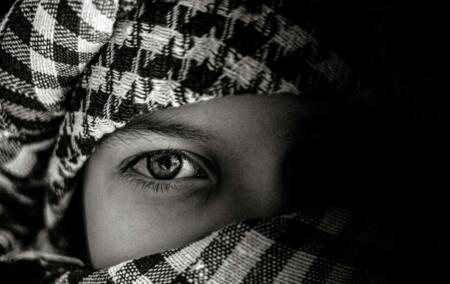
The keffiyeh is worn by many Western academics and feminists as a symbol of liberation. But its history and the societies from which it comes tell a very different story.
It has become the accessory of the activist-academic moment, seen on campuses and in civil-society circles alike. On campuses from Berkeley to Bristol to Johannesburg the keffiyeh – that chequered Middle-Eastern scarf long worn by farmers, soldiers, and activists alike – now hangs from the necks of graduate students, gender-studies lecturers, and protesters chanting about liberation.
It photographs well: rebellion without risk, underpinned by moral certainty. Yet it seems few of its wearers pause to ask where the symbol actually comes from, or what it means in the societies that produced it.
The keffiyeh comes from and still functions within a civilisational context that normalises male authority and female subordination. It has rarely represented a society where women enjoy equal civil, sexual, or human rights. That doesn’t mean every keffiyeh wearer endorses misogyny, but the movements most associated with it – from traditional nationalist parties to groups like Hamas – are rooted in male authority.
So when feminists wear the scarf as a gesture of liberation, they are (often unknowingly, one would hope) signalling identification with movements that continue to restrict women’s equality. This is not to suggest that all Arab or Muslim societies are the same. There are vast differences – Tunisia’s civil code, for instance, bears little resemblance to Saudi Arabia’s guardianship system, or to rural tribal customs.
Yet across these differences runs a recognisable pattern: male authority remains the social baseline, and women’s rights are conditional rather than assumed.
From the field to the faculty
The keffiyeh began as practical headgear for men working under the desert sun. In Bedouin and rural Arab communities, it protected against heat and sand, and its colour and fold could signal tribe, status, masculinity, and regional identity.
Women did not traditionally wear it, though modest-dress norms varied across time and place, tightening under Wahhabi influence in the early 20th century. These garments showed that a woman was respectable and under the care of her family’s men.
Modesty signalled both protection and control: men were expected to guard a woman’s honour, and she, in turn, upheld that honour through modest behaviour.
In those societies, gender order was not a matter of debate but of cosmology. The man provided and decided; the woman obeyed and reproduced. Honour killings, dowry disputes, and guardianship laws were not historical anomalies, though their intensity varied across eras. Many of these customs, long present in other patriarchal societies too, resurfaced in the Middle East during the 20th century after periods of Ottoman suppression.
A garment born in that world can’t easily be turned into a symbol of liberation just because a Left-leaning imagination wants it to be – though, of course, post-modernists would argue that meaning is infinitely malleable.
When the keffiyeh migrated from the village to the political rally during the 20th century, it carried that structure intact. During the Arab revolt of the 1930s and later under Yasser Arafat’s Palestine Liberation Organisation, the scarf became a uniform of nationalist defiance (and, arguably, a symbol of anti-Jewish hatred and erasure – a thought for another piece).
But the gender script stayed the same. Posters of the era show male fighters in keffiyehs; when women appear in those images, they too wear the keffiyeh, but only as mothers of martyrs or symbols of endurance – poetic abstractions of the homeland rather than agents of it.
The scarf’s politics were national, not feminist.
Symbols can change – the swastika once meant good fortune – and in Buddhist contexts across Asia, it still does – while the pink triangle was reclaimed as defiance. But some symbols resist reinvention when their meaning is continually reinforced by the same structures that created them.
The keffiyeh’s modern visibility comes less from reformers than from Islamist nationalist movements like Hamas, which grew out of the PLO and inherited its revolutionary street cred while doubling down on older hierarchies.
Patriarchy with slogans
Fast-forward to the present. Across much of the Arab and Muslim world – from Saudi Arabia and the UAE to Iran and other theocratic outposts of the so-called Axis of Resistance – the basic legal architecture of patriarchy still stands, not the metaphorical ‘patriarchy’ invoked in Western debates about boardrooms and pronouns, but one written into law and daily life. Inheritance rules grant daughters half the share of sons. In court, a woman’s testimony can carry half the weight of a man’s in matters of finance or contract.
In places such as Saudi Arabia and Iran, a woman still needs a male guardian’s consent to marry, travel, or work. In Gaza, under Hamas, similar constraints exist through social enforcement rather than law. In public life, modesty codes are policed formally or informally; deviation invites harassment or violence.
In other words, the social order that produced the keffiyeh continues to define itself through male guardianship and female restraint. Yet many academics, the same ones who would denounce a conservative Christian for questioning abortion rights or gender ideology, treat the keffiyeh as a symbol of liberation. The double standard would be comic if it weren’t so revealing.
This is not to demand that every protestor master comparative jurisprudence before accessorising. But for movements that define themselves by critical awareness, the blindness is impressive.
Many activists would insist they wear the keffiyeh to protest military occupation or specific state policies, not to endorse entire social systems. That intention is fair enough. The problem lies in the symbol’s broader freight: you can’t separate what it signals at home from what it evokes abroad.
To wear the keffiyeh requires ignoring the fact that in the societies it represents, women are often legally minors and socially invisible. It’s an act of symbolic tourism: you get to feel radical without leaving the comfort of your own equality.
The campus costume of conscience
The South African university, ever the leader in global fashion, has made its own fetish of the keffiyeh. It signals the right politics at the right distance – rebellion safely imported.
Statements of solidarity, often little more than throwaway lines at conferences, presuppose a complete and unexamined consensus on morally complex issues. They recycle the same slogans: decolonial struggle, intersectional resistance, solidarity with the oppressed.
There’s nothing wrong with these ideals in themselves, except that they’re misdirected. The scarf becomes shorthand for all these borrowed convictions. Its real origins – rural, patriarchal, theocratic, even extremist – vanish in the wash of virtue signalling.
At Columbia University earlier this year, students – many of them women – draped in keffiyehs staged sit-ins in solidarity with Palestinians. Here were young women exercising freedoms of speech, movement, and dress unavailable to their symbolic counterparts in much of the Middle East.
The irony barely registered. They railed against patriarchy while dressed in one of its uniforms. In South Africa, the imagery has found sympathetic eyes – less a homegrown conviction than an imported mood, absorbed through algorithmic feeds, mainstream headlines, and that familiar moral certainty.
This is not accidental confusion. It is the natural outcome of a politics built on the hierarchy of victimhood. Within the intersectional catechism, the ‘oppressed’ automatically occupy moral high ground, while their internal hierarchies are apparently irrelevant. A patriarchal culture framed as ‘anti-imperial’ or ‘anti-colonial’ acquires immunity from feminist critique.
The scarf becomes a moral shortcut – a way to look righteous without resolving the contradictions.
Selective feminism
The same academics who parse Western advertising for traces of ‘toxic masculinity’ seldom address the routine subordination of women in Arab or Muslim legal systems. Many do, though not all.
There are scholars and activists who challenge both Western and non-Western patriarchies, but they remain exceptions in a field that often spares its allies from scrutiny. The reason is simple: confronting patriarchal structures in non-Western societies would require admitting that not all oppression flows from the West, or from the Western tradition of secular law and individual equality – the rule-of-law culture that grew from those principles. That confession would shatter the neat moral map on which their politics depend.
So the keffiyeh offers a convenient shortcut. It allows the Western feminist to posture as anti-imperialist without risking a confrontation with non-Western patriarchy. It turns solidarity into a costume. The problem isn’t that these women sympathise with the suffering of others – empathy is fine – but that they borrow the symbols of systems that would curtail their own freedom while insisting they’re advancing it, not noticing that the political movements behind those symbols would gladly curtail their own freedoms.
This is not a demand that Western feminists condemn every injustice everywhere. It’s a question of coherence: if your politics depend on universal equality, you can’t suspend that principle when inequality happens to be culturally inconvenient.
Civilisational amnesia
The keffiyeh, like the society it comes from, emerged from a world that kept men visible and women hidden. It emerged from a world in which lineage and honour mattered more than individuality, and where religion reinforced rather than restrained male power. To treat such a symbol as gender-neutral rebellion is not cultural sensitivity; it’s civilisational amnesia.
Western feminists don’t need to apologise for their freedoms. They need to understand where those freedoms come from – from genuinely liberal institutions and secular law, not the supposed ‘liberalism’ now claimed by the radical Left as a slogan for identity politics.
In its original sense, liberalism meant the primacy of the individual, the rule of law, and the protection of conscience. Those are precisely the ideas under pressure, or absent altogether, in many of the societies that celebrate the keffiyeh. A scarf can’t cover that contradiction.
A mirror, not a movement
The fascination with the keffiyeh says less about Middle Eastern politics than about Western moral exhaustion. It reflects the need for borrowed struggle – a way to feel righteous when your own civilisation seems too comfortable to resist. But importing other people’s symbols also imports their histories.
If you wear a garment long used by nationalist and Islamist movements to project male authority and social hierarchy, you don’t get to redefine it via hashtag.
Real solidarity with women in Arab or Muslim societies would look different. It would involve supporting activists fighting for equal inheritance, ending guardianship laws, and opposing religious policing – the very things the keffiyeh-as-fashion conveniently ignores.
Those women exist, but they seldom appear on campus posters because they complicate the narrative. They ask for rights, not rhetoric.
Western academia seems to prefer the costume to the cause and the virtue signal to the practical action.
Draped in contradiction
The keffiyeh’s journey from a farmer’s headscarf to a Western moral badge traces a peculiar kind of hypocrisy. The scarf was born in a world built on male dominance; it still belongs to cultures where equality is conditional at best. Turning it into a feminist accessory doesn’t transform that reality – it only exposes virtue signalling, or, in a university context, an ignorance that ought to be unforgivable.
The irony is that the freedoms allowing Western feminists to appropriate the keffiyeh – freedom of expression, of conscience, of dress – are precisely the freedoms denied to many women in the societies it represents. If symbols mean anything, then this one tells a story its wearers have not bothered to read.
Liberation, like truth, is not contagious. You can’t drape yourself in another culture’s patriarchal relic and call it progress. You may only reveal how little you understand about the world you claim to be liberating.
[Image: Flaviu Costin on Unsplash]
The views of the writers are not necessarily the views of the Daily Friend or the IRR.
If you like what you have just read, support the Daily Friend