

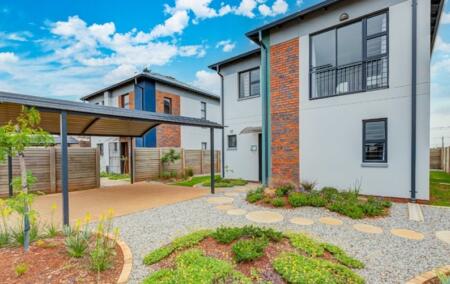
A two-bedroom house in Protea Glen, Soweto, now sells for R1.03 million. It sits behind a boom gate, inside a perimeter wall, with private security patrolling a neighbourhood of paved roads and managed common areas. Emperors Security Estate, developed by Cosmopolitan Projects, is the first full-title security estate in South Africa’s largest township.
For decades, the security estate has been shorthand for a particular kind of South African retreat: middle-class households in Johannesburg’s northern suburbs or Cape Town’s southern peninsula, where people withdraw behind private walls because they no longer trust the municipality to keep the public realm safe, clean, or functional.
That retreat is now visible in Soweto.
Township residents who can afford R9,000 a month in bond repayments are opting for the same model: private security, private infrastructure maintenance, and a managed environment insulated from the failures of the surrounding municipal fabric.
This development reflects a broader declining state capacity and defective service delivery. Households and developers are not waiting for these problems to be resolved. Instead, where possible and where they can, they are pricing in the assumption that municipal service delivery will remain unreliable, and are building around that assumption.
When a developer can sell 40-square-metre starter homes at a premium specifically because they come with private security and a managed common area, it’s a market signal that the baseline municipal offering, including things such as safety, road maintenance, and basic order, is no longer taken for granted anywhere on the income spectrum – not even in the communities historically most dependent on the state to provide it.
The encouraging trend runs as follows. Cosmopolitan Projects has built 45,000 units since 1992, the bulk of them affordable housing, and its expansion into Soweto reflects a maturing township property market.
Real innovation
South Africa’s informal housing sector now accounts for roughly 35% of the national rental market, a scale that has produced real innovation. GG Alcock has estimated the backyard rental economy at R30 billion annually, and platforms such as Indlu Living are following that by financing rental-ready homes and managing thousands of tenancies through structured lending. Dipula Properties, a JSE-listed REIT, is following capital into township retail on the same logic. None of this required a white paper or a state housing programme.
Developers and financiers recognise that township residents are creditworthy, aspirational, and underserved, and are building products accordingly.
Private capital is demonstrating real competence and appetite in a market the state has chronically under-served, and it is doing so partly because the state’s core function – the boring, unglamorous business of maintaining roads, billing accurately, and policing effectively – is eroding, even in the areas it was designed to serve first.
Full-title ownership in Protea Glen means new, formal, ratepaying households entering the municipal tax base. Whether that translates into revenue depends entirely on whether Johannesburg’s billing systems, already strained, can capture it.
If they can’t, formalisation simply produces another cohort of residents paying privately for what they are also, nominally, being billed for by a municipality that fails to deliver. Over time, this is a corrosive outcome for both household budgets and civic trust.
This trend of private developments is set to continue, because local municipalities across South Africa face serious challenges. Protea Glen won’t be the last township estate to sell out on the promise of private security and managed common areas.
The issue that matters in the long run is whether Johannesburg, and cities like it, can turn new full-title homeowners into paying, billed ratepayers before the gap between private investment and public revenue becomes permanent.
Biggest risk
The biggest risk is that formalisation without revenue-capture hollows out the municipal tax base right when Johannesburg can least afford it. New full-title homeowners in Protea Glen are supposed to widen the city’s rates base: the one organic path to fixing its finances without a bailout or a tax hike.
But if strained billing systems can’t capture that new housing stock, residents end up paying twice (and then some), including privately for security and estate upkeep, and nominally to a municipality that bills them but delivers nothing. That makes non-payment rational rather than delinquent.
[Image: An artist’s impression of a unit in the Emperors Security Estate offering. https://www.cosmo.co.za/emperors-security-estate]
If you like what you have just read, support the Daily Friend