


After the First World War and disastrous 1919 Paris peace accord, four young American would-be journalists rolled up on European shores.
Three were Midwesterners – Vincent Sheean from rural Illinois, John Gunther from Chicago, and William Shirer from Iowa. The fourth and oldest, Dorothy Thompson, was a Methodist minister’s daughter born in 1893 in Syracuse, NY. All were in their 20s when they began their reporting careers between 1921 and 1925, variously in Paris, London and Vienna.
They learned languages and sought to understand complex cultures and histories. Most would remain in Europe through two formative, impactful decades. The events they wrote about – communism in Russia, the failure of the League of Nations, malaise in Germany, Mussolini, the rise of Hitler and the Second World War – would shape global affairs for half a century.
Tomáš Masaryk, the statesman who founded Czechoslovakia, wrote that a successful journalist must be “well informed and capable… able to observe and understand… with the whole world as his canvas.”
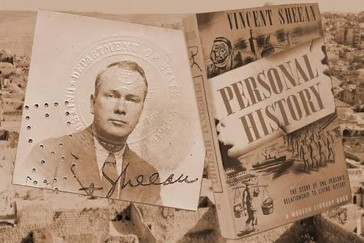
[Vincent Sheean, and his book, Personal History]
More than most, Vincent (Jimmy) Sheean embodied Masaryk’s principles. While retaining a base in Europe and working for news agencies, Sheean travelled in Russia, China and Iran and spent weeks with Arab insurgents in what was French Morocco.
He covered the early months of the Second World War from France, and in England worked with Ed Murrow, who had arrived in Europe in 1937. Marvin Kalb, in later years an acclaimed foreign correspondent, credits Sheean’s memoir Personal History for his becoming a journalist.
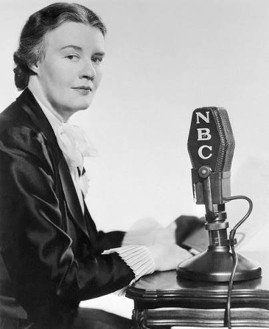
[Dorothy Thompson]
Dorothy Thompson, having moved from Vienna to Berlin in the mid-20s, made a name for herself by writing for the New York Post and Philadelphia Public Ledger. Her contentious interview with Adolf Hitler got her kicked out of Germany.
By the 1930s, and married to writer Sinclair Lewis, Thompson’s thrice-weekly columns and radio broadcasts warned that Germany was preparing for war.
Sheean, by then Thompson’s friend and later her biographer, called her one of the best foreign correspondents. Time magazine in 1939 hailed Thompson as America’s most influential and popular woman after Eleanor Roosevelt.
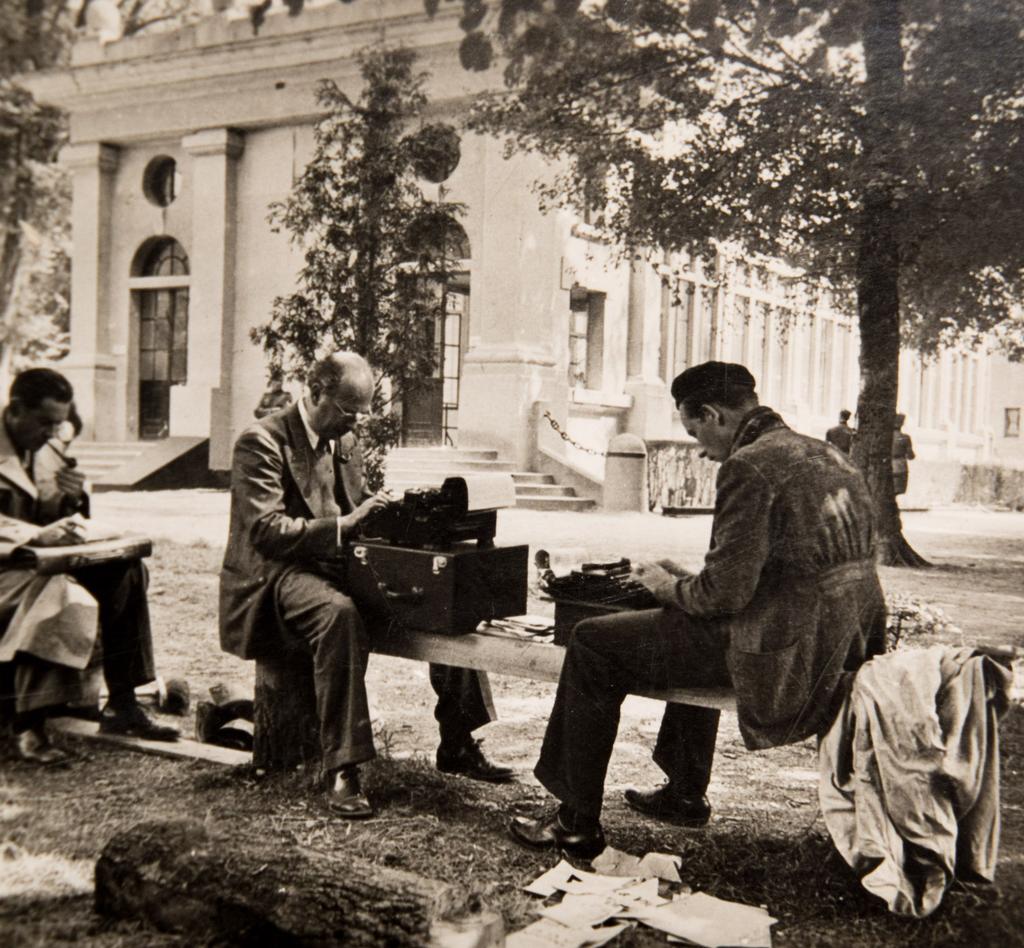
[Shirer (centre) in Compiègne, France, reporting on the signing of the armistice in June 1940]
Bill Shirer also was a long-time Berlin resident. He travelled with the German press to witness the French surrender, and was Murrow’s Berlin correspondent for the CBS World News Roundup.
Shirer ran afoul of the Nazis and departed Germany in December 1940. His post-war Rise and Fall of the Third Reich became the definitive account of Hitler’s Germany.
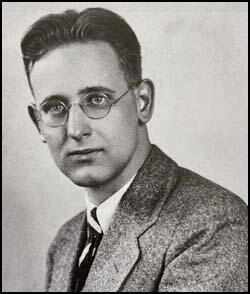
[John Gunther]
As a correspondent for the Chicago Daily News, John Gunther wandered through Europe and beyond, much as Sheean did. He too was alarmed at developments in Germany and felt the need to blow the whistle. In 1935 Gunther was commissioned to write an overall account of contemporary European governance and politics.
That became the blockbuster Inside Europe which introduced readers to what was happening in Europe. It focused heavily on the dictators – Hitler, Mussolini and Stalin.
Journalism historian John Maxwell Hamilton says Sheean, Thompson, Shirer and Gunther comprise a “golden age of foreign correspondence”. That genre, he tells me, has been declining for 50 years.
What about today?
Arguably, comprehensive reporting from all corners of the world is more essential now than ever. We live in dangerous times where great power alignments have been in flux since the Berlin Wall came down in 1989. The cloud of nuclear devastation hangs heavy. The rise of China and a cold war with China heighten uncertainty.
The digital revolution has profoundly disrupted the news media. Newspapers continue to die, eliminating a revenue source for foreign news bureaus.
Where today are the trusted correspondents with a global perspective like those profiled above? Who is reporting and interpreting honestly without political bias? Yes, there are a few, but not nearly enough.
There are so many developments that demand analysis. Examples: What does the rise of Chinese power mean for Japan and the Koreas? Will the United States be driven out of East Asia as the Chinese communists want? What is the future of a weakened Russia? Is radical Islam a growing force? Can the peaceful construction of a European Union be streamlined to avoid its being left behind in advanced technology?
There is no shortage of smart, educated young people roaming the planet. Let us hope that some will become comprehensive observers – modern-day foreign correspondents – who find audiences for what they’re learning.
The views of the writer are not necessarily the views of the Daily Friend or the IRR.
If you like what you have just read, support the Daily Friend