

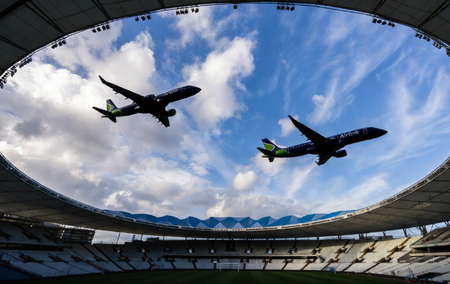
Last Saturday, two Airlink Embraers in Springbok and All Black colours flew over Cape Town’s DHL Stadium just before South Africa played New Zealand. The crowd roared, but pockets of the internet – as it now does with anything that looks like a “near-miss” – turned to hysteria.
Flight-tracking estimates put the lead aircraft something like twelve to fifteen metres above the stadium roof, quite a bit below its wingman. Some (though by no means all) aviation experts and pilots said this clearance left no margin for correction, though ironically in the same breath note how the lead had clearly corrected when the pilots noticed the differential.
Airlink says the flypast showcased “Planning, Precision, Performance”, flown by six senior captains, approved by the South African Civil Aviation Authority (SACAA), and was within the designated altitude and speed limits. SACAA is apparently still examining the data at the time of writing.
This coming Saturday, if weather and officialdom permit, a similar display is expected over the FNB Stadium in Johannesburg.
Is risk bad?
I am willing to concede that the manoeuvre was “risky”. The interesting question is why such a concession would be treated as the end of the argument.
We appear to have arrived at a peculiar civilisational conclusion in the West: risk is inherently bad, or at least that the only respectable risks left are those that live in a spreadsheet or intimate relationships.
Even some business risks are nowadays not merely frowned upon, but prohibited. Labour and environmental law, amidst a thickening web of other rules, have made the old figure of the maverick who bets the firm on a large, uncertain move, look almost folkloric.
Most of this is justified by concerns over spillover and externality: Other people must never be bound by the risks that one takes. And while the premise sounds humane, when it is applied without limit, it becomes a veto on almost everything that is vivid, experimental, or even festive.
Safetyism
This is not a broadside against safety concerns.
The modern airline safety record is one of the great quiet achievements of industrial civilisation. Every accident is mined for causes; those causes are designed out; the next aircraft is safer than the last; and the next crew knows more than their predecessors.
That discipline should clearly continue, as safety ought to be a priority – and a high one at that.
But it should not be the only priority, and it should not sit above every competing human good as a kind of secular sacrament.
Total safety is of course available to us. We can lock everyone in padded rooms, dressed in straitjackets and drip-fed. No more accidents, or even incidents.
But also, no more discoveries or room for the vesting of responsibility and consequence. This supposed “safety first” wisdom is the death of the human soul and the soul of human society.
We already practice this in our daily lives, and then we pretend we do not.
Every time a school puts fifty children on a bus in South Africa, it takes a calculated risk. Given the way this country drives, that day could end with all of them dead. We say – and should say – that each life is priceless. But we put them on the bus anyway, because we also understand that a society which treats the cosmic possibility of death or injury as verboten will deny children the ordinary goods of team sport, excursions, and a life shared with their peers.
Those goods have a cost. The tragedy, if it comes, is often unbearable (though we bear it). But the generalised cost of keeping the children exclusively homebound is just as real. Those who cannot hold both thoughts at once are not more moral than the rest of us, but just less honest.
Human progress
The transformation of safety from an important factor into a secular religion is visible all around us.
Take Chernobyl and Fukushima, which were genuine disasters with high costs.
The policy and social response that followed – to treat nuclear power as a moral contaminant rather than a phenomenon to be better engineered – has however helped to push one of the cleanest and, on the fatality record, safest large-scale sources of electricity to the margins of respectable opinion.
The alternative energy mix is implied to be a world without risk. But in fact it amounts to a world that burns more coal and gas, destroys more nature for renewables, and then congratulates itself for being “cautious”. The risk did not disappear by any means, but was simply better equipped in terms of public relations.
By making an idol of safety, preferred over risk as such, we close the laboratory of human progress and potentially doom ourselves to stagnation if not regression.
The experiments and discoveries that would benefit the species are, almost by definition, things that will go wrong before they go right. Here one immediately thinks of alternative intelligence technologies now being explored.
A civilisation that treats that possibility as per se disqualifying will keep its existing machines well-maintained, and invent very little new.
Messy freedom
The Airlink flypast was not a scientific experiment, but a spectacle: manifest competence during a popular occasion that was given the familiar, powerful roar of jet engines long associated with South African rugby.
The morale boost of that moment – the feeling that South Africa can still do a difficult, inspiring thing with style – is not to be treated as a mere afterthought that can be dismissed when inevitably confronted with safety concerns.
Rugby flypasts are one the few public goods South Africa can still produce without a tender controversy or racial grievance politics. We should place a premium on this tradition.
Set against the residual chance that “something could go wrong” in a manoeuvre for which the crews left “little room to recover”, I do not think the trade is obviously indecent.
People who think it is, should say what quantity of patriotic joy they would accept in exchange for a slightly thicker cushion of altitude. They usually will not, because the safetyist religion does not do quantities; it traffics only in what is allowed and what is forbidden.
My advice to those who want guaranteed safety, all the time, under all circumstances, is simple: secure the locks, close the blinds, and stay indoors. That is a legitimate preference.
But it can never be a template for a free society.
To take part in society is to enter into other people’s risk calculations, and to accept that you might feature as only one datapoint in it. You should always do this with your eyes open, of course, and anyone that misrepresents the reality should be held liable.
But the bus-based excursion, the stadium with tens of thousands, the power station serving millions, or the firm that tries something untested – none of this is possible if there is a rule that no stranger may ever externalise a potential cost onto you. Freedom is messy.
We should be more honest about that.
Calculated risk-taking, and not only the kind that merely fits on a ledger, should be allowed and sometimes encouraged. Safety naturally must remain a top priority, but not the religious principle we have elevated it to. A society that cannot tell the difference will keep people alive in smaller and smaller, blander and blander rooms, and call that compassion.
[Image: Martin van Staden | Grok.com]
The views of the writer are not necessarily the views of the Daily Friend or the IRR.
If you like what you have just read, support the Daily Friend