

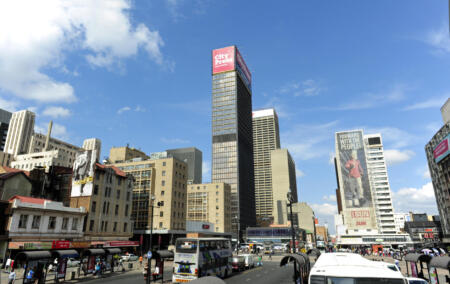
There is a danger that this will be treated as little more than another anniversary to be marked by a municipal programme, a commemorative logo and a series of speeches. That would be a profound waste of the occasion.
A city as young, as rich in history and as consequential as Johannesburg should use its 150th birthday to ask a much more difficult question:
What sort of city does it intend to be for the next 150 years?
My answer begins with something Johannesburg has rather conspicuously neglected:
Its art.
The city should establish a new home for the collection of the Johannesburg Art Gallery, develop a major cultural precinct around it, permanently endow the institution, and make Johannesburg the undisputed centre of gravity for African art.
This is not an argument for abandoning the Johannesburg Art Gallery’s historic building. Quite the contrary. The Lutyens building and the collection it contains are among the physical and cultural inheritances that Johannesburg should be proudest of. They deserve proper restoration and preservation.
But the collection has outgrown the ambition with which the city first acquired it. That is the point.
Johannesburg’s relationship with art is older, grander and more interesting than the contemporary city often remembers.
The original JAG collection was assembled around 1910 through the efforts of Florence, Lady Phillips, with the support of her husband, the mining magnate Sir Lionel Phillips, and the art dealer Sir Hugh Lane. The gallery’s Lutyens-designed building opened in 1915.
Think about what that means. Johannesburg was barely three decades old.
The city had been born in 1886 from the discovery of gold on the Witwatersrand. It was a rough, frenetic mining settlement attracting people from across the world. Yet within a generation its wealthier citizens were already thinking about how to turn the extraordinary wealth being extracted from the ground into something permanent.
They did not merely build mines.
They built banks, libraries, schools, theatres, museums and galleries. They collected art. They commissioned architecture. They wanted Johannesburg to become a city in the fullest sense of the word.
The Johannesburg Art Gallery was part of that transformation.
Its collection eventually came to encompass an extraordinary range of European, South African and African work, including artists such as Monet, Degas, Picasso, Pissarro and Rodin alongside Irma Stern, Gerard Sekoto, Alexis Preller, Walter Battiss, Maud Sumner, Sydney Kumalo, Ezrom Legae and Pierneef.
This is not an incidental municipal collection. It is a record of a city becoming a metropolis. That is precisely why Johannesburg should be thinking much bigger about it now.
The obvious response to the JAG’s difficulties is to renovate the existing building. That is necessary, but it is not sufficient. Johannesburg should use its 150th anniversary to create a new Johannesburg Art Gallery precinct in the inner city, while preserving the historic gallery as part of the city’s heritage.
Newtown is the obvious place to think about this.
It already possesses one of Johannesburg’s most remarkable concentrations of cultural institutions: Museum Africa, the Market Theatre, Mary Fitzgerald Square, the Workers’ Museum and a collection of creative and industrial spaces. It also sits alongside the railway infrastructure and urban land around Park Station.
The opportunity is therefore much larger than constructing another museum, It is to build a cultural quarter.
Imagine a major new museum surrounded by galleries, artist studios, restaurants, design stores, performance spaces, public art, hotels, residences and creative businesses. Imagine Mary Fitzgerald Square functioning as a genuine civic space rather than merely an occasional events venue. Imagine the old industrial and railway landscape being turned into part of the city’s cultural geography.
And, crucially, imagine being able to arrive there by Gautrain, Metrorail, taxi, bus or car. That matters.
It matters that schoolchildren from Alex, Tembisa and Soweto can access it as much as wealthy families in Sandton and Waterfall and corporate titans living in Westcliff and Saxonwold.
Johannesburg cannot become a great cultural capital by placing its major cultural institutions in isolated enclaves accessible primarily to affluent suburban visitors. A genuinely metropolitan cultural institution must belong to the whole city.
The architecture should be unapologetically Johannesburg, the building itself should reflect the character of the city.
Johannesburg has never been a restrained place. It is a city of gold, speculation, migration, mining, skyscrapers, industrial machinery, suburban mansions and extraordinary bursts of architectural ambition. There is no reason for its great 21st-century museum to be timid.
It should be monumental without being pompous; contemporary without being placeless; and unmistakably of Johannesburg.
Gold and bronze, stone, steel and concrete could reference the geology and industrial history that created the city. Highveld light should be used as an architectural material. The galleries should be generous. The public spaces should be dramatic. There should be restaurants and cafés, lecture halls, children’s spaces and places to sit and simply inhabit the building.
Most importantly, it should feel like a building that could only have been built in Johannesburg. There should also be no temptation to solve the question of African art by pretending Johannesburg’s European collection does not exist. It does. It is part of the institution’s history and should remain so.
Johannesburg should be confident enough to display its Monet, Degas, Picasso, Pissarro and Rodin while simultaneously asserting that the future of the institution lies in becoming one of the world’s foremost centres for African art.
That requires serious collecting, conservation and scholarship. It requires fellowships for African curators and partnerships with institutions from Lagos and Accra to Nairobi, Dakar, Cairo and Kinshasa. It requires bringing African artists, academics, collectors and galleries into a permanent intellectual and commercial ecosystem in Johannesburg. Above all, it requires reviving the Johannesburg Biennale.
The city has done this before. The biennales of the 1990s demonstrated that Johannesburg could participate in the international contemporary-art conversation on its own terms. There is no reason it cannot do so again.
A revived Johannesburg Biennale, attached to a properly endowed major African art institution, could become one of the defining cultural events of the continent. Johannesburg should aspire to become the place where Africa’s artistic conversation converges.
Johannesburg’s wealth should pay for Johannesburg’s future
There is, however, one thing that must be avoided: building an impressive museum and then leaving it dependent on annual municipal budgets.
A museum is not just a building; a museum is an institution.
The capital programme should therefore involve the City, Gauteng and national government, but it should also mobilise Johannesburg’s present wealth: mining companies, financial institutions, corporations, foundations, wealthy families and philanthropists.
The great private fortunes of early Johannesburg helped create enduring civic institutions. The question for today’s Johannesburg is whether its present wealth will leave anything comparable behind.
A substantial permanent endowment should be established alongside the construction programme.
The endowment—not the goodwill of whichever politician happens to control the municipality—should provide the institutional foundation for curators, conservation, acquisitions, exhibitions, education, research, technology and maintenance. That would turn the project from another capital works programme into a genuinely permanent Johannesburg institution.
This vision however cannot pretend that Johannesburg’s greatest problem is merely a lack of imagination. People will not use a beautiful cultural district if they are afraid to walk through it.
Safety must therefore be designed into the precinct from its inception: intelligent lighting, extensive “Vumacam” style CCTV, monitored pedestrian routes, controlled service access, private security, rapid response and a dedicated operations centre covering the surrounding streets.
The objective should not be to create a fortress; it should be to create one of the safest and most intensively managed public cultural districts in the country.
Johannesburg also possesses an extraordinary technological and institutional asset in Wits University. The expertise already being developed in artificial intelligence, robotics, autonomous systems by Dr Benji Rosman should be brought into the project to bolster the security architecture.
There is something particularly appropriate about this. A city whose wealth was once extracted from the ground should use its present wealth and intellectual capital to build institutions for the future.
That is what civic ambition looks like. Johannesburg’s first art gallery was an expression of confidence.
It was the product of people who believed that a chaotic young mining town could become a great city, and that great cities required more than wealth. They required beauty, memory, knowledge and institutions.
One hundred and fifty years after the discovery of gold, Johannesburg should recover that confidence.
Restore the old gallery. Preserve its European collection. Build the new museum. Put African art at the centre. Revive the Biennale. Build the precinct around Newtown and Park Station. Connect it to the city’s public transport network. Make it safe. Endow it properly.
And then give it enough ambition that when Johannesburg celebrates its 200th birthday in 2086, people can look back and say that the city used its 150th birthday to decide what it wanted to become.
Johannesburg does not need another monument to decline. It needs a monument to confidence.
Its upcoming 150th birthday should be the catalyst that makes it decide to build one.
[Image: https://www.flickr.com/photos/south-african-tourism/8722268247]
The views of the writer are not necessarily the views of the Daily Friend or the IRR.
If you like what you have just read, support the Daily Friend