

Although largely absent from public conversation, the proposals contained in a recent white paper on local government could herald the most far-reaching set of changes in South African governance since the 1990s. Published in May, it is largely a response to the dysfunctional realities confronting the country’s local sphere.
It makes the point that the crises confronting local governance are not limited to failings in individual municipalities, as important (and prevalent) as these are. The problems are rather systemic and structural in nature, with failures in governance, management, finance, service provision and relationships between the various spheres being interconnected and resulting in what the paper terms “reinforcing cycles of decline”.
And so: “The policy intent of this White Paper is therefore to renew the local government system, not only to ‘fix municipalities’.”
The white paper argues accurately that the current system has produced municipalities with significant disparities in resources, capacities and potential – in other words, the current one-size-fits-all approach was never feasible. This argument has been doing the rounds for years. In particular, it suggests that the two-tier arrangement for non-metropolitan municipalities has failed to perform the coordination function that was expected of it and has been duplicating and confusing functions between local and district councils.
The solution proposed is to dispense with this in favour of a single-tier dispensation. While the details are not fully spelled out, the direction of policy can be inferred from the stress laid on coordination across extended areas. The implication is that some existing local municipalities could disappear.
This would be consistent with a long-term pattern of consolidation and centralisation that has been at work since the 1990s. In the 1990s, prior to the initiation of the current system, South Africa had 843 municipalities, technically interim structures. These were compacted into 284 for the 2000 elections, and over time to the 257 that exist today.
Recent suggestions from within the ANC that Gauteng’s three metros should be amalgamated into a single entity suggest that the White Paper is not alone in demanding another round of centralisation.
This risks compounding rather than ameliorating the problems, since such an arrangement would likely entail aggregating functional and dysfunctional jurisdictions, stretching an already limited resource base. The probable outcome would be that dysfunction rather than competence is redistributed. This is aside from the increased distance from local communities and the weaker sense of representation that such larger units would create.
But the reality is that many jurisdictions lack the rates base, the skills profile or (at least for now) the economic potential to sustain local government as its design envisaged. Some may never be viable, requiring ongoing support for little return. Perhaps unwittingly, Minister Hlabisa alluded to precisely this when discussing the criticism that municipalities were receiving, telling his audience: “If you do not take into account all these factors, you will blame municipalities, saying they’re not performing – how are they going to perform? If there is no revenue base … and the assumption that they will collect 90% is not working – how are they going to perform?”
The answer cannot be another one-size-fits-all system. If municipalities differ so greatly in their economic foundations and administrative capacities, their institutional form should reflect those differences.
A revised system should be founded on recognition that municipalities operate with various levels of competence and with various degrees of viability. The broad contours would be to retain what is working; to recognise that cities, as the locomotives of the country’s economy, need to function under their own authority; to retain local municipalities that are operating passably; and to reconsider the status of those that are structurally non-viable.
The starting point would be for a joint assessment of the current municipal demarcation, by Treasury, COGTA and the Municipal Demarcation Board. This would involve examining the economic viability of local and district municipalities, with a mandate to propose a new system that will reflect the differentiation of capacities and realistic future roles of each. The process would seek input from stakeholders, including, particularly, from those in distressed municipalities as to options for their individual futures.
Cities, both metropolitan municipalities and the wider circle of “intermediate cities”, are generally viable, or at least potentially viable under their own resources, and must be retained. Their governance reach should remain largely confined to the urban centres, and perhaps elements of the rural hinterlands that are tightly functionally linked to them. In some instances, such as Ekurhuleni, which was formed from an amalgam of separate pre-existing centres, it might make sense to break up the existing municipality into smaller functional parts, allowing each to run simplified operations under closer democratic scrutiny. In others, such as Johannesburg, the management and oversight of particular functions could be devolved to local areas, using the “subcouncil” model. Johannesburg once had such a system, but it was abandoned in pursuit of a “megacity”.
Cities in this conception would be required to achieve a basic standard of governance, to fund most of their spending from the revenues they are entitled to collect and to become viable entities. Where ongoing misgovernance occurs, they need to be placed under administration – although this too has a patchy record of success. Where corruption or criminality has gained a foothold, it needs to be ruthlessly investigated and prosecuted. There will be instances where the path to viability will begin with proper law enforcement.
Viable local councils must be retained. These would be those centred around towns smaller than cities, whose overall financial health is recognised by the Auditor General and Treasury as good, and which have demonstrated the rudiments of governance competence through clean or unqualified audits. Indeed, these could be rewarded with larger grants and support for development initiatives, which they would have demonstrated a capacity to use productively. Others with poor governance but sound economic fundamentals might also have the potential to become viable. Possible indicators include funded-budget status, cash coverage, collection performance, creditor days, service reliability, infrastructure condition, critical technical vacancies, economic/revenue base and transfer dependence.
District councils, provided they are not inherently unviable, can potentially serve a coordinating and redistributive role, provided they and the local municipalities they cover are functional. They are not, however, suited to city and town-level management. While the District Development Model is flawed, where existing district councils are fulfilling a useful role, and where the local governments within them are operating competently, they may be retained, subject to the agreement of those municipalities, and the approval of Treasury and COGTA.
Nonviable municipalities – those without the economic and rates base to make a rational case for their existence – could be dealt with in a number of ways. Some might simply be abolished. Basic functions such as water, electricity supply and road maintenance could then be passed to bulk providers, such as Eskom or water boards, or in some instances to private contractors.
There might also be a case for retaining core district administrations. This could result in contiguous local councils being abolished and some functions subsumed into geographically larger units with reduced responsibilities, resembling the Regional Services Boards of the pre-1994 dispensation.
The outstanding question is what would become of local democracy in those municipalities that are abolished. Effectively, communities that had been living under elected governments (however imperfect) would now find themselves under what approaches a long-term form of administrative government. This requires careful consideration, as it would strip millions of South Africans of a key expression of citizenship.
One possibility is that local assemblies might still be elected for these reconstituted administrative areas, though with reduced powers. They would have a deliberative role in the affairs of the area and would be able to make representations to service provision agencies, provincial administrations, and traditional authorities that retain considerable influence on functions such as land administration. Their role would be predominantly advisory, articulating local concerns and advocating for particular developmental projects. They would be modestly funded and, crucially, lack the power of the purse.
The prospect of re-establishing a full municipality could be on offer in the event that certain conditions, such as sufficient taxable economic activity, could be shown to exist. This might allow civic and business organisations to demonstrate that they could fund and manage local government themselves. In other words, municipal status would be something to be earned.
In essence, this would produce a system that is variegated, with a variety of forms, geared towards making the country’s urban nodes perform their functions effectively and shaping systems appropriate to the capacities of its other localities. The principle is simple: form should follow function.
It would probably require a constitutional change. This is not to be undertaken lightly. But the scale of the problem and the costs it is imposing on South Africa demand that extraordinary options be open to consideration.
This column was produced with the generous support of the Konrad Adenauer Stiftung, It draws on the IRR’s forthcoming paper, Local government: Crises decades in the making and how to deal with them, which will be launched on Thursday.
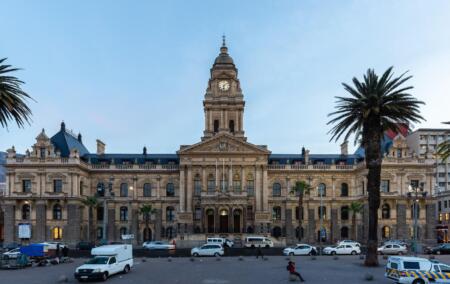
[Image: Cape Town City hall ]

If you like what you have just read, support the Daily Friend