

Just as “war is politics by other means,” racial politics can offer paths to power via coercive means.
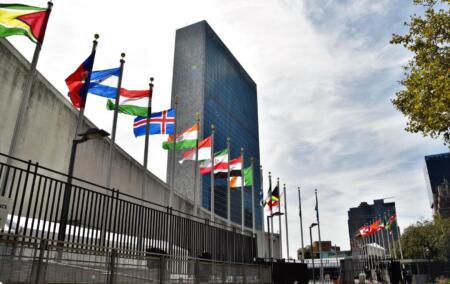
“Durban V” refers to a conference later this month in New York City commemorating the Anti-racism conference held in Durban in 2001. The original gathering was preceded by an agenda-setting gathering in Tehran that adopted an unequivocal antisemitic posture. This led to Israel and the US walking out of the Durban convention and the US’s first black Secretary of State, Colin Powell, publicly disavowing the conference.
Further reactions to proclamations approved by the conclave in Durban were delayed as, within a week, terrorists destroyed the twin World Trade Center buildings in NYC. Instead, this month’s UN General Assembly high-level forum will be the fifth rendition of this anti-racism conference – and the list of nations boycotting or limiting their involvement has grown.
Durban V is perceived by many as being an anti-Western initiative promoted mostly by China and SA. Anti-racism energy was not inadvertently reshaped into hatred toward Israel. China, Russia and Iran seek to undermine Western influence, values and rights in favour of authoritarianism and, in the case of Iran’s Islamic Revolutionary Guard Corps, Islamic values. Yet SA’s interests and values are not anti-Western.
Durban V’s biases echo a distinct leftward shift in recent decades among many key institutions. Many top universities, NGOs and media outlets share negative views about Israel and various Western values; as do many countries across the Global South. The net value of Russia and Iran to SA is negative and unaffordable. Conversely, value-added exporting to Western markets is by far our most plausible path for creating many millions of jobs. China will continue to buy primary materials and sell us finished goods.
Prosperity
Since the 1990s political transition, our core mission should have been achieving broad prosperity. SA’s poor and unemployed have been the biggest losers from policies displacing merit with race-based regulations. Cosying up to the most blatantly anti-Western leaders is similarly destructive.
While SA’s poor are predominantly rural, our upliftment paths are both grossly inadequate and overwhelmingly urban. Envisaging broad prosperity begins with imagining sharp policy pivots in Parliament leading to tremendous rural-urban migration. And while adequate job creation is essential for achieving broad prosperity, this can’t happen at a noticeable pace without our economy becoming much more integrated into global supply chains.
ANC elites were feted as the world’s social justice champions throughout the 1990s and, for the five years ending in 2008, SA’s GDP grew at nearly a 5% annual clip. Yet perceptions can be misleading. The strong growth was spurred by a surge in commodity demand following China’s massive infrastructure build-out after joining the WTO. At no point have we been on a path that could deliver broad prosperity.
This era’s high-volume upliftment path was developed by Japan in the 1950s and eventually spread across Asia. It emphasises productivity gains supporting exports to affluent consumer markets. The ANC’s economic and international relations policies are incompatible with such high-volume upliftment.
Thabo Mbeki and his team pursued an African renaissance vision which generally presumed governance upgrades would sustain high growth across the region. However, the rise of Asia, perhaps humanity’s greatest accomplishment, was not premised on Asians selling to Asians. Rather, the common denominator among Asia’s high-growth countries is that they add value to exports destined for affluent Western markets.
Unfortunately, this growth path requires a devotion to efficiency and competitiveness which isn’t compatible with the ANC’s patronage politics or its redistribution-focused economic policies. Consequently, our economic growth is restrained by the inadequate employment capacity of our domestic spending.
High-growth economies don’t target African consumers as this continent’s share of the world’s discretionary spending is so modest. Neither our extreme youth unemployment nor our rampant and deeply entrenched poverty can be overcome without purging the anti-Western foreign policies the ANC indulges.
While the corruption and incompetence of Jacob Zuma’s years in power have been somewhat mitigated, strong growth and rapid job creation remain elusive. Instead, the ANC’s global image as social justice champions helps to reinforce a culture of entitlement. Their aged leaders would rather chew on the carcass of SA’s economy than make the sweeping adjustments that are required.
Distractions
Abundant governance shortcomings distract attention from how SA’s international relations don’t serve the interests of this country’s poor and unemployed. On the international stage, the party’s reputation was faltering due to the socio-economic consequences of its policies and practices. Then the Black Lives Matter movement reinvigorated the ANC’s anti-racism credentials and this further distracted attention from the party’s underperformance.
George Floyd should not have died the way he did; nor should he have lived the way he did. Neither celebrating George Floyd’s misspent life nor advocating to defund the police were helpful. Nor can the immediate condemnation of Israel after Hamas’s 7 October massacre be justified.
Public opinion is vulnerable to “Israel” and “genocide” being paired to create jingles that resonate politically. Donald Trump’s weave about a white-farmer genocide in SA is mockery of such jingles. Durban V is poised to reenergise the political exploitation of racial sloganeering.
High-profile international gatherings are opportunities to advance SA’s interests. Our relations with key trading partners would benefit if we were seen as seeking to defuse racial tensions. Durban V is shaping up as another missed opportunity.
[Image: UN Headquarters, New York]
The views of the writer are not necessarily the views of the Daily Friend or the IRR.
If you like what you have just read, support the Daily Friend