

Some economists accuse business of an “investment strike”. Investors don’t strike. They respond to conditions that only government can fix.
A year ago, the Stellenbosch economic historian Johan Fourie sat in a meeting room at the Department of Trade, Industry and Competition (DTIC). Around the table sat the minister, Parks Tau, along with officials, academics and consultants. Each consulting team pitched the industries it thought the state should back, each according to its own criteria.
Fourie argued that the best industrial policy would fix the electricity, ports, rail and rules on which every firm depended. This was, he reports, unpopular. At the end of the session, participants were asked to choose two sectors to “support”. He has forgotten which two won.
Nobody in the room mentioned data centres. This, in a year when five American technology firms are projected to spend $775 billion on capital investment, much of it on data centres. That is 1.8 times South Africa’s entire 2025 GDP.
Fourie tells this story in a fascinating essay on his Substack, Our Long Walk, in which he asks where in South Africa data centres ought to be built.
Servers in the Karoo
He scored 187 towns on eleven criteria that developers actually use: proximity to the high-voltage grid, clean power, sunshine, fibre and internet exchanges, water, land prices, neighbours who might object, municipal audit outcomes, and summer heat.
Walkerville, south of Johannesburg, came first. Johannesburg itself came tenth. Cape Town, with its expensive land and scarce water, came 42nd. Adjust the criteria for an AI training campus, and Colesberg, near the Gariep Dam, leaps from 26th to third.
It is an insightful analysis, and its conclusions are damning for the officials he met.
While they were choosing their two favourite sectors, a global investment boom was hunting for sun, cheap land and clean power, which parts of South Africa have in abundance.
But the beating heart of the essay is not data centres. It is the idea of horizontal industrial policy and the principle of economic freedom upon which it depends.
Ten thousand consultants
Fourie created a clever illustration. Since every consultant would weight the criteria differently, he let 10,000 imaginary consultants loose on his data, each with randomly drawn weights. They produced 8,785 different top-ten lists, and 140 of the 187 towns made at least one of them.
If you want a picture of what economists call the knowledge problem, this is it. Fourie cites the German trade economist Andreas Freytag, who argues that governments attempting industrial policy end up “mostly picking losers”.
If anything, the simulation understates the problem. Fourie’s fake consultants draw their weights at random. Real investors don’t. Each brings to the decision what Friedrich Hayek, in his 1945 essay The Use of Knowledge in Society, called “the knowledge of the particular circumstances of time and place”.
A real developer knows what cooling technology they will use, how much delay their customers will tolerate, what a grid connection will cost them, and how long their money can wait for a return.
Much of this knowledge is never written down. It exists in the heads of the people who act on it, and it changes as they learn. No ministry can collect it. It cannot be compiled into a spreadsheet and posted to planners at the DTIC in Pretoria.
Ludwig von Mises pushed the point further. Even a planner who somehow knew the right weights would have no way to tell whether the result of their intervention in the economy was worth its cost.
In Economic Calculation in the Socialist Commonwealth, he wrote: “Where there is no free market, there is no pricing mechanism; without a pricing mechanism, there is no economic calculation.”
Fourie’s own prescription is pure Mises: charge data centres the full cost of the power and water they use, he says, and let investors decide which sites make sense for them. A subsidy or a tax break merely hides the signal that ought to decide where it goes.
Picking losers
To be fair, a newer literature argues that targeted industrial policy can work. Fourie cites Réka Juhász, Nathan Lane and Dani Rodrik, and Lane’s finding that South Korea’s support for heavy industry in the 1970s left durable capabilities behind. He grants the point, but notes that Korean support was temporary and disciplined by export performance.
The DTIC’s Master Plans are neither. They shelter domestic producers from foreign competition, indefinitely.
As I have written before, the industries blessed with Master Plans – motor vehicles, steel, sugar, clothing, poultry, furniture – have mostly seen exports shrink and domestic prices rise. Steel industry bodies agreed last year that the Steel Master Plan has failed (as I had said). The International Trade Administration Commission’s response was to propose raising steel duties to the maximum permitted under World Trade Organisation rules.
When all else fails, double down, seems to be the lesson these socialist planners learn from their endless failures.
The government does this in the belief that rescuing struggling industries benefits the country as a whole. The truth is the exact opposite.
Master Plans don’t merely waste subsidies. Through tax breaks, tariffs and handouts, they keep capital, workers and managerial talent locked up in businesses that cannot survive on their own. That prevents their redeployment to more productive and more profitable ventures. The government doesn’t only pick losers. It keeps them on life support, at the expense of winners that never even got off the ground because investors were all chasing subsidies, tax breaks and import tariffs.
There is no strike
This brings me to a fashionable complaint: that South African business is on an investment strike.
The economist Daniel Meyer put it bluntly in a Daily Maverick headline: “We have an investment strike!”
He is right that capital investment in South Africa is far too low to sustain a growth economy.
Fixed investment has fallen below 15% of GDP, less than half the National Development Plan’s target, and his list of causes – load-shedding, policy uncertainty, debt, corruption – is hard to fault.
But his own data betrays his headline. Public investment fell from 6.3% of GDP in 2010 to 3.9% in 2025, while private investment fell far less. He concedes that the shift reflects the “relative collapse of public sector investment”.
Stuart Theobald, writing in Business Day, was right: there is no “investment strike”. Corporate cash holdings have grown roughly in line with balance sheets. Dividend payout ratios are close to their two-decade average. Private investment has doubled since 2008, while investment by state-owned enterprises grew by less than half. He called the strike narrative “politically convenient but empirically wrong”.
It is worse than wrong. It is absurd.
A strike is collective action in pursuit of demands. Investors as a class are not activists. They do not stand on principle, make demands or seek concessions. They are neutral. (The few individual investors who aren’t are exceptions that prove the rule.) All they do is look for opportunities where, in their subjective judgement, the expected rewards justify the risks.
Capital is not homogeneous
The objectives of investors differ enormously. Firms have different risk appetites, different skills, different time preferences and different profit targets. A pension fund, a family farm and a hyperscaler building server farms will respond to the same tax break in entirely different ways, or not at all.
Planners talk of “investment” as if it were a single fluid, to be pumped into whichever sector the minister favours, or whichever sector promises to create the most jobs. But as Mises wrote in Human Action, “All capital goods have a more or less specific character.”
I have an old shirt with the slogan “Capital is Heterogeneous” on the front, and a diagram of the different time-preferences of investors as they respond to central bank interest-rate decisions. This lies at the root of the booms and busts central bankers believe are to be blamed on “the market”, instead of on their own interventions that treat capital as if it were homogeneous.
Outside libertarian events, I have rarely met anyone who understood that shirt, but I like it.
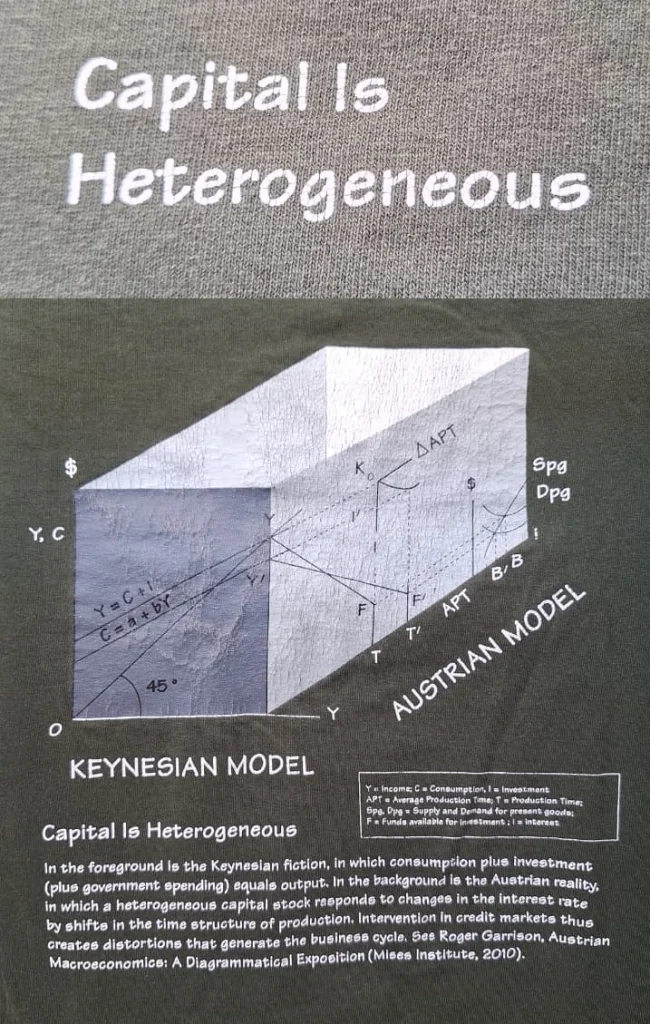
In Capital and its Structure, Ludwig Lachman elaborated a theory of capital that recognises capital stock to be subject to the micro-economic decisions of many individuals, as opposed to a single lump that responds to macro-economic controls.
He argues that the heterogeneity of capital means that “even in the most fiercely competitive market, each firm bears the mark of the individuality of its leading minds”.
Investment consists of millions of specific decisions about specific assets, made under different circumstances, by individual people with their own knowledge and their own (or their shareholder’s) money at stake. Anticipating how they will respond to a central planner’s interventions is a fool’s errand.
What every investor wants
There is only one thing a government can know for certain: every investor responds to risk.
They all respond to the reliability (or otherwise) of electricity and water. They all respond to a favourable tax regime. They all respond to ports and railways that work. They all respond to transparent, honest government. They all respond to lower crime rates. They all respond to secure property rights.
That is what Fourie means by horizontal industrial policy. His list of obstacles facing data-centre builders reads the same way: slow grid connections, slow permission to wheel private power, slow water licences and zoning approvals, unreliable municipal services, and visas that specialist technicians struggle to get.
None of these is specific to data centres. They burden the citrus exporter as much as the server-farm builder.
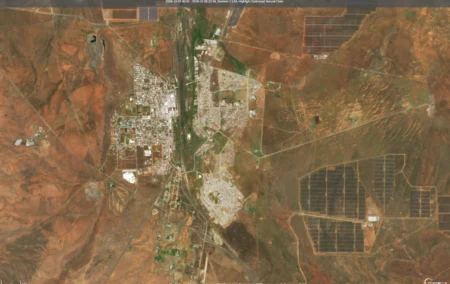
Even his one concession to intervention – an internet exchange at De Aar, the old Karoo railway junction – fits the principle. It solves a coordination problem, costs very little, and picks no winning firm. If nobody comes, the loss is small.
Let them choose
So fix the grid. Fix the ports and railways. Cut taxes and red tape. Prosecute criminals and corrupt officials. Secure property rights. Then step back, and let investors decide which sectors deserve their money.
They are the only ones with the knowledge to make those choices, and – unlike government bureaucrats – they take the loss when they get it wrong. That is a great motivator.
The DTIC asked a room of consultants to pick two sectors to support. The right answer was “none”.
[Image: Satellite image of De Aar in the Northern Cape, where railway lines, high-voltage transmission lines, and solar power converge, and where Johan Fourie would place an internet exchange. Image based on adjusted Copernicus Sentinel satellite data, 2026]
The views of the writer are not necessarily the views of the Daily Friend or the IRR.
If you like what you have just read, support the Daily Friend