
The recent submission by South Africa’s Department of International Relations and Cooperation (DIRCO) of dossiers to the International Court of Justice (ICJ), alleging Israel’s non-compliance with the Court’s provisional measures orders, creates the misleading impression that the Court’s proceedings have been concluded and that final verdicts have already been issued, but are being disregarded by one of the parties.
This approach appears to deflect attention from South Africa’s failure to submit its response as soon as possible, as it claimed that the case was of an urgent nature. South Africa has requested an additional 18 months to submit its written response, or Memorial, which raises questions about the strength of its case and the evidence upon which its allegations are based. The prolonged process strengthens the belief that South Africa’s case relies heavily on contested or unsubstantiated claims rather than sufficiently-verified evidence.
Of particular concern is the manner in which statistical figures contained in the official statement are presented as facts without adequate identification or explanation of their sources. The provenance, methodology and reliability of such data are essential, particularly when the figures are being used to support allegations in proceedings before an international court.
The statement claims that, as of August 2026, at least 73,407 Palestinians had been killed and 174,335 injured in Gaza since 7 October 2023. Such figures should be subjected to rigorous independent verification, particularly given the highly contested nature of casualty reporting during an active conflict. Where possible, casualty figures should be corroborated by credible and independent institutions, including relevant United Nations agencies, the International Committee of the Red Cross and other recognised humanitarian organisations with established methodologies for documenting casualties.
Presenting disputed figures without clearly identifying their source, methodology and verification status risks blurring the distinction between reported figures and independently verified facts. In proceedings as consequential as those before the ICJ, claims of this magnitude should be supported by transparent, verifiable and independently corroborated evidence, rather than presented without sufficient qualification.
Journalists, international bodies and governments have often used figures provided by the Hamas authorities without a pinch of suspicion, but they have never scrutinised the authenticity of the numbers emanating from the same terrorist organisation that is eager to see Israel collapse. It is obvious that the numbers would be characterised by subjectivity and a lack of impartiality, because they are supporting a particular political interest.
In the casualty figures Hamas provides to the world, there is no distinction between combatants and civilians, as is often made clear in Israel, where soldiers are distinguished from civilians. Hamas has to tell the world how many Hamas operatives have been killed and how many civilians have been caught up in the crossfire.
The ICJ indeed issued orders for provisional measures, not a ruling on the merits of the matter. It has also not been found by the ICJ that genocide is taking place in Gaza. It is therefore important to analyse the wording of South Africa’s DIRCO statement, which gives the wrong impression that rulings have already been made but are being undermined by Israel.
What the government has not told its citizens is that it has asked for more time to file its reply in the genocide case against Israel before the ICJ. Israel will then be given until November 2029 to submit its rejoinder. This is not a simple case that will be resolved overnight. It will still have to be argued before the Chamber at The Hague before a verdict can be delivered after 2029.
The judgment to be made by the UN’s ICJ will not bear significant political implications, but rather offer a legal case-study for international law students and practitioners, because the political situation in the Middle East is changing rapidly. Hamas, an Iranian-backed terror group, has announced its dissolution and supported the idea of allowing UN-backed technocrats to take over the running of the formal government. By 2029, there will be changes with respect to the military and political relations between the Palestinian Territories and the State of Israel.
South Africa should acknowledge that its case against Israel is not as tight and strong as it had hoped; hence, it is not easy to facilitate a mere reply to the case it initiated. It does not make financial sense that so much money has been spent on a case that has had no implications for the situation between Hamas and Israel. It was evident that diplomatic efforts by the US, Qatar, and Egypt played a much greater role than this costly legal case.
Kgwadi is a writer, political scientist, and research fellow at the Middle East Africa Research Institute (MEARI).
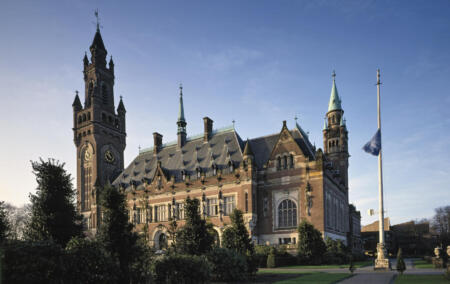
[Image: ICJ]
The views of the writer are not necessarily the views of the Daily Friend or the IRR.
If you like what you have just read, support the Daily Friend