

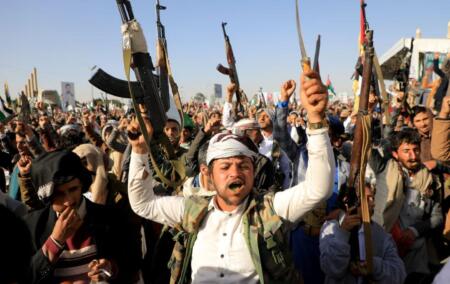
Iran-aligned Houthi forces have taken control of Yemen’s entire Red Sea coastline, seizing the islands that command the Bab al-Mandeb strait and handing the group leverage over one of the last open arteries for Gulf oil. The advance, completed Friday after a week-long offensive, coincided with Saudi Arabia’s shutdown of its East-West crude pipeline following a drone strike; a one-two blow that has pushed oil back above $100 a barrel and left Washington facing a choice it has been trying to avoid.
The Houthis captured the port city of Mocha at dawn Thursday, then pushed south to Dhubab and by boat onto Perim (Mayyun) Island, which sits in the middle of the strait, after government forces withdrew. Yemeni government sources told Reuters and AFP that the takeover of the Bab al-Mandeb area was complete. Houthi military spokesman Yahya Saree claimed his forces expelled Saudi-backed units from six districts covering roughly 5,400 square kilometers, though Al Jazeera noted the Houthi leadership had not formally announced control of the strait itself.
Forces of the internationally recognized government, based in Aden, responded with air strikes along the west coast and said they had begun shelling Houthi positions around Mocha and the Mocha-Dhubab road. Saudi jets reportedly hit Mocha’s airport. But a senior Yemeni military official told the AP he was stunned that Riyadh had not acted to prevent the city’s fall, and blamed poor coordination between the army and allied militias for giving the Houthis an opening. Analyst Andreas Krieg of King’s College London told Al Jazeera the anti-Houthi front is badly fragmented, with rival Gulf patrons funding militias more focused on southern Yemen than on the Houthi north.
Meanwhile, Saudi Arabia’s energy ministry confirmed it had shut the 1,200-kilometer East-West pipeline as a precaution after drones struck it Thursday in the Riyadh and Medina regions, injuring several people. The line, running from Abqaiq to Yanbu on the Red Sea, had become the kingdom’s primary workaround for the Iranian blockade of the Strait of Hormuz, carrying an estimated 4 to 5 million barrels a day, approximately 4 to 5 percent of world supply.
Both Riyadh and Baghdad said the drones were launched from Iraq, where Iran-backed militias operate. Iraq dismissed a regional military commander and closed two border crossings with Iran; an umbrella group of Iraqi militias denied involvement. Saudi Arabia said it would hold off on retaliation at Iraq’s request but reserved the right to act. Regional officials told the AP the Houthis had helped Iraqi militias plan earlier strikes on Saudi energy infrastructure.
The IEA says Saudi crude output is already at its lowest level in more than three decades. With the Bab al-Mandeb route now under Houthi control and the pipeline offline, the kingdom’s remaining option is routing crude north through Suez or Egypt; a far longer path to Asian buyers that the Houthis have also targeted.
Crown Prince Mohammed bin Salman called President Trump at least twice Thursday seeking American strikes on the Houthis, according to Reuters and Axios. Trump declined, with officials saying he wants to stay focused on Iran and Hormuz rather than open a new front. The U.S. instead offered intelligence and targeting support.
Speaking in Dublin on Saturday, Trump said the Houthis had reached out directly: “The Houthis called us and they don’t want to fight with us.” Trump added that Iran was likely behind the pipeline attack and predicted things would work out. Houthi officials have publicly insisted shipping in the Red Sea faces no danger, even as the group warned against outside intervention and threatened to close the strait entirely.
Iranian officials praised the Houthi advance, with an adviser to Supreme Leader Mojtaba Khamenei calling it a resounding victory. Tehran denies directing the group and has called for an end to Saudi Arabia’s blockade of Yemen and a return to negotiations. Oman is reportedly convening Gulf states to discuss a Hormuz reopening deal.
Reuters reporting has cautioned that a full Houthi closure of Bab al-Mandeb would choke off another 7 percent of global petroleum supply and about 12 percent of world trade.
[Image: Mario Nawfal]
[Sources: Reuters, AP, Al Jazeera, Axios]
If you like what you have just read, support the Daily Friend