

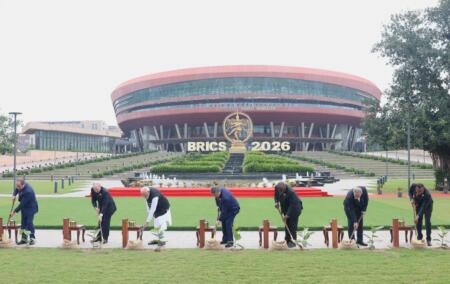
The BRICS grouping — Brazil, Russia, India, China, and South Africa — and its other members and partners met in New Delhi over the weekend and issued a mammoth 51-page declaration. A long declaration with little really new is a sure sign that the drafters could not agree on a few big, important things.
The declaration was certainly not a sign that the BRICS have a common purpose. Rather, it is a sign of the extent to which they simply take well-worn positions on global issues and put them in a declaration to try and show purpose. The declaration was also an attempt to boast about how well the body thinks it is doing.
As communiques go, this will certainly go down as long and inconsequential.
As anticipated, there was moderate support for the Iranian position, but by no means a heavy backing. This was evident in the expressions of concern over tensions in the Middle East and a condemnation of sanctions not authorised by the United Nations (UN). There was a condemnation of the US and Israel for “deliberate attacks” on civilian infrastructure and nuclear facilities in Iran. But there were no promises to Iran of massive military aid.
The Trump administration was condemned for unilateral rises in tariffs.
What was important was that the summit gave Russian President Vladimir Putin a chance to attend an international gathering outside Russia, something he can rarely do. As India has never signed the Rome Statute, creating the International Criminal Court (ICC), it does not have an obligation to arrest Putin on charges of war crimes in Ukraine. Putin stayed away when SA hosted the BRICS summit three years ago, as SA would have had to arrest him.
In a way that marked a symbolic victory for Putin as it demonstrates he can travel to a limited extent and has friends who invite him to places.
There was a repeat in the declaration of the regularly voiced call by developing countries for an inclusive and just world order and the “comprehensive reform” of the United Nations (UN).
But do Russia and China really want the sort of “comprehensive reform” of the Security Council that might abolish the veto system or dilute their position in other ways?
It is through the veto system that China and Russia, as well as the US, France, and the United Kingdom, can exercise such an influential role.
The importance of such summits often lies in what happens on the sidelines. Meetings on the sidelines, afforded by the BRICS Summit, are the real reason many of the leaders from member countries are likely to attend. They afford the chance to have one-on-one meetings with other world leaders and are a way of lobbying and pushing a diplomatic agenda forward.
Indian Prime Minister Narendra Modi held a meeting with Chinese President Xi Jinping to discuss their border dispute. The biggest schism in BRICS might well be that between China and India, who are intense rival powers in Asia. Bilateral meetings on the sidelines might be one of the reasons the BRICS Summits are able to attract so many of their members.
BRICS might lack direction and clear purpose as it is not a regional body or one that focuses on one key area, but there are benefits. There is little chance that the wider ambitions that some set for the body of creating an alternative reserve currency to the dollar will ever be achieved. And it is not about to become a free trade area or a military alliance.
Apart from the invitations to Summits, BRIC membership does give access to borrowing both for the purposes of development and in the event of a financial crisis. Having that additional access credit is useful, as it could provide a partial alternative to borrowing with heavy conditions from the World Bank and IMF.
The original concept behind the BRICS was not that they should form a grouping, but rather that Brazil, Russia, India, and China’s were growing faster than rich Western countries and that they would become increasingly influential. O’Neil did not include SA in this group as its growth rate was comparatively low, and our economy is smaller than any of the other original BRICS countries.
Three years after its founding in 2006, SA was invited to join because of the Mandela legacy, and the existing members wanted to extend a diplomatic hand to an African country.
Today it is a pretty motley group, with Brazil, Russia, India, China, and SA as well as Egypt, Ethiopia, Indonesia, Iran, Saudi Arabia, and the United Arab Emirates as full members. Then there are partner countries – Belarus, Bolivia, Cuba, Kazakhstan, Malaysia, Nigeria, Thailand, Uganda, Uzbekistan, and Vietnam. Partners have the right to participate in special sessions and can propose new initiatives, but they have no voting rights.
And then there are the special invited countries, which this year included the Philippines, Vietnam, and Burundi.
Powerful, and making up about 70 percent of the combined BRICS GDP, China is the power behind the BRICS. Yet, partner countries – Malaysia, Thailand, and Vietnam, as well as special guest, the Philippines, are very wary of Chinese naval expansion in the region.
The BRICS is fundamentally about putting on a diplomatic show, much of it to demonstrate that they are not prepared to rely on Washington. Admitting Iran was really to demonstrate that the BRICS are prepared to stand up to the US. Yet India and some other members are close to the US.
SA is the exception in that it has almost made BRICS a cornerstone of its foreign policy. That is based on false expectations and hopes.
We would be far better off by aligning ourselves with other middle powers—countries that do not set the rules—by cooperating with them on key issues on an ad hoc basis. Canadian Prime Minister Mark Carney, who has been struggling to deal with the giant next door, pushed for far greater cooperation between democratic middle powers against coercion from the US and China in his speech at Davos earlier this year.
Some potential middle powers are already in the BRICS — Brazil, India, Indonesia, and Saudi Arabia. Other large middle powers include Türkiye, Nigeria, and Kenya. Australia, Canada, South Korea, Italy, Spain, Poland, the United Kingdom, and France might also be potential middle power allies. There are already bodies which bring middle powers together on a regional basis, but there need not be a formal organisation for a middle power movement to work.
Flexibility and pragmatism in our foreign policy, rather than rigidly looking to the BRICS and the African Union for leadership, would greatly improve our world leverage.
[Image: BRICS Summit 2026 ]
The views of the writers are not necessarily the views of the Daily Friend or the IRR.
If you like what you have just read, support the Daily Friend