

Hello from the District of Columbia swamp! This column goes live on 17 September, Constitution Day in the United States, and I had the privilege of writing it during a long stay in the American capital. Two days earlier, 15 September, was National Voter Registration Day.
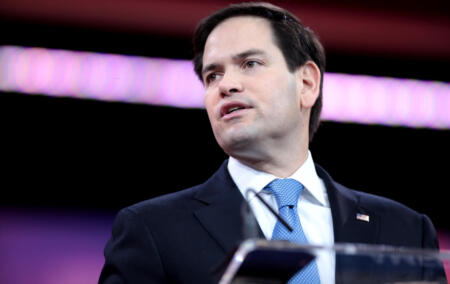
What better way could there be for the United States to mark the occasion geopolitically, than for Secretary of State Marco Rubio to announce that the federal government has imposed restrictions on South Africans “who are responsible for, or complicit in, the enactment or implementation of laws or policies that enable uncompensated land seizures, race-based discrimination, and/or the incitement of imminent violence against members of minority ethnic or racial groups”.
This is a fine vindication of that role America has long played – or at least is meant to have played – on the global stage. Good on Rubio!
Two civic cultures
The celebration of Constitution Day is a civic habit of a political culture that still, however imperfectly, treats its constitution as something more than a decorative pamphlet. South Africa and the United States live in two very different political cultures, and it is visible in the “small things”.
Just this week, the Presidency in South Africa boasted proudly about Cyril Ramaphosa’s participation in a BRICS leadership session in New Delhi. Beside the close association of South Africa with some of the world’s worst regimes, what stands out is the leading photo of the man who believes he is the President of South Africa sitting behind an upside-down South African flag.
This admittedly “small thing” says a lot.
The head of state of the country could not notice that his country’s flag was upside-down. He could have removed the clearly adjustable plastic flagpole, pulled the fabric out, and re-inserted it so that the flag would hang the right way up. He could also have asked one of the many people in his entourage to do it.
But neither he nor they noticed or could be bothered. Nor did the Presidency’s public relations team notice before posting the photo.
The correct orientation of the South African flag is not merely mandated by the South African Constitution – the Constitution even contains a picture in schedule 1!
Cyril Ramaphosa is a performative state president – an empty suit, in that capacity. He is, simply, not there. And when he is there, he is in fact exercising the duties of the role he deems far more important, that of President of the African National Congress.
The American difference
The obvious question is whether the American president, Donald Trump, would notice or be bothered to fix it if his country’s flag were displayed upside-down. Well, maybe not. But that is not the point. The point is that the question simply will not arise.
The American political elite – right and left – still possess a base value of self-respect and patriotism. At least one official, and probably many more than one, would have noticed such a small-though-crucial thing.
In South Africa that basic belief in the self as a civil servant is conspicuously absent.
An inverted flag is, in the older language of distress. It is also, in this case, a portrait of a governing class that does not truly inhabit the offices it supposedly occupies. The oath of office to uphold the Constitution is a box-ticking exercise and no more.
Constitutionalism
Constitutionalism cannot be the mere existence of a beautiful text. South Africa certainly has one of those!
In reality, constitutionalism is the habit of treating the text, the flag, the office, and the public as if they impose real constraints on those who hold power, and as if they deserve one’s reverence. It is a culture of respecting external limitation and exercising self-limitation in pursuit of a greater cause. But if self-limitation is totally absent, then external limitation will be treated as an annoyance to be overcome.
I write this as a constitutionalist who has spent years watching and studying South Africa’s official constitutionalism decay into Transformationism: the doctrine that the text is infinitely malleable when malleability serves the ruling racial-socialist ideology, and suddenly rigid when rigidity serves the same ideology.
According to this “transformative constitutionalism”, the Constitutional Court can discover “spatial justice theory” in the right to housing provision that contains no such words; Parliament can pass race law after race law and call it “redress” while the Constitution insists on non-racialism; and the executive can assent to an Expropriation Act that pretends, illogically, as if “nil” can be a payable amount of compensation. The public is then invited to clap for the “highest law” while the highest law changes from one day to the next.
That is why Constitution Day in Washington is notable. Americans still argue, often bitterly, about what their Constitution means. That argument is itself a form of fidelity. Too much of South Africa’s elite no longer argues about meaning, but treats the Constitution as a mere revolutionary mood of change where the meaning is whatever serves the revolution.
Randy Barnett
I had a lifetime privilege this week of meeting one of my intellectual heroes, Professor Randy Barnett, whose work I have often cited in these columns (not to mention my doctoral thesis).
Barnett’s work has been about recognising the United States Constitution as an (inherent) constraint on power, not as a licence for judges and politicians to improve upon the people. In Restoring the Lost Constitution, he argues forcefully for the presumption of liberty and the minimalist role of the government established by the Constitution. This is an attempt to keep a republic from sliding into the thing South Africa already has, which is a constitution that is supreme on paper and subordinate in practice to whatever the “[adjective] justice” fashion of the moment is.
Isn’t that something? A law professor who is actually interested in constitutionalism and limiting abuses of official power. In South Africa, the great majority of law professors would not take note of the fact that the head of state under the Constitution does not realise his flag is upside-down and believe – as a matter of firm conviction – that a court can amend the Constitution by importing an academic theory and calling it “interpretation”.
Why am I in the United States?
My agenda in the United States on behalf of the Free Market Foundation and alongside David Ansara is simple and will be familiar to anyone who has read these columns.
The first is to emphasise to Americans that they have it right when it comes to South Africa’s race laws. Marco Rubio clearly gets it – but others in the think tank and press space still hesitate.
Since 1994, South Africa’s Parliament has enacted some 122 Acts that make a person’s race legally relevant. This is not a misunderstanding that can be cleared up by a charming ambassador and a few talking points about “transformation”. Persecution is official policy. Large swaths of law and policy are designed to burden minorities born after Apartheid, leading to perfectly avoidable and incredibly harmful distortions in an economy that the black majority needs.
Non-racial and equal citizenship is routinely derided as “ahistorical”, rather than being recognised as the whole point of 1994.
The second is that the gaslighting by the South African political elite and the pretend- “journalists” who serve it should be recognised, and dismissed. The script is now well-rehearsed: any foreign notice of racial statute, farm murder, expropriation without compensation, or elite capture is “right-wing disinformation”, “the myth of white genocide”, or an attack on sovereignty. The purpose of this exercise is not, of course, to refute evidence, but to make the evidence unsayable.
The third is that Americans should continue to have the backs of South Africans who want a prosperous and free society at the southern tip of Africa. This is not a plead for charity.
A South Africa that respects private property, non-racialism in law, and limited government, is a South Africa that remains useful to the United States and to the West more broadly.
A South Africa that drifts further into racial socialism, confiscation, and alignment with the worst regimes, is a strategic liability.
The United States has already noticed more of this than Pretoria likes to admit. That notice should not be walked back to spare the feelings of an articulate though empty suit.
[Image: Marco Rubio]
The views of the writers are not necessarily the views of the Daily Friend or the IRR.
If you like what you have just read, support the Daily Friend