
In the bestselling satirical novel by Timur Vermes, Look Who’s Back, a scruffy character in a dusty and petrol-soaked trenchcoat with a trademark sweep of dark forelock and a toothbrush moustache awakes on a patch of open ground in central Berlin one early afternoon in 2011.
Yes, it’s failed artist turned global pestilence Adolf Hitler who is back, due to some inexplicable glitch in the matrix, and to his horror he finds his beloved Fatherland filled with brown-skinned immigrants and run by a woman.
Befriended by a newspaper kiosk operator, he sets out trying to understand the craziness of a world that has definitely fallen very far from his ideal of the Thousand-Year Reich.
He’s of course immediately identified, but because it’s impossible that he is truly the old dictator restored, as he insists, he is presumed to be rather an actor, or some sort of walking art installation who never falls out of character.
Bedazzled by the multi-hued deluge of consumer culture though he is, our revived Führer is as curmudgeonly as one would expect with the shallowness of modern lifestyles.
And herein lies Vermes’ genius, for his tale is told through the eyes of Adolf himself, and he immediately butterfly-pins, as we also uncomfortably surely do, the flimsy, ersatz nature of today’s commercialised “culture”.
History’s most despised personality, in other words, becomes a relatable bellwether of today’s social discontent and, arch-grifter that he is, sees an opportunity to remake Germany in his image via the celebrity industry.
The novel naturally came to mind with the recent far-right Alternative für Deutschland (AfD) win in the German state of Saxony-Anhalt, which has alarmed everyone from French President Emmanuel Macron to Holocaust survivors.
The spectre is of a revival of Nazism in its heimat, its hearthland, from which it was supposedly exorcised by decades of intense and extensive mea culpa literature, academic thought, artworks, reparations, and memorialisation.
Massacre in memory in the country most associated with it has been clever and nuanced.
There’s the intimacy of the stolpersteine (stumbling-stones): brass plaques on cobblestones outside buildings simply naming former residents and their fates in the SS death-camp archipelago.
There’s the simple fact that a child’s playground is the location of the buried and deliberately unmarked entrance to the Führerbunker in Berlin where Hitler actually committed suicide back in 1945.
But it seems there is a resurgent taste for darkness today, not only in Germany, Europe, and the benighted United States, but globally, and as far away as South Africa, with a revival of nostalgia for evil pasts.
It is fuelled by discontent with the rapaciousness of neoliberal economics which has destroyed decades of hard-won social security and welfare certainties, at least in Europe where these obtained, and societal conventions on the commons elsewhere.
Faced with a hyperdrive globalisation denaturing what would have been slower processes of nations acculturating immigration and social difference, Homo sapiens has retreated into Cro Magnon mode, into its caves and torchlight-flicker mythologies.
Shock doctrine
Zeitgeist critic Naomi Klein, who has visited South Africa, calls this neoliberalism’s “shock doctrine,” the deliberate dismantling of the commons and of common-sense by spectacular, shockingly bold acts of what I would call treason, sabotage, and grand larceny of a scale last visited on peoples world-wide by canon-fired, god-inspired colonialism.
For the commons, think of the bliss of walking your dog in a public park, now greedily eyed by some schmuck developer (apparently a real threat in Joburg); and for common-sense, think of South Africans’ world-famous hospitality and good neighbourliness, now soured by Zulu chauvinists.
The bitter irony is that these two inhuman strands, so poisonous of our democracy, are mutually reinforcing: populism is fired by ordinary folks suffering the highway robbery of the gangsta state and its accomplices who have created diversionary populist proxies.
In Jacinta the Splinter, they combine as the same thing: her noxious project is obviously designed to divert popular rage from a lynching of her traitorous father; yet Zulu nostalgia for the old Zululand bantustan is built of fatuous fictionalisation of both actual Zulu culture and of its history.
Zulu women are by tradition not chattel subject to arbitrary male molestation, and introspection is required from a people whose Offensive Group death-squad, trained in Caprivi by the SADF, was a lethal arm of apartheid.
That’s very far from the whole tale of a people, of course, but significant signposts on its journey.
But amidst all this Zulu hubris and posturing with “cultural weapons”, it seems that in parallel, there has been a reversion to other ethnocentrisms in South Africa.
Note the revival of Venda nationalism, with its wistfulness for the day when they ruled their own one-party “independent” bantustan under the otherwise forgettable figures of Patrick Mpehphu then Frank Ravele, with the Venda vierkleur flag proliferating on cars and taxis.
Celebrating Dr Death
Meanwhile it comes as no surprise that the Boerevolk are still in awe of charming-to-the-point-of sociopathy Brigadier Dr Wouter Basson, retired, the former chief of apartheid’s offensive chemical and biological warfare (CBW) development, Project Coast.
Dubbed “Dr Death” by the media, he sold out Pretoria’s 380-seat AfriForum Teater on 4 September, for a talk on Coast that Rise Mzanzi policy chief Chris Maxon in an op-ed for IOL characterised as “a funeral dirge for the ‘rainbow nation’ ideal.”
Maxon argued that AfriForum mobilises “a white minority around a narrative of victimhood that fundamentally undermines the project of non-racial nation-building in South Africa.”
He said that in hosting Basson, AfriForum, an “ethnicist movement,” was “not exploring history,” but “sanctifying” a version of history that does not view apartheid’s perpetrators as “criminals or ethical pariahs,” but as people who deserve a sympathetic ear.
The object is to mobilise Afrikaners around not only nostalgia for the apartheid past, but around the manufactured and weaponised existential threat of a “white genocide,” that has helped validate South Africa’s white populist right within the global white supremacist revival project.
As a researcher and writer on the darkest corners of apartheid black ops, personally I would be more than happy to listen to Basson’s version of a project that I have investigated and written on in depth, especially because over a quarter of a century, Basson has refused to speak to me, despite several approaches.
For instance, if Basson claimed at his talk, as was reported to Deutsche Welle, that Project Coast was a defensive CBW project, then he lied.
Coast was offensive and fell under Special Forces and the SA Medical Services, while Project Muly (later renamed several times) was the defensive CBW project directed by Commandant Rudolph Louw, and it rather fell under the SADF and state armaments procurement firm Armscor.
The scariest characters
A key part of my work is to shake hands with and sit down with some of the scariest characters from our past in an honest attempt to understand their motivations and write accurately about the benighted mechanisms they built.
For example, determining and reminding people what Project Coast (and its neglected successor, Project Jota under Colonel Ben Steyn) actually achieved until shut down in 1993.
Delta G Scientific made about 20 tons of CR firegas and its immediate precursor, and about one ton of CS teargas, plus about one ton of the hypnotic sedative Mandrax and just under a ton of the party drug ecstasy.
Roodeplaat Research Laboratories’s total biowar output is unknown, but a 1989 list alone includes 32 bottles of cholera, and small quantities of poisoned sugar, cigarettes, whiskey, beer, chocolates, deodorant, ten doses of a lethal pesticide, and a dose of mamba venom.
About half the firegas was used by the SAP and SADF in “riot control” during the 1985-1990 states of emergency, while some of the ton of the incapacitant BZ (purchased by Basson, not manufactured by Delta G), may have been used in a mysterious apparent drone attack on Mozambican troops on 16 January 1992 that left four dead and 28 hospitalised.
Biological warfare agents are far harder to trace than chemwar agents, so it is simply not known how many deaths may have been caused by Roodeplaat’s toxins, though several poisonings have been linked by repute to the project.
But accessing accurate detail is presumably not the motivation for the average punter who listened in rapt attention to Basson; no, that was more like hero-worship, a celebration of Dr Death’s achievements.
Unfortunately, even Basson’s opponents appear to have forgotten the details of Project Coast/Jota, with the unintended consequence that they, like Basson’s adulatory audience, have rendered of him a cypher – which is just the way Basson likes it.
Failures such as Delta G’s inability to turn the Mandrax and ecstasy into crowd pacifiers, or the failure of RRL’s cholera to incapacitate SWAPO returnees housed in camps in 1989 prior to Namibia’s first democratic elections, are thus forgotten; myths grow in fact-sterile vacuums.
It is a pity that Maxon cites Roelf Meyer, currently ambassador to the USA, fulminating against ethnic “balkanisation,” for it is forgotten today that while Deputy Minster of Law & Order during late apartheid, Meyer presided over the totalitarian National Security Management System (NSMS) part of the function of which was to decide which activists to murder.
Unfortunately, Meyer, like Basson, did not respond to a recent request from me to comment on his past for a recent article; it seems the sanitising of apartheid pasts is all the rage now.
Year Zero
Abroad, we have just witnessed an attempt to whitewash the reputation of Serbian extreme nationalist Colonel-General Ratko Mladić, “the Butcher of Bosnia,” who was about to be buried with full state honours when outrage among EU nations forced the Serbian government to switch to an unofficial funeral.
Still, the man sentenced in 2017 to life imprisonment by the International Criminal Tribunal on the former Yugoslavia (ICTY) for genocide, crimes against humanity, and war crimes relating to the siege of Sarajevo and the Srebrenica Massacre was laid to rest in Belgrade by Serbian Orthodox Patriarch Porfirije, known as a revanchist who considers disputed Kosovo to be Serbian territory.
And Serbia erupted in an outpouring of praise and grief for the mass-murderer; it is that kind of Year Zero anti-thought that enables genocide in the first place.
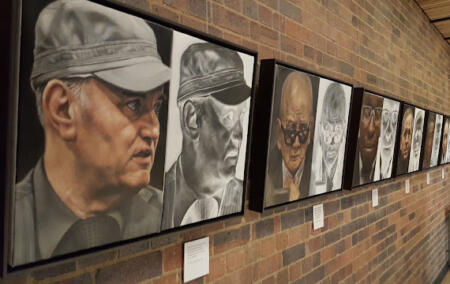
Thorsten Wedekind’s recent award-winning play Sarajevo recalled the horror of how that bloodletting tore apart and brutalised friends of different ethnicities and confessions, and reminded me of Bradley McCallum’s 2017 exhibition, Weights & Measures, of positive-and-negative diptych portraits of genocidaires like Mladić who have been brought to justice.
While his Mladić paintings are unremarkable, in McCallum’s renditions of Serbian Republic ex-President Radovan Karadžić, jailed for life by the ICTY for genocide, war crimes, and crimes against humanity, the man stares right into the lens, his black eyes penetrating, swallowing the light; but in the negative image, they reflect an even more chilling bone white.
The faultline
In Germany, the faultline that produced the AfD win is geo-historical, for though the Berlin Wall was torn down, the Germany that reunited on 3 October 1990 never quite dissolved the ideological and economic divide between comfortable westerners (“Wessies”) and poor easterners (“Ossies”).
Both the Federal Republic of Germany and the German Democratic Republic dealt with their Nazi pasts first by prosecuting and executing some leading perpetrators, and officially “denazifying” their states – but also by absorbing thousands of surviving Nazi apparatchiks into their public services.
Thus, in the west, Konrad Adenauer’s first democratic government included leading race scientists, while in the east, Walter Ulbricht’s first communist regime integrated many Nazi thugs into the notorious Stasi secret police, the best portrait of which is Anna Funder’s brilliant interview collection Stasiland (2003).
Western laxity would allow a long chain of thinly disguised neo-Nazi parties to survive, despite restrictions, as outlined in Martin A. Lee’s 1997 study The Beast Reawakens, providing the ideological-organisational antecedents of the AfD.
For the Ossies, the state’s red fascism saw dissident youth adopt brown fascism as their mode of rebellion as retold in reformed neo-Nazi leader Ingo Hasselbach’s 1996 autobiography Führer-Ex.
The first-generation Nazis retained their toxic views in their Diaspora and spread them through organisations such as the Wessies’ German Soldiers’ Combat League that sent mercenaries to kill blacks in Rhodesia, an experience that deeply shaped the SADF, while old SS enclaves in Pretoria and Vryheid continued to marry according to their racial “purity” code; at the same time, the Stasi trained MK commissars in their dark arts.
In the wake of reunification, the Ossies never quite caught up with the economic development of the Wessies, providing a fertile seedbed for neo-Nazi parties like Hasselbach’s which organised mercenaries who operated in a Croatia nostalgic for its Ustaše fascist past, killing Bosnians and Serbs as if out on safari – and later, for revivalists like the AfD.
Meanwhile, the recent toenadering between AfriForum and March and March is a flocking together of birds of a feather, united in their nostalgia for their race-exclusivist terrains of old.
With brown fascism running in many white ex-SADF soldiers’ veins and red fascism likewise in many black ex-MK guerrillas’ veins, is it any surprise that South Africa’s race-extremists have creepy commonalities?
[Image: Paintings by Bradley McCallum of Ratko Mladić at left, then Nuon Chea, Khmer Rouge leader Pol Pot’s “Brother No.2,” convicted of genocide by the Khmer Rouge Tribunal, and other war criminals at the Weights & Measures exhibition, Johannesburg, 2017. Michael Schmidt]
The views of the writer are not necessarily the views of the Daily Friend or the IRR.
If you like what you have just read, support the Daily Friend